This personal luxury coupe was an interesting choice for the discerning Cadillac connoisseur in 1988.
Equipped with the 155hp 4.5l V8 instead of the 165hp LN3 3.8l V6 available in it’s platform mates, the Oldsmobile Tornado and Buick Riviera. Cadillac’s penchant for “high tech” proprietary power plants in the 80’s, 90’s and 00’s instead of the venerable 3800 V6 would continue to haunt them until they stopped designing their own engines altogether.
Notable for also being shortest Eldorado at 191.2″ in length which would make it 0.5″ shorter than a current 2017 Ford Fusion.
This particular car was purchased by the local bank in Clovis, NM and managed to accumulate 58,000 miles. This car sold at auction for $4700.
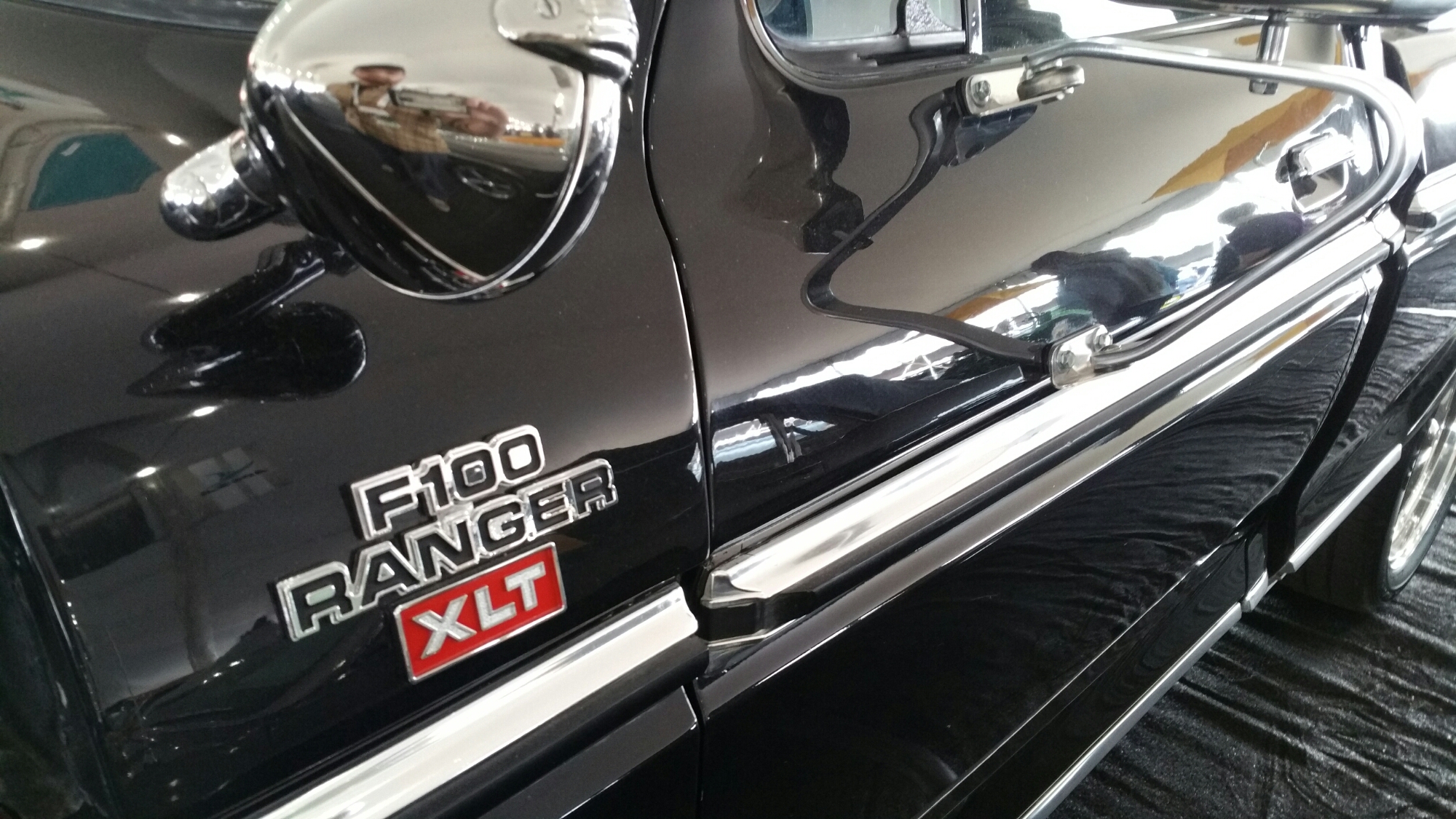
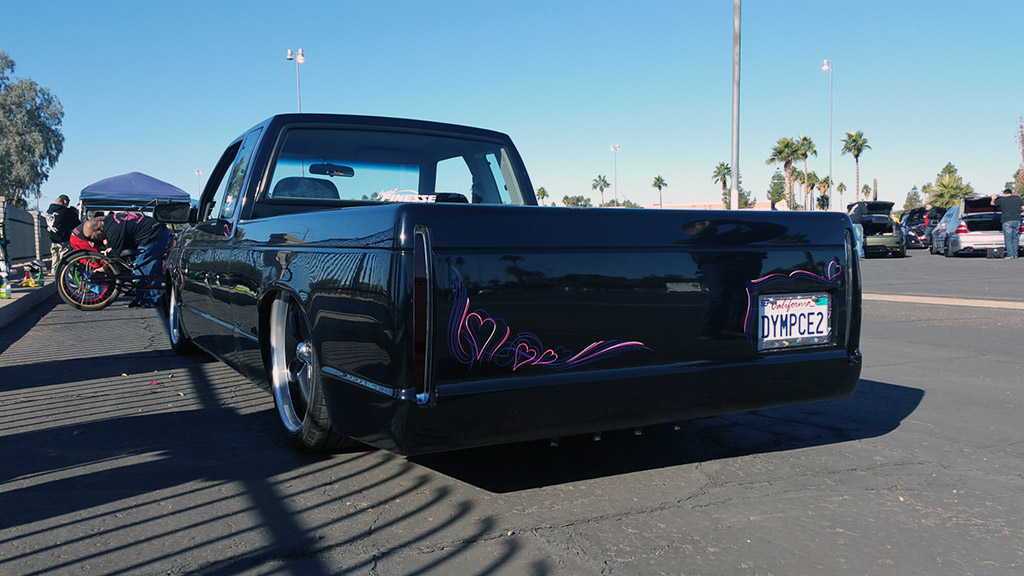
This one goes to eleven. Black paint, supercharged small block Ford with over 600hp, 3.70:1 end and a TKO 5-speed. Chrome everywhere and classic f-series looks. It has an image that says, “Clear a path.”
I was drawn immediately to this truck upon seeing it, and I must have not been the only one as it went for $16,500 on the Scottdale auction block.
One of the more interesting vehicles found at Barrett-Jackson this year was this Pontiac Grand Prix 2+2. Among the more high-profile G-bodies like the Monte Carlo, El Camino, Cutlass and Buick T-type, the Pontiac tends to become more of a forgotten offering. Couple that with this aerodynamic-enhancing body conversion by Auto-Fab for homologation purposes and you find yourself with one interesting piece of history.
Being one of only 1,225 Grand Prix models converted, it’s provenance is evident in it’s smooth Firebird/Camaro-esque rear windshield, revised front fascia and small fiberglass trunk lid. That’s correct: Despite it’s appearance, that window is static, not hatch.
And that lack of useful storage space is only one of the many issues that kept this production variant out of the General Motors limelight. The lackluster performance from the 150hp 5.0L carbureted v8 available only through the 2004r auto and a 3.08:1 rear end ratio didn’t help either. If you remember correctly, even the lowly Monte Carlo SS had an alternative 180hp variant during it’s run, not to mention the offerings from Buick and Oldsmobile.
Despite it’s shortcomings, aesthetically it’s a stud in the confines of it’s era. Which, along with it’s rareness, is probably why this well-kept, low-mileage example went for an impressive $11,000 at auction.
We don’t often cover import cars. This year, we had the honor to see Hot Import Nights here in Scottsdale, AZ. I was genuinely excited for a few reasons. Not least of which was it’s venue, Westworld, where we have the absolutely massive Barrett-Jackson auction every year. I assumed this was supposed to be a big show for the import scene.
It’s too bad that it didn’t work out that way.
The day of the show I receive an email from one of the shows corporate staff. Unlike any other car show or event I’ve ever been to, it has a list of demands that need to be completed and submitted within a week or else I would not be eligible for media coverage next year.
I understand how a traditional shot list works to benefit the promoters, but I’ve never been held to one at an event like this. Not to mention how absurd their requests were.
The list includes making sure that we’re really putting a focus on the vendors and models (not models as in the cars, but the barely dressed attention mongers standing in front of the cars) and to be sure to portray an overall positive experience.
As you may be able to tell in the above picture, there’s really not many cars there. In fact, there were probably less imports inside this building than at the pavilions off Indian bend and the 101 just miles from the show. That was my major gripe of the evening:
There were hardly any imports.
Look at these pictures of these amazing “import” cars found at Hot Import Nights:
Are you kidding me? I came here to see the imports I think are cool like the z31, z32, 3000gt, Starion, 1g DSMs, and anything with a turbocharged Toyota inline 6. Not Scions with fast and furious wraps and any other car that is all mouth and trousers.
When I imagined this website almost half a decade ago it was to represent the automotive counter culture. At one point in time, I’m sure the import scene was the counter culture to the rest of the performance auto world. If this show is truly representative of today’s import scene then I must say good riddance. You’re dead on your feet.
Despite my love for trucks, I’m admittedly not well versed in their history and model differences. When it comes to GMC, I know less than I do about it’s sister brand – my favorite truck brand – Chevrolet. Now when we talk about GMC trucks 1973 or newer, it’s really a moot point: Badge engineering is in full force. To that extent I can’t believe that people still buy into that “professional grade” nonsense they shill on the TV. It’s the same truck as the Chevy with some trim differences.
Despite my lack of knowledge, I do know some GMC fun facts. A 1960 model could be had with a GMC-specific 370ci Oldsmobile-derived v8. They also ran some Poncho v8s for a while in the 50’s.
Long before the Internet was a prolific source for knowledge, my dad showed me my first 60 degree, 305 cubic inch GMC v6 in a dump truck he had bought at auction.
Thanks to the Internet I found out that huge 5.0L v6 was actually the smallest one GMC made and that they even had a v12 derived from that family. And while I’m on the topic of the v6, I would be remiss if I didn’t mention the plaid valve covers available on the half tons of the 60s.
What’s the point in glossing over this history? Well its not because I’m trying to show off. I’m sure I’m not long for an email or comment regarding how little I know from a truly die hard fan who is scoffing to themselves as they read this now.
The point is that I’m still learning passively with each vehicle I see at trade shows , car shows and meet ups. This is just one reason why I’m so strongly against the current homogenized restomod approach to building an older car or truck. You take a bit of what made unique, to impress the people that can only handle things that are easy, familiar and the same as everyone else.
This 1970 GMC may not be anything flashy with its “350 crate motor” which is probably a goodwrench v8 that’s surely slower than what it had stock. The mild 2 inch lift and automatic transmission with shift kit don’t really bring much excitement to the table either. To me, this truck in it’s current state of modification is a great period piece of when Bigfoot was new and this truck was only a decade and a half off the lot. It’s aspiring to be something the everyman couldn’t yet achieve.
What would it add to this truck if it were to become victim to the latest trends? Flared prerunner fenders, late model bucket seats and an LS motor? I feel like at that point you’re just taking away from what it was.
I guess what’s funny to me is that what I learned is so minor in compared to my view of the history of this truck. I just always assumed GMC used the same 10/20/30/40 etc sequence for designating the tonnage of their trucks that Chevy did. When I first read 1970 1500, I figured it must have been an error on the owner’s part. However, I was wrong.