SEMA 2024: 1993 Chevrolet Corvette C4 Mercedes Turbo Diesel Swap – Kustom by Keck

The Malaise Era of 1975 to 1985 was a dark time for automotive enthusiasts. With new emissions and safety regulations from the Federal government, cars quickly got slower, heavier, and uglier.

The 1972 Corvette was rated at a dismal 200 horsepower, while the full-size 1977 Monte Carlo was available with a 140 horsepower 305 V8 or a 170 horsepower 350 V8. The era of the muscle car had come to an end, and a new era had begun that was focused on efficiency, not performance.In an effort to increase the average fuel economy of its fleet, General Motors experimented with smaller engines, turbochargers, and other tricks and technologies to get more MPGs.

With so much attention on smog pumps and secondary air injectors, there was one thing General Motors never built: a diesel-engine Corvette. To do so would be unthinkable; it would be a sacrilege of the highest degree. While there were many prototype and experimental vehicles throughout Corvette’s history, no customer cars ever left the production line with a diesel engine from the factory.

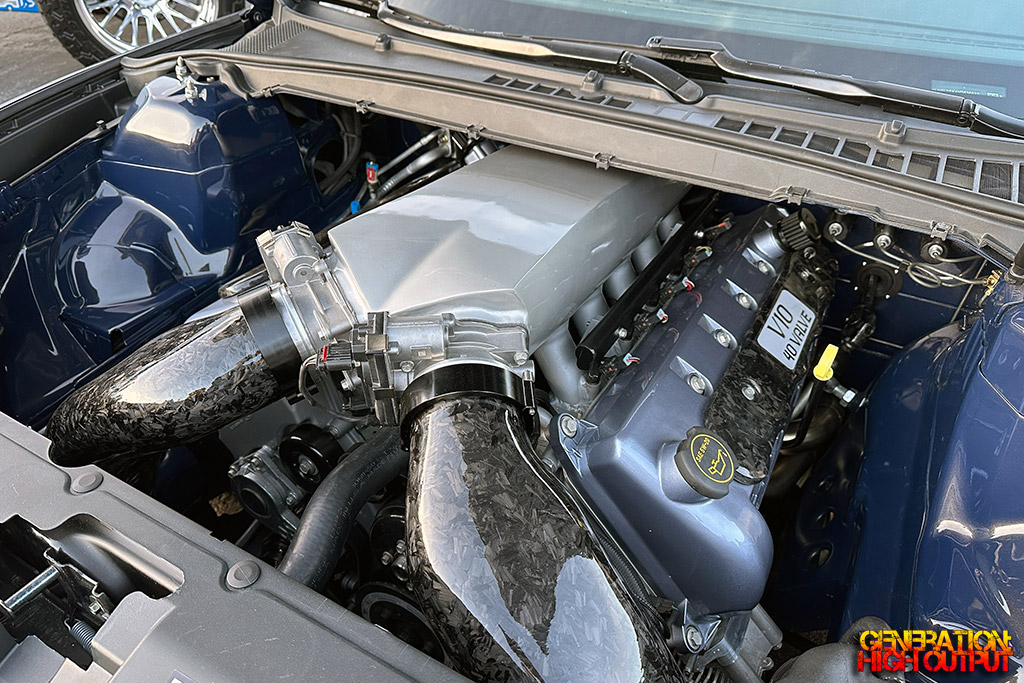
However, Tennessee-based Kustom by Keck has transformed his 1993 Chevrolet Corvette C4 Greenwood Edition into a diesel-powered sports car. I saw his custom Corvette at the 2024 SEMA Show, at the Air Lift Performance booth in the Central Hall.The Corvette’s original powerplant has been swapped with a 1999 Mercedes-Benz 3.0L OM606 turbo diesel engine. It is paired to a 700R4 transmission from Transmission Mafia in Gainesville, Georgia.

This is the kind of weird engine swap I would have loved reading about in Grassroots Motorsports or Car Craft magazine back in the day (after reading about V8 S10 swaps, of course).

The Corvette rides on Air Lift Performance suspension, allowing for adjustable ride height at the touch of a button to achieve the perfect stance.The exterior of the car is a visual blast from the late ’80s and early ’90s, and it’s over the top in the best way possible. The car gives serious Miami Vice vibes with its white wheels and teal and purple custom pinstripe graphics.

Kustom by Keck didn’t stop with the visuals, either. This car is filled with unique custom touches, including a standout set of custom infinity mirror taillights from RetroVette, which provide a high-tech, futuristic flair to set it apart from every other Corvette. Every corner of this C4 has been considered, detailed, and reimagined.

In a world full of LS swaps and carbon-fiber everything, this diesel-powered, 90’s throwback C4 show car breaks the mold and refuses to fit in. It’s more Radwood than SEMA, and I enjoy highlighting custom car builders that do their own thing.

This one-of-a-kind car was recently advertised for sale on social media in June 2025, with an asking price of $15,000.

For more, follow @kustom_by_keck on Instagram.

SEMA 2019: 1983 Volvo 242 LSX Swapped


What comes to mind when you think of Volvo? Probably words like safe, practical, boring. None of those are words that would describe Sean Fogli’s 1983 Volvo 242 coupe. The resto-modded car was featured in the Optima Ultimate Street Car area at the 2019 SEMA Show in Las Vegas. I stopped in for a closer look at this amazing build.

What looks like a dull, early 80s Swedish car is actually a highly capable, tire-smoking, track-ready race car in sheep’s clothing. The car’s original 4-cylinder engine has been swapped for a GenIV 6.0L V8 LS engine mated to a T-56 manual gearbox. The cherry on top is an LSA supercharger from a Cadillac CTS-V, and an LS9 fuel rail and injectors.

Peering in the windows, the roll cage, Racepak display, and Recaro seats with Schruth harnesses are more clues that this is no ordinary car. This Volvo is set up to handle the twists and turns of a road course, which was definitely not in its original design requirements.

The car has a great stance and rides on CCW Wheels with Bridgestone tires. It competed in the 2019 Optima Ultimate Street Car Invitational, an annual track event that is open to street legal cars and trucks.
The LSX badge on the rear of the car is one of a few subtle hints that this Volvo is definitely not stock. This is a super cool build and one of the standout cars of the Optima Ultimate Street Car Challenge. I was privileged to see this car at SEMA 2019, and really enjoy featuring these types of custom cars for our readers. The car participated in the end of show SEMA Cruise on November 8, 2019.

Follow Sean Fogli on Instagram @hackster1.

Cadillac LSA-Swapped 1968 Buick Riviera

It’s no secret that I’m a fan of resto-mods, as I cover plenty of them every year at the SEMA Show. The combination of timeless styling and modern turn-key reliability is a formula that many people find appealing. But as is so often the case, people tend to overdo it.

I understand that if you’re going to upgrade the engine and build a car, you’re also going to do better brakes, suspension, and fix up the rest of the car. As a matter of personal opinion, I am conflicted when I see an old car with 20-inch billet wheels, fender flares, and massive disc brakes. Are you trying to build a muscle car or a modern race car? It looks a bit odd to me to see carbon fiber air dams and projector headlights on a 1960s car.

With this 1968 Buick Riviera, they really got it right.

I spotted this car at the monthly Cars and Coffee gathering in Scottsdale, Arizona. The original engine has been swapped with a supercharged 6.2L LSA V8 from the Cadillac CTS-V. With 556 horsepower, it certainly packs more power than the original engine.

And again, there is that turn-key reliability. Modern engines can run on ethanol-blended fuels with no problem (ethanol blended fuels are sold in Maricopa County). Modern engines don’t need to have the valves adjusted every 30,000 miles. You don’t need to let it warm up on a cold morning. You don’t need to worry about vapor lock on hot summer days. You just get in, turn the key, and cruise.

This car appears to be set up as something of a sleeper/cruiser. It doesn’t have a wild paint job, crazy wheels, or anything to indicate that it’s packing a serious wallop under the hood. From the outside, it just looks like a clean, restored classic car. Even the exhaust tips with stock-looking turndowns are present.

I’ve got to hand it to the owner on this Rivera for doing it right by not over-doing it. Well done.

1988 Dodge Caravan SRT-4 Engine Swap

Though it may be hard to imagine a time when minivans were ever considered cool, that was certainly the case in the late 1980s and early 1990s.

In the era before SUVs and Crossovers, minivans were the hottest thing on the market. Chrysler CEO Lee Iacocca and his friend Hal Sperlich had imagined a vehicle that would hold seven passengers, have removable seats for extra cargo space, and get better gas mileage than a full-size van. Their dream became a reality in 1983, and the new Dodge Caravan and Plymouth Horizon minivans sold like hotcakes with sales topping 200,000 units in the first year alone. For the next 25 years, no one sold more minivans in America than Chrysler.

But somewhere along the way, minivans became uncool. The SUV boom of the 2000s and the Crossover Craze yielded vehicles that offered much of the same functionality without the “soccer mom” stigma of a sliding door.

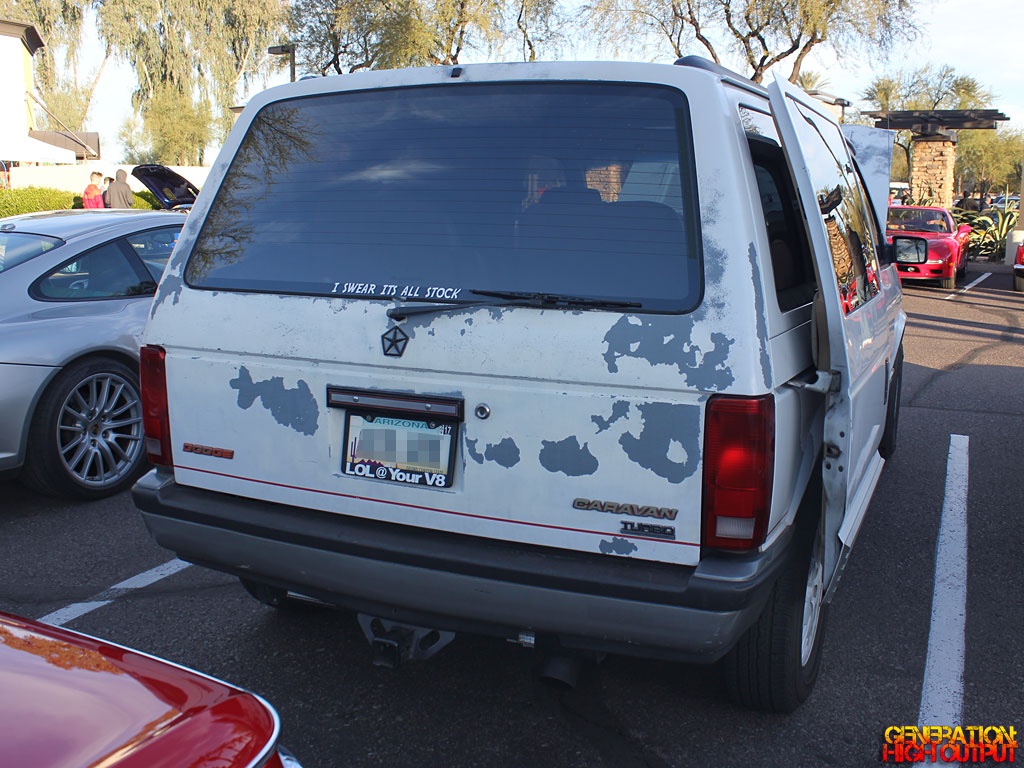
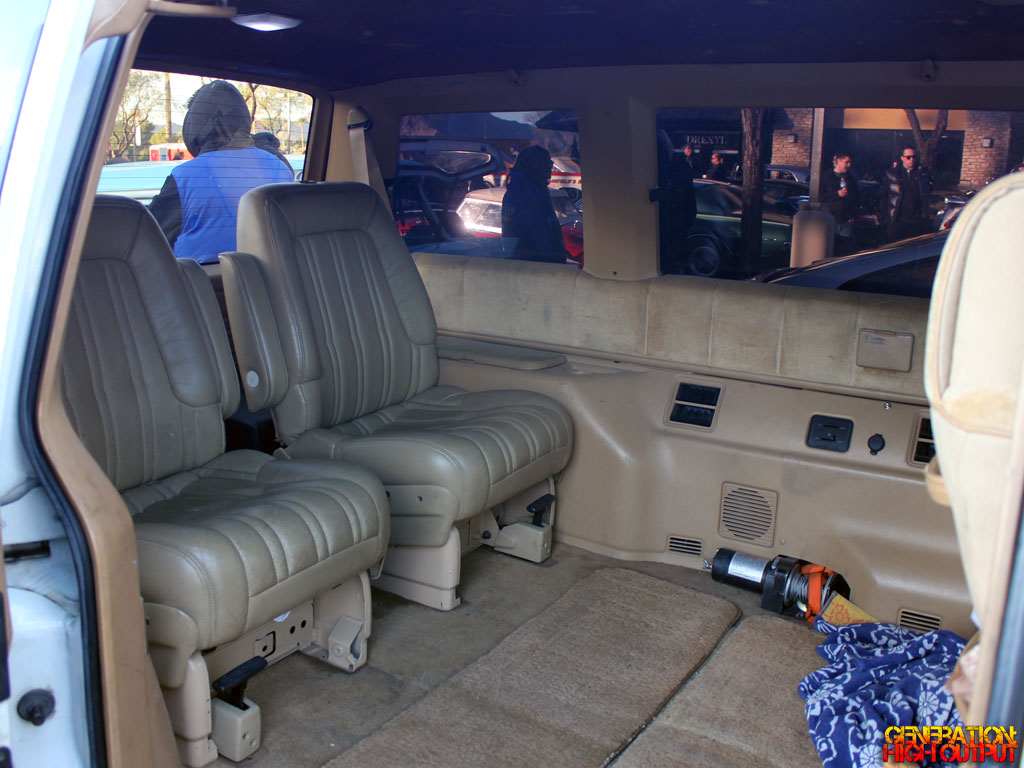
At a recent car show in Scottsdale, I saw a first-generation Dodge Caravan that really caught my eye. For starters, this was a car show that featured primarily European exotic and high-end supercars such as Ferraris and Lamborghinis. A 1988 Caravan with peeling paint definitely didn’t fit in with this crowd.

But as you might have guessed, this is no ordinary Caravan. This one has seen the original 2.5L 4-cylinder engine swapped out with a much more modern 2.4L turbocharged 4-cylinder from a 2004 Dodge SRT-4. Whereas the original engine made 100 horsepower, the new one puts out 230 horsepower in stock trim – but this one’s not stock.

With an AGP Zeta dual ball-bearing turbocharger, an air-to-water intercooler, upgraded fuel injectors, a MegaSquirt fuel management system, and a 3.5″ exhaust with Magnaflow muffler, this beast is putting down 305 horsepower and 365 lb-ft of torque at the wheels! Wow!

A spec sheet on the vehicle says it has run 12.6 in the quarter mile @ 111 mph on E85, 25 lbs of boost, and slicks. With a fast reaction time, that puts it on par with a base model C6 Corvette – for a lot less dough. It’s also been converted to 4-wheel disc brakes, with the front brakes and suspension from a 1995 Grand Caravan and the rear disc brakes from a 1993 Dodge Daytona R/T.

Part of why I love this van is because it pulls off the “sleeper” look quite well. The peeling paint and OEM-style wheels do not give any indication that this vehicle is actually quite fast, and the “Turbo” and “SRT” badges may be dismissed as purely ironic – until the turbo spools up and it blows your doors off.

The other reason why I love this van is that a long time ago, our family had a blue 1994 Caravan which I remember fondly. This was the era before dual sliding doors, power liftgates, and fold-flat seating. These old vans are super primitive by today’s standards, but the boxy design reminds me of my childhood.

I didn’t get to talk to the owner, but if you are reading this Mr. Caravan Owner, congrats on the awesome build.

1977 Toyota Celica 2JZ Engine Swap

Cars and the engines that power them come in a wide variety of styles and configurations. The more I read and learn about cars, the more I believe that there is something magic about inline-6 engines.

Many of the automotive greats have used the straight six engine, from the Jaguar E-Type to the Hudson Hornet to numerous BMW, Mercedes, and Jeep models. In general, inline sixes are known for being well-balanced with a smooth, even delivery of power. Though not high revving, they are reliable “workhorse” engines that can have a surprisingly long service life.

Toyota had been producing inline 6 engines as early as 1955, but they really hit a home run with the introduction of the 2JZ family of engines, which were produced from 1991 to 1998 in the US (and through 2002 in Japan).

This was the engine that powered the Lexus SC300, the first and second-gen GS 300, and an even more powerful variant went into the A80 Toyota Supra. Today, the 2JZ engine has a cult-like following. It is renowned among import car fans for its heavy-duty internals and its huge potential for tuning. This is probably what motivated Arizona resident John Garza to swap a 2JZ-GE engine into his 1977 Toyota Celica coupe.

I had seen this car in early 2017 at the Future Classics car show in Scottsdale, and crossed paths with it again at Cars and Coffee. The car has been featured in the October 2016 issue of Hemmings Sports & Exotic Car magazine, and gets a LOT of attention at local car meets and events.

This 1977 is a close match to Mr. Garza’s first car, another ’77 Celica that he drove in high school. The Toyota Celica was recognized as Motor Trend’s Import Car of the Year in 1976.

Under the hood, John has swapped in a 2JZ-GE mated to a 5-speed manual gearbox from a 2004 Lexus IS300. It’s an incredibly clean swap, and truly looks as if the engine came that way from the factory. However, getting it all to work was anything but easy.

A page of build photos shows how John had to make some serious modifications to the crossmember and to the oil pan in order for everything to fit. The car borrows parts from the Toyota family, including the rear axle from a 1981 Supra and the steering box from a Corolla. Heavy modifications were also done to the car’s suspension in order to accommodate larger wheels and brakes.

Rounding out the build is a wood and brown leather custom interior with all of the ambiance and warmth of a 1970s smoking lounge. It looks wonderfully comfortable, and is a welcome change from the typical Sparco seats and MOMO steering wheels that adorn most import builds.

The combination of a classic car with modern performance and reliability is truly a win-win situation. We wish John many happy miles with his awesome car and hope to see it at more shows and events in the future!

SEMA 2015: 1965 Dodge Dart SL by Big Oak Garage

1965-dart-sl-profileHot Rodding may have begun in southern California, but the guys at Big Oak Garage in Hokes Bluff, Alabama have certainly perfected the craft. They have given the “Big Oak” treatment to this 1965 Dodge Dart, which I saw on display at the 2015 SEMA Show in Las Vegas.

The car’s bright green and chrome look caught my attention right away! The color is actually a stock Mopar color called “Green With Envy,” which I thought was very cool. You don’t see too many of these cars around, especially at a show like SEMA which is dominated by pro-touring Camaro and Mustang builds. The Dart stands out, and in a good way. Continue reading