Not Sold Here: Mitsubishi Lancer Evolution IV

Today’s edition of “Not Sold Here” features this Mitsubishi Lancer Evolution IV GSR that I recently spotted at Highline Autos Cars and Coffee in Arizona.

The Lancer Evolution arrived in North America in 2003, but it was already well-established in Europe and Asia since its debut in 1992. The Lancer Evolution has a long history of track racing, hill climb, and World Rally Championship wins, including four consecutive WRC Driver’s Championships from 1996 to 1999.

The Evolution IV was produced from 1996-1998, with a total of 13,134 units built. There were 12,193 units in GSR trim and 941 units in RS trim, according to a post on Lancerregister.com.

On the exterior, the front is dominated by two oversize fog lights set low in the front bumper. The large front mount intercooler, hood vent, and single NACA duct on the passenger side give the car an aggressive look.

A front lip spoiler and side skirts hint that this is no ordinary sedan, and the massive rear wing confirms it.

The car has a gray interior with red inserts on the sport seats and door cards. A Momo leather steering wheel and white-face gauges round out the interior of this Japanese sport sedan. Being that this is a Japanese import car, the steering wheel is on the right-hand side.

Power comes from a 2.0L turbocharged inline 4-cylinder engine making 276 hp and 243 lb-ft of torque. A 5-speed manual gearbox was the only transmission offered.

This car shows its original 16-inch OZ Racing F1 wheels wrapped in Dunlop Direzza ZIII tires. It looks to be a nice, clean example of a Lancer IV, which you don’t see very often in North America.
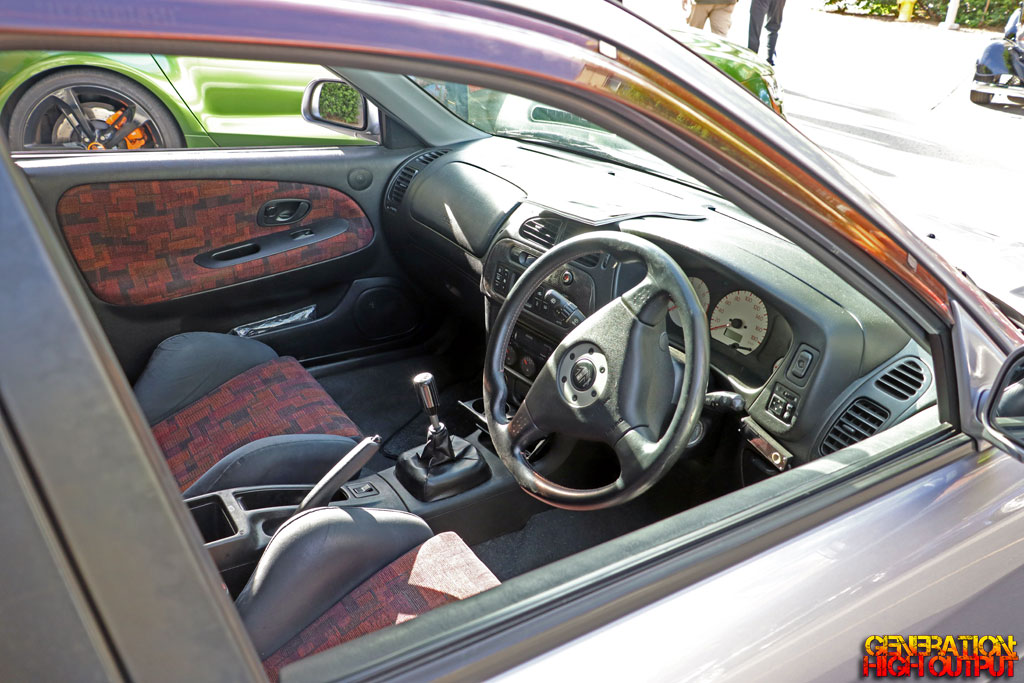
Importing vehicles that are 25 years old or more means that the vehicle is NOT bound to the 2,500 mile per year limit under the “Show or Display” law of 1999. That law only applies to vehicles that are less than 25 years old and with no similar make or model certified for sale in the U.S.

Because of this, there have been a lot of quirky Japanese cars popping up in the U.S. lately, such as the Honda Beat, the Toyota Sera, and countless Nissan Skylines.

I think it is neat that we are starting to see more of these unique cars appearing in the U.S., and I was glad to have crossed paths with this Japanese sport sedan.
Not Sold Here: 1961 Mistral Roadster

One of my favorite local car events to attend is the Concours in the Hills car show, held each year in February in Fountain Hills, Arizona. Concours in the Hills is not a formal concours with judges in straw hats and white gloves awarding points. It is a more casual, informal event. The 2020 event was the largest ever, with more than 1,000 vehicles wrapping all the way around the perimeter of the lake and its namesake fountain. It was a stroke of good fortune that this event was able to be held in 2020 and not cancelled like so many others due to the COVID-19 pandemic.

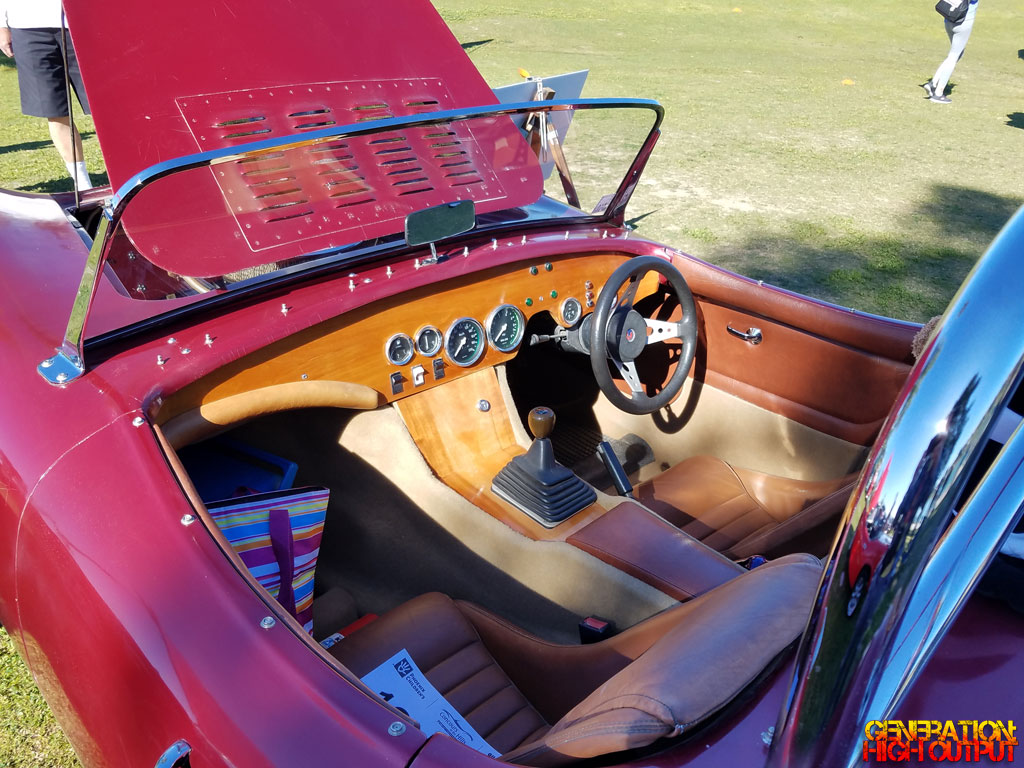
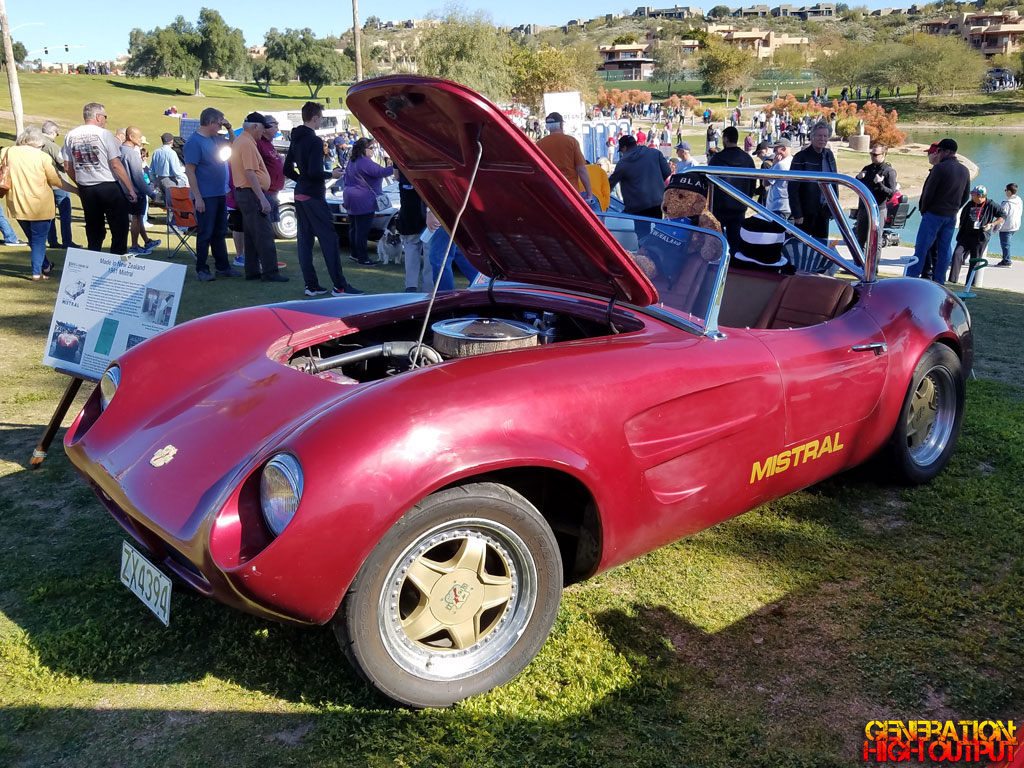
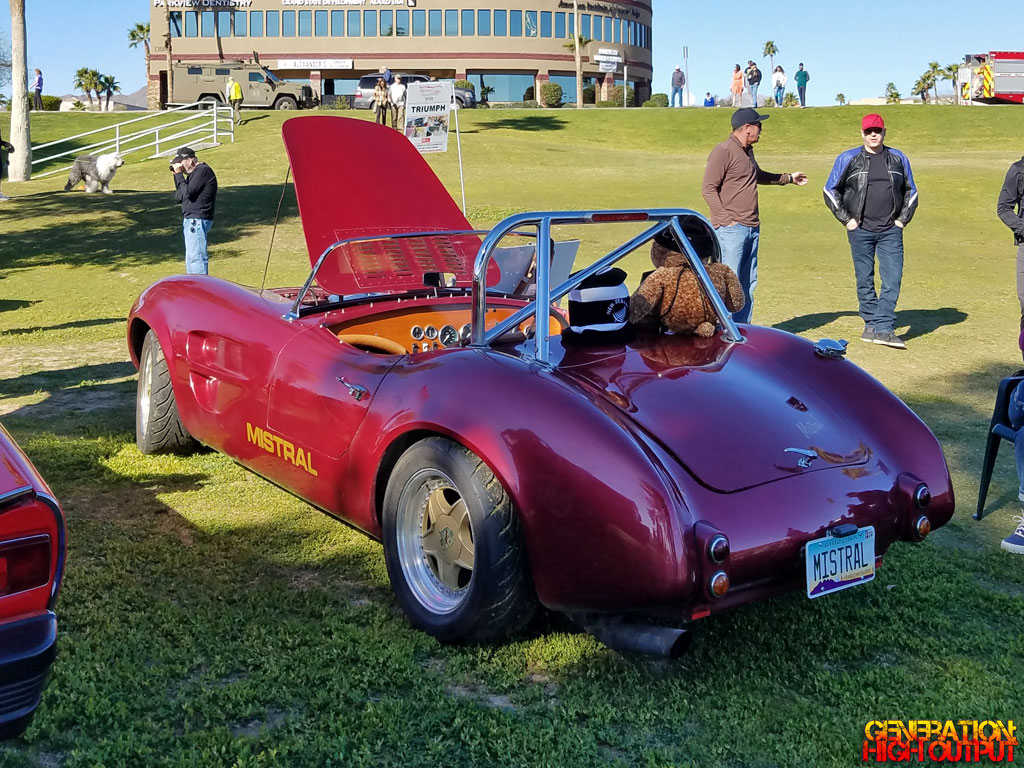
One of the first cars I saw at this year’s show was a unique little two-seater that caught my eye. Looking a bit like a Shelby Cobra or a Scarab, the car had the name “MISTRAL” in gold lettering on each side. Also, it was a right hand drive car – which are not commonly seen in the U.S.

A cheery couple was camped out next to the car in folding chairs. They had a large sign next to the car that told the history of the vehicle, which I will provide below:

“The Mistral body was designed by Bill Ashton in England during the early 1950s. Constructed out of a new material called fibre glass, it was developed to be used on Buckler and Lotus chassis in the 750 Motor Club’s 1174 Formula class. A few years after introduction it was sold to Weltex in Christchurch, New Zealand and a year later to coach builders Elmslie and Flockton in Dunedin.

Production records are gone, but there were approximately 200 total. Mistrals were sold as “rollers” ready to install the engine and transmission, which the customer specified. Because you could specify a Corvette engine and transmission (and consequently a finished weight of 1900 lbs), several were road racing in the USA during the 1958-62 era.

Although various cars like Austin and Toyotas were assembled in New Zealand, Mistral was probably the only New Zealand car company. The map of New Zealand can be seen on the insignia.”

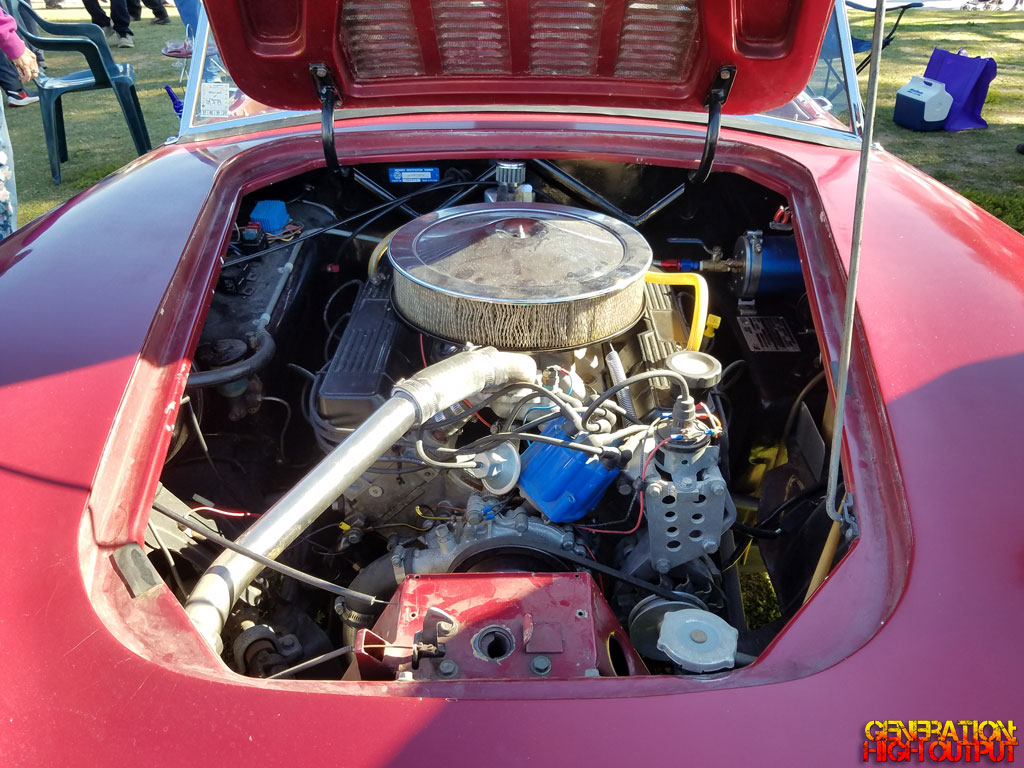
“This 1961 Mistral has evolved since it’s birth as most did. For about the last 35 years it has had a Rover V8, Toyota 5 spd., Mazda LSD, and Vauxhall front end. It raced in street legal class in New Zealand and more recently, to remain legal, had to have a taller roll bar and 3 piece wheels to accept modern tires.”

It is a very cool little car, and one that I was delighted to have seen at the car show. Thanks to the owners for bringing it out!

Not Sold Here: 1990 Toyota Sera with Super Live Sound System (SLSS)


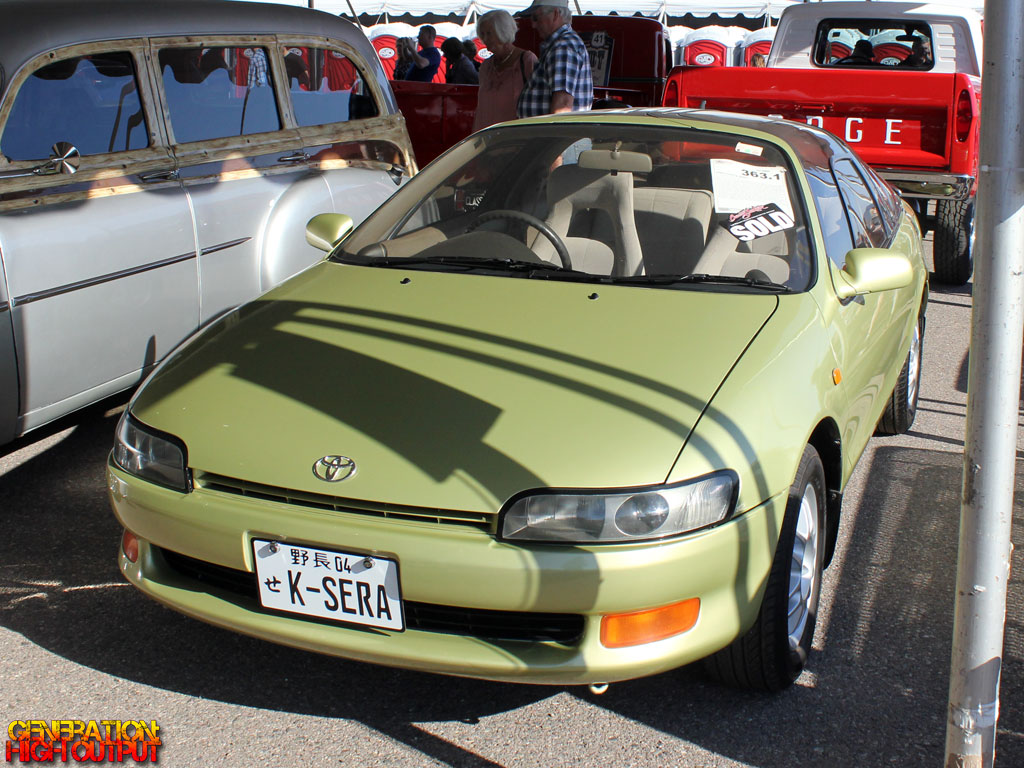
Welcome to Not Sold Here, the series where we look at interesting cars which were never sold in the United States market, but have made their way to American soil. Today’s feature car is a 1990 Toyota Sera, a sporty, compact car from Japan. About 15,941 vehicles were produced during the five year production run from 1990 through 1995. All models were equipped with a 1.5L engine producing 110 horsepower and 98 ft-lbs of torque, with either a 4-speed automatic or 5-speed manual available. The Sera is noted for its numerous unusual features and options.

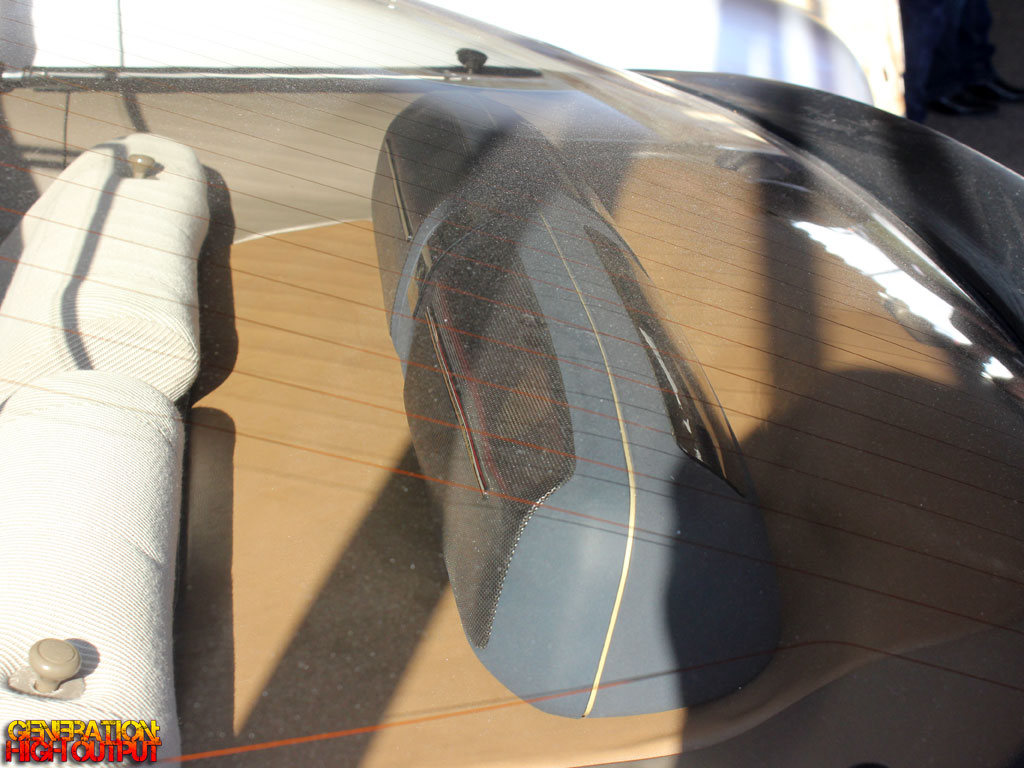
The most prominent feature of the Sera is its butterfly hinge doors, which open outward and upward instead of in the conventional fashion. Gordon Murray, designer of the legendary McLaren F1, credited the Sera as his inspiration for the F1’s similar styled butterfly doors. The three-door hatchback has seating for four, though the backseat is quite small.

Another unusual feature of this particular Sera is its paint color. The car was offered in 11 different colors. There were of course standard colors such as black, gray, red, and blue, but there were also less traditional colors like turquoise blue, burnt orange, and greenish yellow, which is what this car has. I really couldn’t imagine a color like this selling well in the U.S. market.

Continue reading

Not Sold Here: Seat Ibiza

There are certain cars that become world famous simply because so many of them have been produced. In America, one of the most famous cars ever built is the Ford Model T. In Germany, the Volkswagen Beetle is the car everyone knows. Japan has produced more than 40 million Toyota Corollas worldwide. And over in Spain, the most commonly produced automobile is the SEAT Ibiza.

Most folks in the U.S. have never heard of this car, but SEAT has produced more than 5.4 million of them since 1984. It’s a supermini car, or what we could call a subcompact in the American market. It is sold in Mexico, which is where this one came from. With a base price around $11,000 USD, the Ibiza is similar to the Nissan Versa, another subcompact made for the global market.

The SEAT Ibiza isn’t a terribly interesting car. It’s not limited production, doesn’t have any unique or exclusive features, and it’s not a top performance machine. The only interesting thing about this car was that I saw it driving around in Phoenix, Arizona which is noteworthy because this car is not offered for sale in the United States.

Don’t quote me on this as I am not a lawyer, but I believe that foreign citizens are allowed to bring their cars into the US for personal use for a period of one year. The car must not be sold during that time, and is required to have liability insurance through a US provider. It’s interesting that we don’t see more cars from Mexico and Canada driving around our roads. You never know what you might spot just by keeping your eyes open!

Not Sold Here: Audi S1 Hatchback

If you want to see people go nuts at a car show, simply bring an Audi R8 supercar and watch as the crowd flocks around it like moths to the proverbial flame. Don’t get me wrong – I like the R8 – but I’ve been to plenty of car shows and seen plenty of them. At the Concours in the Hills car show, I saw an Audi that I had never seen before.

The Audi S1 is a hot hatchback based on the Audi A1 platform. It’s not sold in the United States, but it is sold in Mexico. You can think of it like Audi’s answer to the Ford Focus ST, the Fiat 500 Abarth, or the Mini Cooper John Cooper Works (JCW) edition. Hot Hatchbacks have long been popular in Europe, and are only recently starting to make inroads in the US market, where trucks and SUVs reign supreme.

Under the S1’s hood is a turbocharged 2.0L engine making 228 horsepower. Audi says it will accelerate from 0-60mph in 5.8 seconds and has a top speed of 155 mph – quite impressive for such a small car! It also has Audi’s permanent Quattro all-wheel drive system.

This car is incredibly rare to see in the US compared to the R8, but hardly anyone paid it any interest at the car show. Just goes to show what you might see when you keep your eyes open!

1986-1991 Toyota Soarer Z20

toyota-soarer-gt-front

The Ford Thunderbird will go down in history as the car that created an entire market segment: the personal luxury coupe. Since that time, many other auto makers have produced their own version of the Thunderbird. Over time, the segment came to be defined by a few characteristics: an emphasis on luxury and the latest technology, powerful engines with comfortable suspensions, and of course, a 2-door, 4-passenger seating arrangement.

Although the American economy went through a recession in the early 1980s, things  turned around and the demand for personal luxury coupes was on the rise by the later end of the decade. General Motors had the Buick Riviera, Ford had the Lincoln Mark VII, and Chrysler had resurrected the Imperial name for their 1981-1983 coupe. The United States wouldn’t see the Lexus SC400 until 1991, but this car was its Japanese predecessor: the Toyota Soarer Z20.

Continue reading