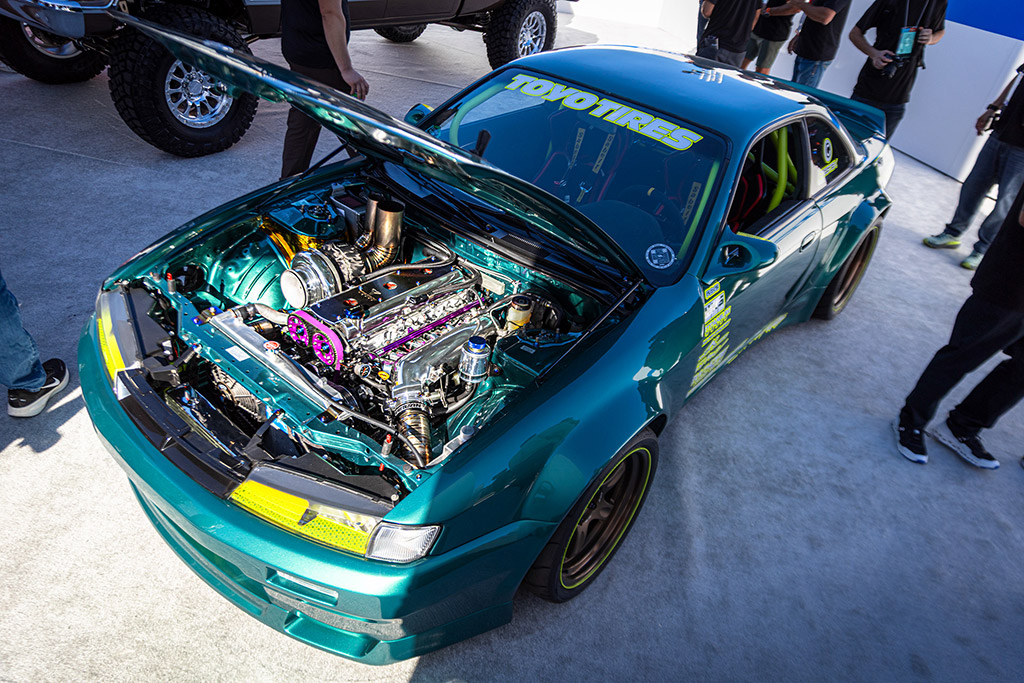
 There are certain cars at SEMA that make perfect sense. You look at them and immediately understand what the builder was going for. Then there are cars like this Nissan 240SX from Crown SpeedLab.
I walked up to it in the Toyo Tires Treadpass Pavilion at the 2025 SEMA Show and spent the first few minutes trying to decide what color I should be looking at.
Not because the paint changes color or anything fancy like that. There are just so many colors competing for your attention that it starts to feel like someone opened Photoshop and clicked every swatch before heading out to the garage.
And somehow it works.
 The car itself is a Nissan 240SX, although at this point “240SX” is probably more of a suggestion than an accurate description. Between the custom widebody kit, full roll cage, and everything else going on, there isn’t much left of whatever rolled out of the Nissan factory decades ago.
Another customization that’s hard to miss is the turbo exhaust sticking through the hood. The turbo is attached to a Toyota 2JZ engine, which feels almost mandatory at this point. If you told me there were more 2JZ-powered 240SXs at SEMA than actual Toyota Supras, I’d probably believe you without checking.
 The engine bay is where things get especially interesting. There are anodized purple cam gears and a matching fuel rail, gold foil heat shielding, a dark green engine bay, and a bright blue oil filler cap. On paper, that combination sounds like something a middle school art teacher would use to explain what happens when a group project gets out of hand.
Standing in front of the car, though, it somehow comes together.
I think.
The longer I looked at it, the less sure I became.
There’s also a massive intercooler from Koyorad sitting up front, which is good because I have a feeling the phrase “moderate boost pressure” was not part of this build’s design notes.
The lighting deserves some attention too. The custom headlights feature yellow transparent honeycomb inserts that look like they belong on some sort of futuristic racing drone. Around back, custom LED taillights continue the theme of making sure absolutely nobody mistakes this car for a stock 240SX.
Not that they were going to.
The perfect stance was achieved with coilovers from Fortune Auto, while bronze Volk Racing TE37 wheels with electric yellow lips sit at each corner. If you’re keeping score, that’s more colors added to the list. The wheels are wrapped in Toyo Proxes R888R tires, which are about as subtle as the rest of the car. Behind them are Brembo brakes with cross-drilled rotors, with electric yellow calipers.
 It’s funny, growing up in the 1990s and early 2000s, a Nissan 240SX was one of those cars that always seemed just out of reach. Every magazine had one. Every import tuner build seemed to involve one. Every internet forum was full of people arguing about SR20 swaps, KA-T builds, and whether drifting was ruining perfectly good cars.
Now I walk through SEMA and see a 240SX with a Toyota engine, a turbocharger the size of a carry-on suitcase, and a small fortune of aftermarket parts. And somehow it still feels completely normal.
Maybe that’s the strangest part.
Twenty years ago this thing would have looked like a concept car from the future. Today it just feels like another chapter in the long history of people looking at a 240SX and deciding that whatever Nissan originally intended wasn’t nearly ambitious enough.
Either way, I spent far longer staring at the details on this car than I probably should have.
I’m still not convinced that dark green engine bay should work.
But now I’m thinking about painting something dark green, so maybe that’s how these things start.
Follow Crown Speed Lab:
https://crownspeedlab.com/
https://www.facebook.com/Crownspeedlab
https://www.instagram.com/crownspeedlab/