Driving home from work, I caught sight of a rather unusual car: a Toyota Paseo convertible. I couldn’t recall ever having seen one before.
As it turns out, the convertible model was introduced in the U.S. in August 1996 and the Paseo was discontinued in 1997. That means the Paseo Convertible was a one-year only car for the United States. According to Wikipedia, the convertible models were never offered in Britain or other markets. Continue reading →
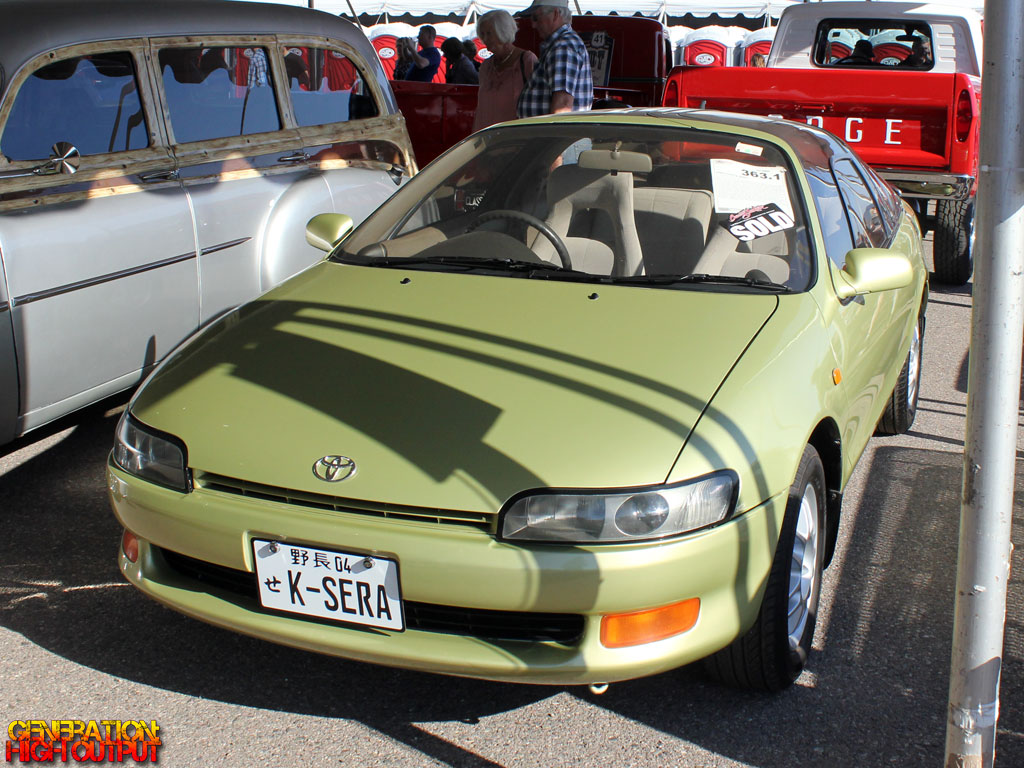
Welcome to Not Sold Here, the series where we look at interesting cars which were never sold in the United States market, but have made their way to American soil. Today’s feature car is a 1990 Toyota Sera, a sporty, compact car from Japan. About 15,941 vehicles were produced during the five year production run from 1990 through 1995. All models were equipped with a 1.5L engine producing 110 horsepower and 98 ft-lbs of torque, with either a 4-speed automatic or 5-speed manual available. The Sera is noted for its numerous unusual features and options.
The most prominent feature of the Sera is its butterfly hinge doors, which open outward and upward instead of in the conventional fashion. Gordon Murray, designer of the legendary McLaren F1, credited the Sera as his inspiration for the F1’s similar styled butterfly doors. The three-door hatchback has seating for four, though the backseat is quite small.
Another unusual feature of this particular Sera is its paint color. The car was offered in 11 different colors. There were of course standard colors such as black, gray, red, and blue, but there were also less traditional colors like turquoise blue, burnt orange, and greenish yellow, which is what this car has. I really couldn’t imagine a color like this selling well in the U.S. market.
The Ford Thunderbird will go down in history as the car that created an entire market segment: the personal luxury coupe. Since that time, many other auto makers have produced their own version of the Thunderbird. Over time, the segment came to be defined by a few characteristics: an emphasis on luxury and the latest technology, powerful engines with comfortable suspensions, and of course, a 2-door, 4-passenger seating arrangement.
Although the American economy went through a recession in the early 1980s, things turned around and the demand for personal luxury coupes was on the rise by the later end of the decade. General Motors had the Buick Riviera, Ford had the Lincoln Mark VII, and Chrysler had resurrected the Imperial name for their 1981-1983 coupe. The United States wouldn’t see the Lexus SC400 until 1991, but this car was its Japanese predecessor: the Toyota Soarer Z20.
I spotted this thing stuck in rush hour traffic as I cruised on past in the HOV lane. I can’t find much about it, it may have even been imported from Mexico? It does have Arizona plates on it so who knows. There probably aren’t too many like this out there so go ahead and soak it in. Continue reading →
While wandering around at Cars and Coffee a few weeks ago, I spotted an odd-looking car with its rear view mirrors attached to the front fenders. “Oh yikes, this thing probably belongs to some weeaboo guy who gets a raging boner from reading his collection of Initial D mangas” I thought to myself. But as I got closer, I could see that this car was not some wanna-be drift machine covered in JDM stickers. No, this car is the real deal.
I’ll admit that when it comes to vintage Japanese automobiles, I know next to nothing about them. However, I know just enough to recognize that this right-hand drive Toyota Corona 2000GT is a very unique automobile here in the USA. Having spent a couple of hours researching mid-1970s Toyotas, I can now proceed to share with you some information about this car.
If there is one thing I have learned from watching Antiques Roadshow, it is that you should never try to clean any object that might be old and valuable. In doing so, you may destroy much of the item’s value. The same rule applies to antique guns, guitars, and more recently, automobiles.
Not too long ago, people restored old cars to a factory-new finish in order to make them valuable. Now, the emphasis is shifting towards leaving the car “as-is” and showing its age. People really dig the “patina” look but personally, I never really understood why.
Then I saw this ’77 Corolla, and I think I am starting to understand.

 Driving home from work, I caught sight of a rather unusual car: a Toyota Paseo convertible. I couldn’t recall ever having seen one before.