Stay up to date on the latest news about the Barrett-Jackson Collector Car Auction. Every year we cover the Scottsdale Auction with photos and information.
The bread and butter of every Barrett-Jackson auction event is American cars from the 1950s, 1960s, and 1970s. This is what the company specializes in and what their target demographic wants to buy.
Walking through row after row of white tents in Scottsdale, I passed by hundreds of Mustangs, Camaros, Corvettes, Chevelles, Novas, Firebirds, and Dodge Chargers and Challengers for sale. But every once in a while an oddball car would be tucked in among the American muscle cars.
In this case, the 1981 Ferrari 400i Stretch Limousine is a truly rare and weird car. Rare because the Ferrari 400 (and its fuel-injected successor, the 400i) were never officially sold in the United States, and weird because Ferrari vehicles are not a popular choice for limousine conversions. Any 400i vehicles in the U.S. today are grey market imports that were ordered from Europe and federalized to meet U.S. DOT regulations. With 1,305 examples of the 400i produced between 1979 and 1985, it is a safe bet that the number of these cars in America is “not very many.”
So you can be forgiven for never having heard of the Ferrari 400i in America. Its three-box styling and pop-up headlights are typical of the period. A non-stretched version of the 400i made an appearance in the 1988 movie “Rain Man” starring Tom Cruise and Dustin Hoffman. Power comes from a 4.8-liter V12 engine producing 310-315 horsepower, depending on the year. The car was among the first Ferrari vehicles to be offered with an automatic transmission, starting in 1976. The vinyl top and the wheels are not earning this car any style points, in my own opinion.
This 1981 Ferrari limo sold for $52,800 (including buyer’s premium) at the auction. While it may not be the most aesthetically pleasing or tasteful example of Ferrari automobiles, you can bet that you will be turning some heads at Cars and Coffee as you roll in with this one-of-one car.
Neoclassic cars are a specialty product for a niche audience. I have written extensively about neoclassic cars for this website, and the companies that build them follow a similar pattern:
1) Company begins building fiberglass bodied cars on top of an existing 1970s or 80s Ford or GM chassis
2) Company builds a few hundred to a few thousand cars
3) Company runs into financial trouble and closes up shop
4) The cars trade hands in the secondhand market, with little to no verifiable information about the company or vehicle’s history
This story has been told time after time with Zimmer, Philips, Clenet, Classic Tiffany, Corsair, Gatsby, and the short-lived reboot of Stutz.
The story of SAMCO follows a similar path, though the cars themselves were unique in a way that stood out from the pack.
SAMCO is an acronym for Sports Automobile Manufacturing Company. It was a side project of William “Bill” Lear, creator of the Learjet – the world’s first mass-produced business jet.
While Lear was well-established in Wichita, Kansas the automobile operation was located in Oklahoma. From 1968 through 1970, the company produced approximately 400 SAMCO Cord replica cars.
According to the website www.stutzbearcat.com, the cars were offered in two models: the Warrior with a 108-inch wheelbase and the Royale with a 113-inch wheelbase.
Engine choices were a Ford 302 V8 engine or a Chrysler 440 Magnum V8 engine. The website www.barnfinds.com says that unlike most neoclassic cars which are built on another chassis, the SAMCO Cords are unique in that they are built on a custom frame.
Initially located in Tulsa, Oklahoma, production was later moved to Mannford, OK which is about 23 miles west of Tulsa.
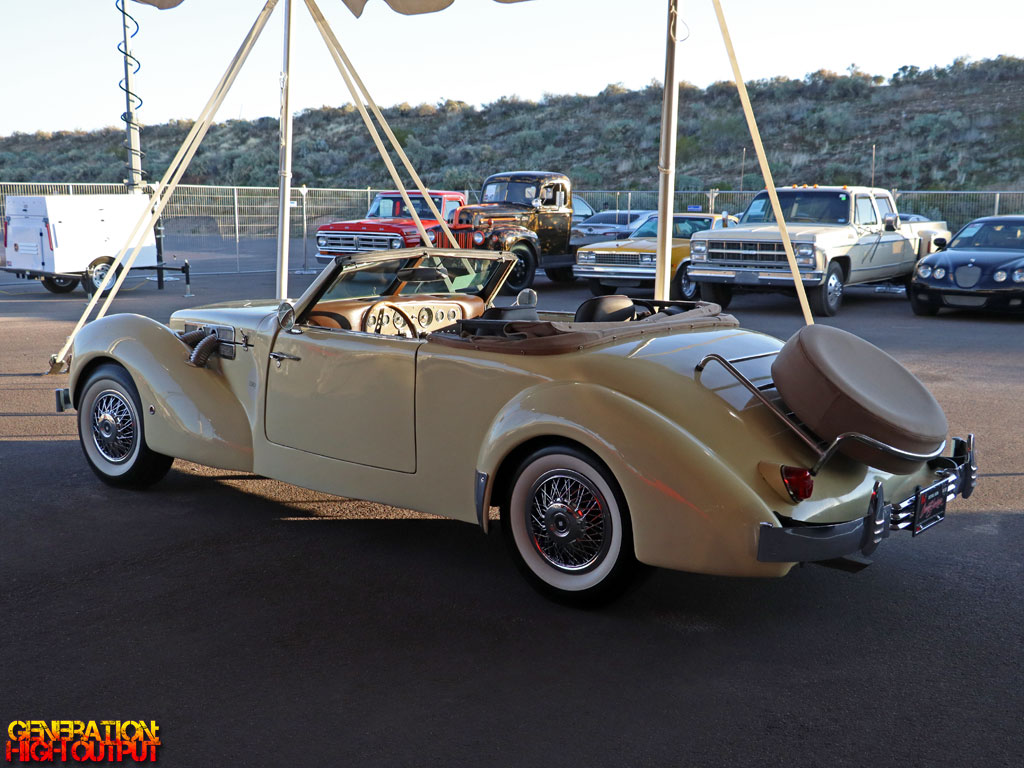
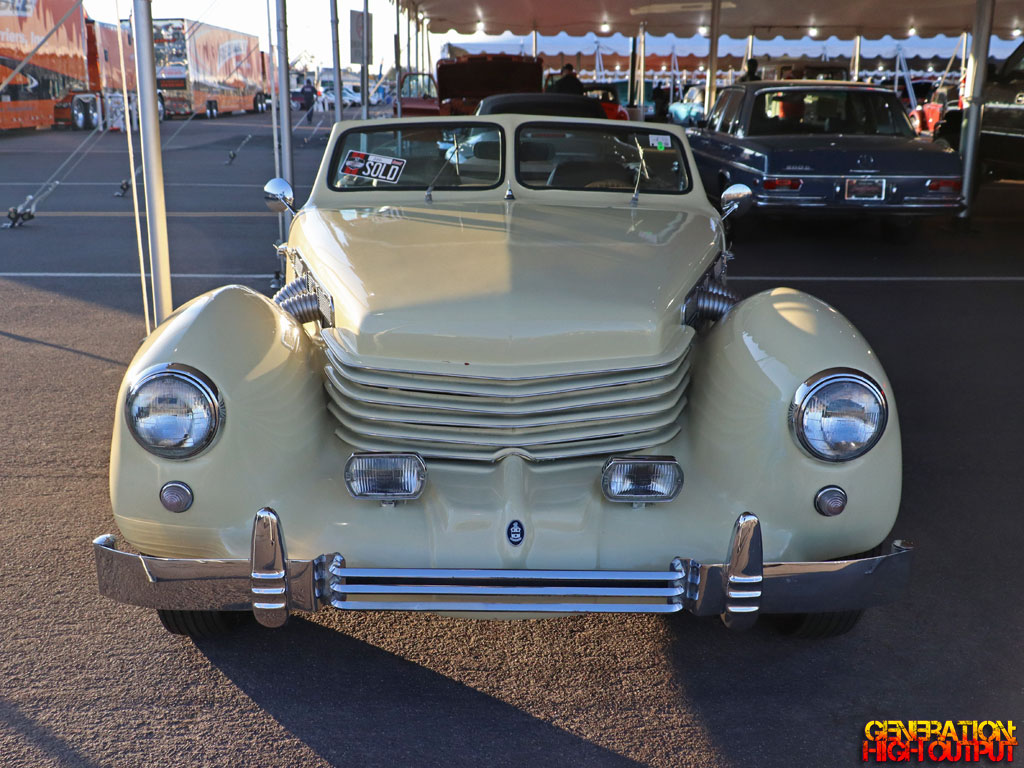
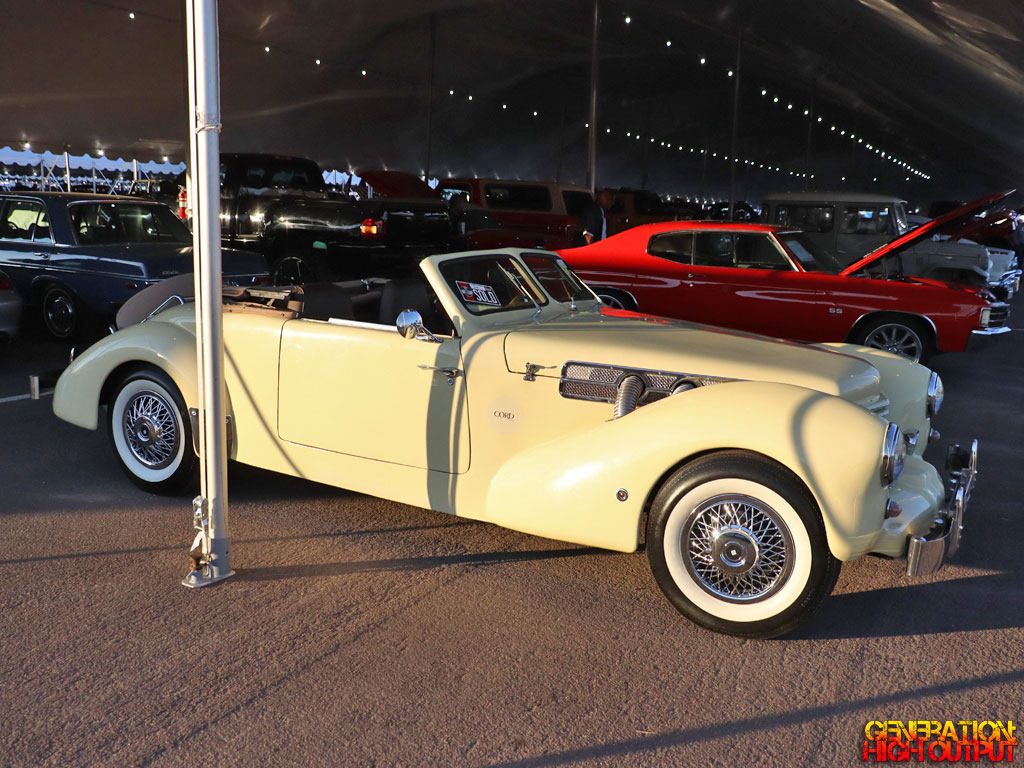
This 1970 vehicle is a replica of the 1937 Cord 812 Sportsman, though the proportions are quite different from the original. This SAMCO Cord is much too small to pass for a 1930s vehicle. The real Cord automobile is famous for its “coffin nose” styling with headlamps cleverly hidden in the front fenders. This gives the car a streamlined look that was very modern for the time. This car has no trick headlights, but a couple of round lamps fixed to each fender and two smaller lights in the middle. It’s a far cry from the sleek look of the original.
It has a manually-operated convertible top over two bucket seats up front. The vehicle is equipped with power steering, disc brakes, chrome wheels, and a rear luggage rack. Interestingly, the car does feature rear-hinged doors and white-wall tires, like the original upon which it is based.
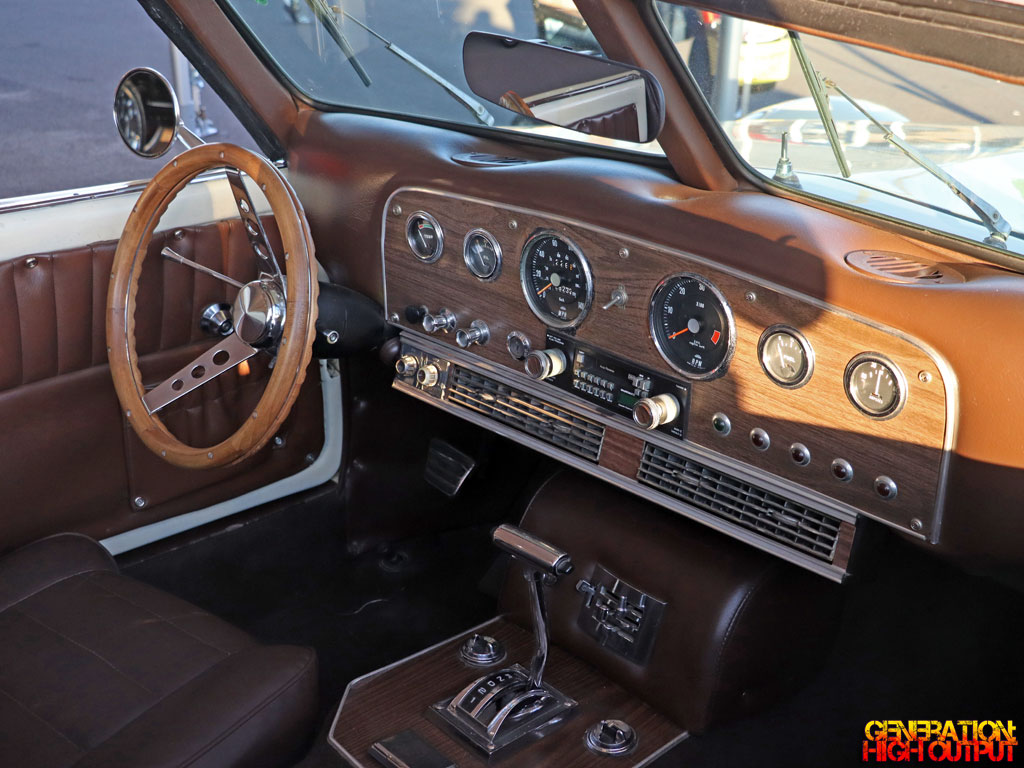
The dashboard has a cassette player radio, air conditioning, and all the faux woodgrain trim and brown vinyl upholstery you can handle. The layout is unconventional with the speedometer and tachometer in the center of the very flat dashboard. This car sold for $24,200 (including buyer’s premium) at the Barrett-Jackson Scottsdale 2022 Collector Car Auction as lot #109.
Way back in 1966, Carroll Shelby partnered with rental car company Hertz Corporation for a special promotion. Hertz would order 1,000 Shelby GT350 vehicles and make them available for rent. These special edition cars featured black paint with gold stripes and GT350H badging. The campaign was advertised as “Rent-a-Racer” and was very successful.
The popularity of the original program has endured over the years, and has resulted in Hertz doing a number of re-boots and similar offerings featuring newer Shelby Mustangs, the Chevrolet Corvette, and most recently, the Chevrolet Camaro.
Hertz revived the Rent-A-Racer program in 2006, 2007, and 2016 with customized Mustang vehicles available for rent at select locations throughout the United States. Hertz also partnered with Chevrolet to produce a special “Hertz edition” Corvette ZHZ in 2008, 2009, and 2018. 2020 saw the debut of the first ever Hertz edition Camaro. These vehicles, developed in partnership with Hendrick Motorsports, take the “Rent-A-Racer” concept to a whole new level. A total of 224 units were built, with two versions. One model based on the Camaro SS is equipped with the 6.2-liter V8 engine and produces 480 horsepower. The other version is based on the Camaro ZL1 and features a Callaway supercharged 6.2-liter V8 producing 750 horsepower! Both cars wear yellow stripes over gloss black paint. One of these special Hendrick Motorsports #24 / Hertz / Camaro ZL1 models was recently offered for sale at Barrett-Jackson’s Scottsdale 2022 auction. The 650-horsepower Camaro ZL1 is an excellent starting platform to build a special car.
The Camaro’s stock supercharger was upgraded to a Callaway Gen3 supercharger with triple-cooled intercooler, boosting power output to 750 horsepower. To make room for the new supercharger, a hand-built carbon fiber hood insert was designed and manufactured by Hendrick Motorsports. The car is production number #012 according to a data plate under the hood.
Additional modifications include a Hertz / Hendrick Motorsports graphics package with the Hendrick Motorsports #24 logo, Forgeline wheels with #24 center caps over Hertz yellow painted brake calipers. Continuing the theme, the car features Hertz Yellow door inserts, lighted door sills with the Hertz logo, William Byron’s signature and the #24 logo, as well as #24 floor mats. The car sold for $104,500 (including buyer’s premium) at the 2022 Scottsdale auction and shows just 6,600 miles on the odometer. That’s dangerously close to COPO Camaro money, for a car that can actually be registered and driven on the street. Although six figures sounds like a lot for a Camaro, I think it is warranted given the limited edition nature of the Hertz/Hendrick ZL1 and the low production volume. The car is also remarkably low mileage for a rental. I wish the new owner all the best with their new Hertz ZL1 Camaro! This is definitely a Special Edition car to be cherished and enjoyed, preferably on back roads with a heavy right foot!
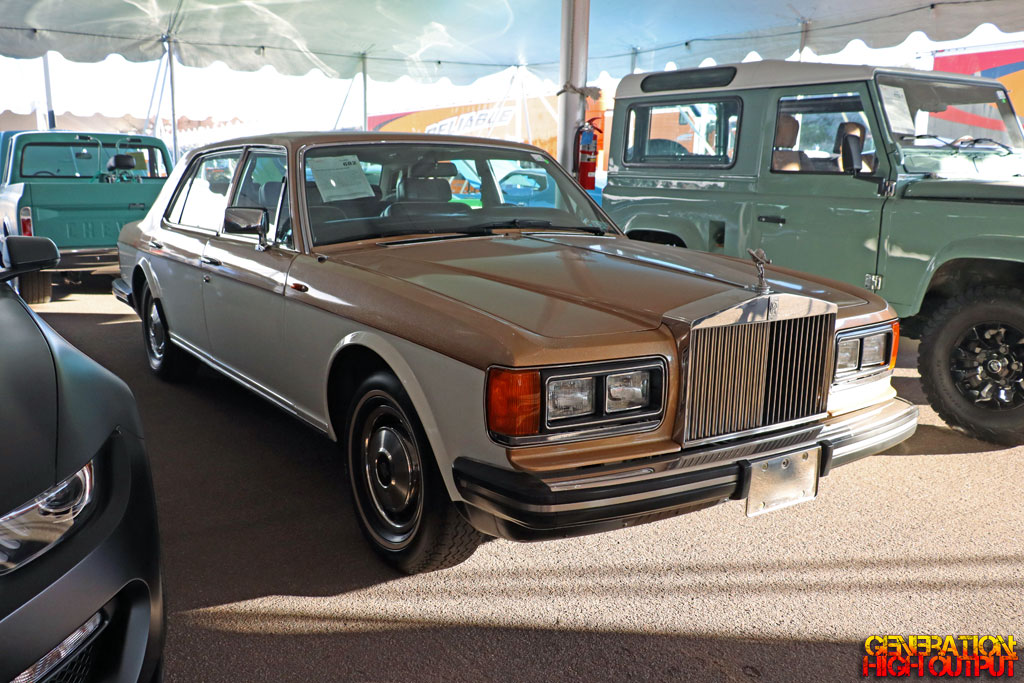
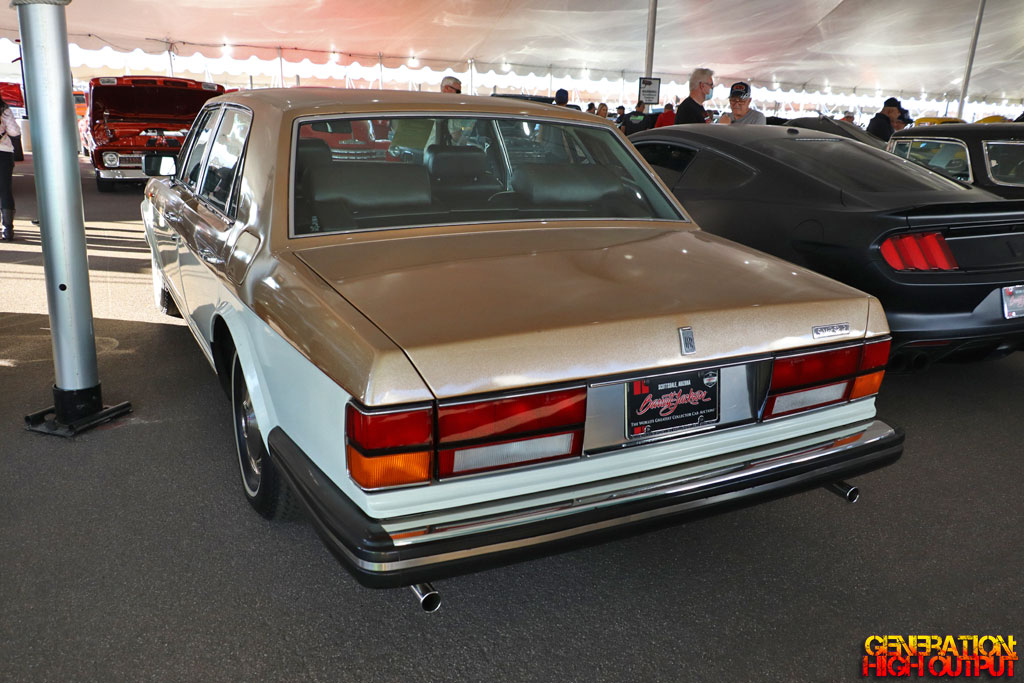
Every Rolls-Royce automobile is special, but this 1982 Silver Spur is a little extra special. The car features two-tone metallic white and gold with a dark tobacco leather interior.
The former owner of this luxury British sedan was a spiritual leader who went by the name Bhagwan Shree Rajneesh. He founded Rajneeshism, a self-described “religionless religion” that focused on each individual discovering their own religious path, rather than ideology and philosophy.
The founder came to the United States in May of 1981 and began preaching his own religious ideas, which he called Neo-Sannyasinism. His influence in the U.S. grew to the point where he had approximately 2,000 followers who moved to a private ranch in northern central Oregon state, near the small city of Antelope (pop: 50).
Though members described it as an “intentional community,” it was considered a religious cult by outsiders. These members sold or gave away all of their personal belongings to join the group, where they lived in a communal living arrangement. Members of the Rajneesh community carried out the bizarre (and later criminal) wishes of the leader, such as dressing in orange robes and group chanting exercises. In practice, the religion was known for its mysticism and sexual freedom.
By 1984, the community had grown to more than 7,000 people. It had its own police and fire department, restaurants, mall, townhouses, a local bus system, sewage treatment plant, and a 4,200 foot airstrip.
During this time, the Rajneesh leader had attained significant wealth due to its expansive enterprise of both secular and spiritual businesses. One report estimated that the movement was responsible for $120 million in revenue during its time in Oregon.
What did the founder of this religion do with his wealth? Rajneesh had a penchant for Rolls-Royce automobiles, and at one time owned a staggering 93 vehicles! Management of the fleet was set up under its own company, Rajneesh Modern Car Collection Trust, whose purpose was to deal with the acquisition and rental of Rolls Royce automobiles.
This car was one of the more than 90 Rolls-Royces owned by Rajneesh. This 1982 Silver Spur was consigned to sell at the Scottsdale 2022 Collector Car Auction by its owner. The car shows 2,500 miles on the odometer, which is very, very low for the age of the vehicle. The listing states that the car “…was driven by the Bhagwan within the compound to bestow blessings from his followers.” Sold as Lot #682, the car fetched $22,000 – including the buyer’s premium.
The group sought to attain political influence by getting its members on city and county voting boards. To accomplish this, some of the members engaged in a biological attack by spraying salmonella bacteria on salads at local restaurants, poisoning more than 700 people. This was part of a plot to influence the election in their favor.
Rajneesh and his leaders were also later discovered to be engaged in a massive wiretapping scandal, eavesdropping on all incoming and outgoing communications from their members. There was also a serious plot to assassinate a U.S. District Attorney for Oregon, which was investigated by the FBI.
The ranch lasted from July 1981 through approximately September 1985. Rajneesh was deported from the United States in 1985 and he died in India in 1990 at the age of 58.
The legacy of the Rajneesh and his community endures to this day. It has been the subject of multiple books and biographies. The narrative was parodied in a 1998 episode of “The Simpsons” in which Homer is brainwashed into joining a religious cult that bears many similarities to the Rajneesh community. In one scene, the mysterious leader drives around in a Rolls Royce while the group members labor in the fields.
Netflix released a six-part documentary series about the Rajneesh movement in 2018, called “Wild Wild Country.”
Following the death of its founder, the Rajneesh movement is essentially non-existant today. However, this car is a physical link to a time and a place that no longer exists. I wonder what happened to the rest of the Rolls Royce automobiles?
There is so, so much more to this story that I could not possibly fit into this article. For more information, please see these links:
The Scottsdale 2022 Collector Car Auction will be a milestone for Barrett-Jackson, which celebrates its 50th Anniversary next year. Founded in 1972 by Russ Jackson and Tom Barrett, the company is now headed by Chairman and CEO Craig Jackson and President Steve Davis, both automotive legends in their own right.
Today, Barrett-Jackson has grown to five major auction events, having recently added Houston to the list that includes Scottsdale, Palm Beach, Las Vegas, and the Northeast U.S.
The Scottsdale 2022 auction will be a return to the form for the auction company, which was forced to offer a scaled-back event in 2021 due to capacity restrictions in Arizona at the time. The January event was pushed back to March and saw lower attendance than previous years due to the pandemic. However, Arizona can expect a full-scale event for next month’s auction.
Those attending the 2022 Scottsdale event from January 22-30 can expect a very special event celebrating the company’s 50th Anniversary. Barrett-Jackson is a company that likes to offer surprises, such as in 2018 when former President George W. Bush made a special appearance on Super Saturday to help auction a Chevrolet Corvette for charity. There’s no telling which celebrities may appear at this year’s auction – though we do know that Bret Michaels and Grammy-winning artist Pitbull will be a few of the big stars present at the upcoming event.
With just over a month to go, the auction catalog is already filling in with more than 400 collector vehicles already listed online. Though Barrett-Jackson is primarily focused on American cars from the mid-century such as Camaros, Corvettes and Mustangs, the catalog has everything from muscle cars to late model sports cars, present-day exotics, and even pre-war classics. There’s something for everyone to enjoy at these events!
Do you plan to attend the 2022 auction event in Scottsdale, Arizona? Which cars are you looking forward to seeing? Post a comment below and share your thoughts!
The Corvette name is directly associated with the zenith of Chevrolet performance and if you haven’t been paying close attention, you might think it always has been. The C1 generation was a bit of a bumpy start for what was a Thunderbird copycat.
In 1954 it was equipped with a souped-up version of the standard 235ci inline six cylinder. This “Blue Flame” sported most obviously three Carter side-draft carburetors and coupled with a high compression ratio was good for 150hp that was capable of propelling all 2886 lbs to 0-60 in 11.6 seconds. If that seems underwhelming, keep in mind that it was enough that GM didn’t have a manual transmission fit to sit behind it and since opted for the 2-speed powerglide auto on all models.
That didn’t stop a dealer option that would add a Paxton supercharger, though this model is without one. With a Polo white exterior, Sportsman red interior seen in pristine condition this ‘Vette was able to make it’s owner $60,500 on the block.

 The bread and butter of every Barrett-Jackson auction event is American cars from the 1950s, 1960s, and 1970s. This is what the company specializes in and what their target demographic wants to buy.
 Any 400i vehicles in the U.S. today are grey market imports that were ordered from Europe and federalized to meet U.S. DOT regulations. With 1,305 examples of the 400i produced between 1979 and 1985, it is a safe bet that the number of these cars in America is “not very many.”
 Power comes from a 4.8-liter V12 engine producing 310-315 horsepower, depending on the year. The car was among the first Ferrari vehicles to be offered with an automatic transmission, starting in 1976. The vinyl top and the wheels are not earning this car any style points, in my own opinion.