About Mike Ross

I love anything you can drive. But I love it even more if it has a small block Chevy or Ford motor, a turbo, four wheel drive, is a hatchback, or was made in the 80s. My ideal car would be a combination of all of these things, and I'm working on building a time machine so I can go back to the 80's and convince Chevy and Ford to collaborate on a twin-engine, single turbo 4x4 XR4Ti/Fox Mustang/Third Gen F-body and hide one in a mineshaft for me to recover in brand new condition. Look for a blog post about it just as soon as it happens. Or maybe it already did, and I've already posted about it in the future and the internet just needs to catch up with it. Okay, my head hurts, never mind.

SEMA 2024: 1987 Jeep “Street Comanche” by Off Grid Research

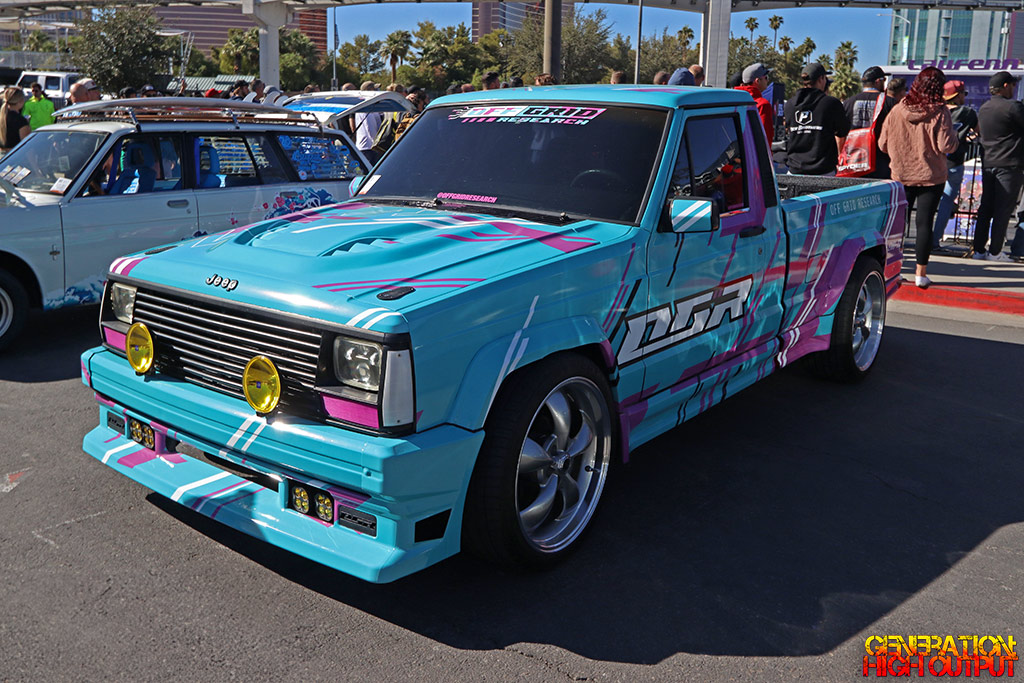
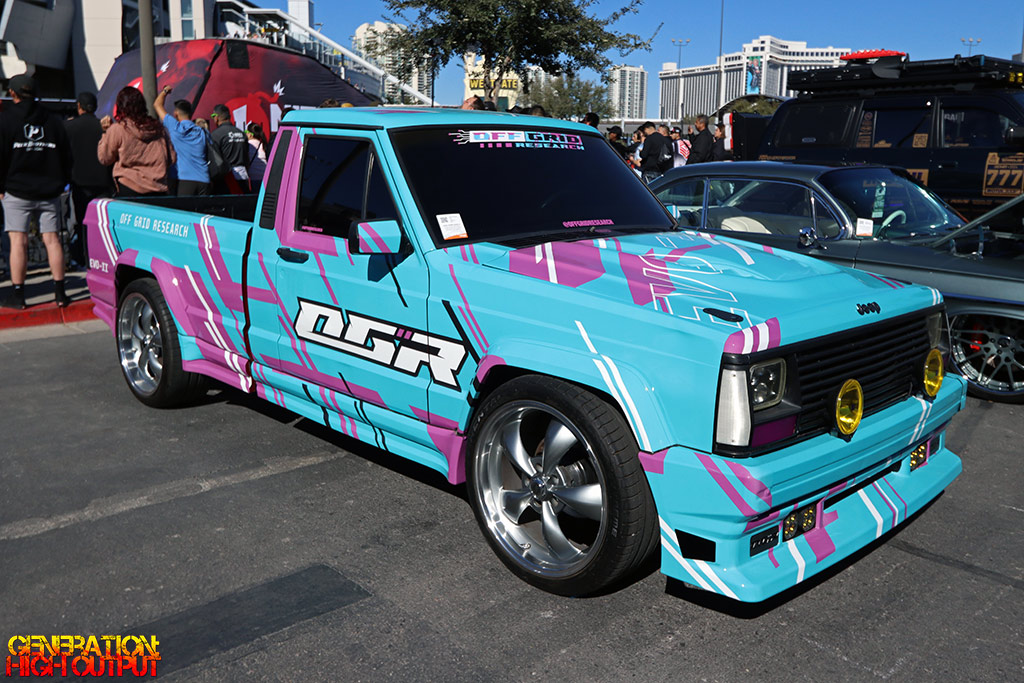
Let me be honest, after three days at the 2024 SEMA Show, surrounded by an endless sea of overbuilt lifted show trucks, carbon fiber everything, and “tuner” builds that all somehow look exactly the same, it’s easy to get a little numb. You start to wonder if originality died quietly sometime around 2016. Then, just when you’re about to call it a day and write the same story for the tenth time, you turn a corner and see something that grabs your eye: a 1987 Jeep Comanche pickup. The truck’s baby blue and pink exterior looks like it drove straight out of a VHS racing montage.

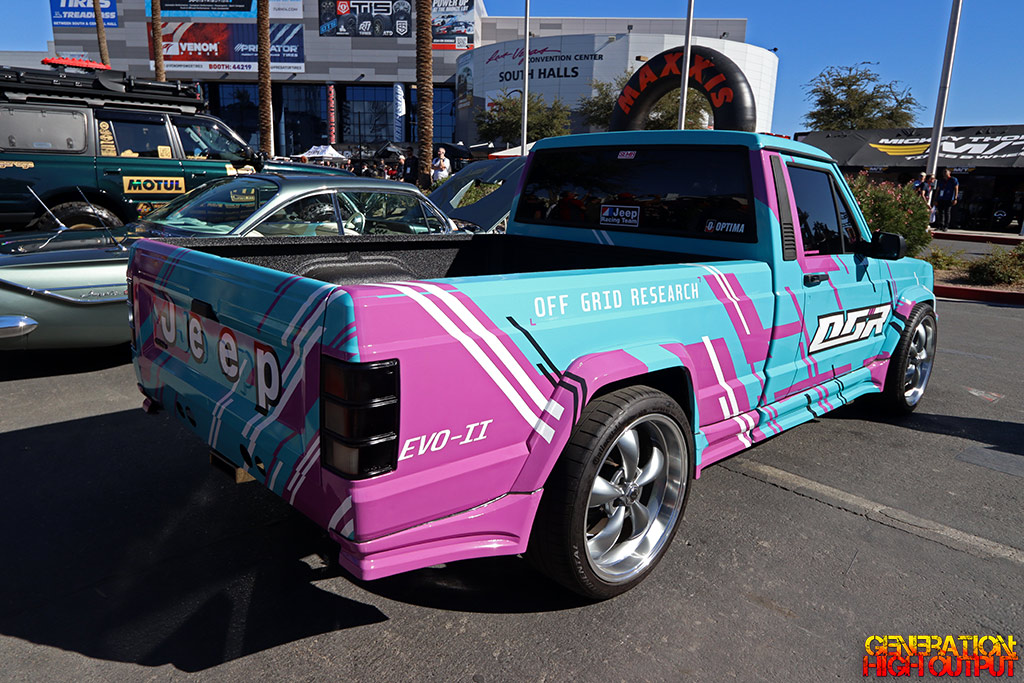
This truck was built by Nate Lanken of Off-Grid Research. This particular Comanche is no ordinary Jeep. It is one of only 100 “Street Comanche” special editions ever made, commemorating the Archer Brothers’ 1988 victory in the short-lived but delightfully weird SCCA Race Truck series (1987–1991). Most of those trucks are long gone or forgotten, but this one has been resurrected with an updated twist on the factory race truck theme.
There’s nothing cookie-cutter about this Jeep. Off-Grid Research gave the Comanche a thorough mechanical refresh while keeping its character intact. The 4.0L inline-six under the hood isn’t exotic, but it is renowned for its reliability and toughness. Paired with a 5-speed manual, a lightweight flywheel, a 6-puck clutch, and a Hurst shifter, it must be quite engaging to drive.

Cooling comes courtesy of an aluminum radiator and a CNC-machined solid fan hub, a combination that says, “Yes, this truck actually runs, and no, it won’t overheat after two blocks.”

Inside, the Comanche keeps the theme going with a pair of Corbeau limited edition racing seats. No digital screens or color-changing LEDs here, just function, form, and a throwback to when trucks were trucks and race seats meant business.

What really sets this build apart is the authenticity. The exterior features Off-Grid Research’s Evo II Body Kit and RaceRubi hood give the truck a muscular stance. The baby blue and pink wrap is a bit much, but it actually works pretty well on this truck.

The suspension has been lowered around 6 inches up front, and 5 inches the back, and it sits perfectly over a set of 20-inch American Racing Classic Torq Thrust II wheels. Finally, a build that isn’t lifted to the clouds or slammed into uselessness. It looks fast, ready, and importantly, fun.

In a show filled with open checkbook builds, endless crate engine swaps and flawless painted cars, this plucky Jeep Comanche was a breath of fresh air. The forgotten motorsports history adds an interesting note to this truck I already like, having owned one myself.

Nate Lanken and Off-Grid Research didn’t just build a truck. With the care and creativity put into this truck, it brought a little bit of personality back to the SEMA Show. And for that, I am grateful.

Check out www.ogrshop.com for more.

SEMA 2024: 1993 Chevrolet Corvette C4 Mercedes Turbo Diesel Swap – Kustom by Keck

The Malaise Era of 1975 to 1985 was a dark time for automotive enthusiasts. With new emissions and safety regulations from the Federal government, cars quickly got slower, heavier, and uglier.

The 1972 Corvette was rated at a dismal 200 horsepower, while the full-size 1977 Monte Carlo was available with a 140 horsepower 305 V8 or a 170 horsepower 350 V8. The era of the muscle car had come to an end, and a new era had begun that was focused on efficiency, not performance.In an effort to increase the average fuel economy of its fleet, General Motors experimented with smaller engines, turbochargers, and other tricks and technologies to get more MPGs.

With so much attention on smog pumps and secondary air injectors, there was one thing General Motors never built: a diesel-engine Corvette. To do so would be unthinkable; it would be a sacrilege of the highest degree. While there were many prototype and experimental vehicles throughout Corvette’s history, no customer cars ever left the production line with a diesel engine from the factory.

However, Tennessee-based Kustom by Keck has transformed his 1993 Chevrolet Corvette C4 Greenwood Edition into a diesel-powered sports car. I saw his custom Corvette at the 2024 SEMA Show, at the Air Lift Performance booth in the Central Hall.The Corvette’s original powerplant has been swapped with a 1999 Mercedes-Benz 3.0L OM606 turbo diesel engine. It is paired to a 700R4 transmission from Transmission Mafia in Gainesville, Georgia.

This is the kind of weird engine swap I would have loved reading about in Grassroots Motorsports or Car Craft magazine back in the day (after reading about V8 S10 swaps, of course).

The Corvette rides on Air Lift Performance suspension, allowing for adjustable ride height at the touch of a button to achieve the perfect stance.The exterior of the car is a visual blast from the late ’80s and early ’90s, and it’s over the top in the best way possible. The car gives serious Miami Vice vibes with its white wheels and teal and purple custom pinstripe graphics.

Kustom by Keck didn’t stop with the visuals, either. This car is filled with unique custom touches, including a standout set of custom infinity mirror taillights from RetroVette, which provide a high-tech, futuristic flair to set it apart from every other Corvette. Every corner of this C4 has been considered, detailed, and reimagined.

In a world full of LS swaps and carbon-fiber everything, this diesel-powered, 90’s throwback C4 show car breaks the mold and refuses to fit in. It’s more Radwood than SEMA, and I enjoy highlighting custom car builders that do their own thing.

This one-of-a-kind car was recently advertised for sale on social media in June 2025, with an asking price of $15,000.

For more, follow @kustom_by_keck on Instagram.

1974 Lotus Elite – Malaise Era Sports Car

The “malaise era” of the 1970s was marked by stringent emissions regulations, rising fuel prices, and economic uncertainty. While many manufacturers struggled to adapt to new safety requirements, Lotus managed to produce cars that retained their innovative edge. The Elite’s fiberglass body and efficient powertrain showcased the company’s ability to innovate despite the challenges of the time.

The 1974 Lotus Elite is a testament to British ingenuity during the automotive industry’s “malaise era.” This wedge-shaped sports car recently sold at the Barrett-Jackson Scottsdale Fall collector car auction for a very affordable price of $6,050. Let’s dive into what makes this Lotus Elite a fascinating piece of automotive history.

In the 1970s, the wedge-shaped design became a hallmark of sports cars such as the Bricklin SV-1 and a new prototype car called the DeLorean. The Lotus Elite (and its platform mate, the Eclat) offered a much more angular and geometric design, compared to the previous Lotus Elan. The Elite featured sharp, angular lines and an aerodynamic profile, which gave it a futuristic appearance for its time. Like its contemporaries from Italy, the car featured pop-up headlamps, a feature that screamed 70s sophistication and made the Elite stand out on the road.

The car’s red exterior, paired with a tan interior, provided a striking contrast that exuded classic sports car charm. Sitting on 14-inch wheels, this Lotus perfectly encapsulated the minimalist yet stylish ethos of the brand.

This 1974 Lotus Elite is powered by a 2.0-liter 4-cylinder engine, delivering respectable performance for a vehicle of its era. Paired with a 5-speed manual transmission, it offered a driving experience that prioritized engagement and agility over raw power. Lotus’s engineering focus on lightweight construction ensured the Elite remained nimble and responsive, true to the brand’s racing pedigree.

While many cars at Barrett-Jackson sell for six figures, there are still bargains to be had. With a hammer price of $6,050, this Lotus Elite represents a fantastic opportunity for collectors and enthusiasts. Though it may not command the astronomical prices of other classic sports cars, it offers a unique blend of history, design, and performance. For those looking to own a piece of 1970s automotive culture, this Elite ticks all the boxes.

The 1974 Lotus Elite is more than just a car; it’s a piece of automotive history that captures the spirit of a challenging yet transformative era. Its wedge-shaped design, pop-up headlamps, and lightweight engineering make it a standout choice for collectors and enthusiasts alike. With its recent sale at the Barrett-Jackson auction, this Elite proves that you don’t need to break the bank to own a car that is both unique and interesting.

A Three Hour Tour… Barrett-Jackson 2024 Full Walkthrough (Video)

Here is a look at every single car up for auction at Barrett-Jackson 2024 in Scottsdale, Arizona. Maybe you weren’t able to make it this year or you did attend and just want to relive the experience. Possibly you are planning on making a bid and would like another look at the car that’s caught your attention. Whatever the case may be, if you are into collector cars, this 3+ hour video is definitely for you.

SEMA 2023: 1961 Chevrolet Impala TymeleSS by Maharaj Customs

On the surface, the SEMA Show is where people from all corners of the automotive world converge to do business. But we all know why we are really there: to see amazing custom built cars.

Walking the show floow, I came across this incredible 1961 bubble top Chevrolet Impala in the Powerbass Audio booth. The car, which is nicknamed “TymeleSS” was built by Maharaj Customs with custom metal fab by Nickell’s Customs in Lodi, California.
The light minty green custom paint looks fresh and clean, and every inch of chrome was polished to perfection. There are so many custom touches to take in, like the billet hood hinges from Eddie Motorsports.

Under the hood is an LS3 engine with a dual intake setup that produces approximately 600 horsepower. It’s visible through a cutout in the hood that looks absolutely crazy. The car rides on a full custom tube chassis that was made from scratch. It does use Ridetech suspension components and rides on a set of Forgiato wheels.
The white interior really pops thanks to the upholstery by @davescustoms5441 who did the custom seats and carpet. The front bucket seats are 11-way power seats out of a Lexus that have been restyled for this car. An Ididit steering column and custom center console round out the interior.

The audio setup in this car is also very impressive. The stereo was done by Zamz Audio in Visalia, CA using all Powerbass components. There are three XMA 4250 IR 4-channel amps running a pair of L3H horn tweeters and speakers, and a PBX-DSP8 32-bit processor. The bass consists of three XMA 2000.1 Monoblock amps driving three 3XL Powerbass 15-inch subwoofers, all mounted in a custom 2-piece enclosure. This thing will be sounding good at cruise night!
The owner spent 3 years on this full custom build and restoration. Really impressed with this great car from Maharaj Customs!

SEMA 2023: 1987 Merkur XR4Ti by Jordan Henke

Captive Imports

A “captive import” is an automobile that is produced in a foreign country and imported and sold in another country under a different name or brand.

In the 1980s, Ford Motor Company Vice President Bob Lutz felt that the Ford brand should have a small, luxury-sports car to compete with European rivals like BMW. Rather than develop a new car in-house, they leaned on Ford’s European division instead.

A Sierra By Another Name

The Ford Sierra was sourced from Europe and brought to America, with an increase in power thanks to a turbocharger. Engine output was 145 hp with the automatic transmission and 175 with the manual transmission (this was the 1980s after all).

The cars were sold in North America as the Merkur XR4Ti from 1985-1989, during which time 42,464 units were built. The car failed to meet Ford’s sales goals and was retired after only four years on the market. More than 30 years later, I am always surprised at how many people within the car community have not heard of the Merkur XR4Ti.

1987 Merkur XR4Ti Custom

I’ve been a fan of the bodystyle for years, as well as pretty much anything with a turbo from the 80s. When I saw this XR4Ti in the Battle of the Builders area at SEMA 2023, I was immediately drawn to it.
The first thing I noticed was the color – Ford’s “Area51” Blue with highlighter orange accents. They coordinate well together and provide a unique look to the car. It rides on a set of American Racing VF529 wheels finished in black, though personally I feel that silver would have stood out better. A set of Toyo Proxes tires provides the necessary grip when cornering.

The next thing I noticed was the wide flares over the wheel arches. The XR4Ti was never available in a widebody version – this one was completely custom made by Jordan Henke and his team at JH Restorations in Windsor, Ontario. They 3D scanned the car and made their own widebody kit and carbon fiber hood – technology that is commonplace today but would have been unimaginable in the late ’80s.

Every inch of this car has been upgraded with modern components and technology. The original engine was replaced with a Ford 2.3L Ecoboost turbo engine coupled to a Tremec TKX five-speed transmission and an 8.8 rear differential from a 2018 Mustang. I like that the 2.3L Turbo engine remains true to the original spirit of the car.

The suspension was also completely re-engineered and is based on Corvette C6 hubs with QA1 coilovers. Integrated into that are 14-inch disc brakes from Wilwood, front and rear.

The interior is a comfortable place to be. The retro-style Recaro racing seats are wrapped in leather with Recaro fabric seat inserts. A set of custom Dakota Digital gauges provides the driver with all of the necessary information.

Jordan Henke made it to the Top 10 Finalists at the 2023 Battle of the Builders at SEMA – an impressive achievement!

For more information, check out JH Restorations: https://www.facebook.com/jhrestorations