Stay up to date on the latest news about the Barrett-Jackson Collector Car Auction. Every year we cover the Scottsdale Auction with photos and information.
With so much nostalgia online for the 1980s and 1990s, here’s one only the real ones will remember: the GEO automotive brand. GEO was a short-lived partnership between General Motors and three Japanese automakers: Toyota, Isuzu, and Suzuki. Sales were discontinued in the U.S. after just eight years.
One of the better-selling GEO models was the Tracker, a mini SUV that initially was a four-wheel drive vehicle, with a two-wheel drive model introduced later.
The cars were equipped with a wheezy 1.6-liter engine that coughed out about 96 horsepower on a good day. While the Tracker was light and nimble, it was very underpowered.
Jon Moss was the head of GM’s Special Vehicle Group. They cooked up a one-off concept called the GEO Dirt Tracker. The original 95 horsepower engine was replaced with a 3.4-liter L32 V6 engine from the Chevrolet Camaro making 200 horsepower.
Coupled to this is a 4-speed automatic transmission, and an all-wheel drive transfer case from an Oldsmobile Bravada.
What they created is a capable off-roader that can sprint from 0 to 60 in 8.5 seconds. The vehicle was reviewed by Motor Trend Magazine in August 1996, and they praised the Dirt Tracker, calling it a “well-finished machine that presents some tantalizing possibilities for a toughened Tracker image.”
Well, GEO ceased production in North America by 1998 and the remaining models were sold as Chevrolets. The Dirt Tracker was to only be a one-off concept vehicle and not a production model.
This 1-of-1 concept car recently appeared at the Barrett-Jackson Scottsdale Fall 2024 auction with just 1,365 miles on it. Barrett-Jackson is one of the only places you can see and bid on concept vehicles like this one!
This unique car sold for $12,100, including the buyer’s premium.
Demand from both buyers and sellers has been pushing the collector car market to new highs in recent years. In January 2024, Barrett-Jackson filled all of their consignment slots in record time. This prompted the Arizona-based auction company to launch a new Scottsdale Fall auction, which took place Oct. 10-13, 2024.
The new Scottsdale Fall auction was a smash success, any way you look at it. The catalog featured 794 vehicles and more than 400 pieces of collectible memorabilia over the three-day auction.
Collector Car Sales
Collector car sales were strong, with a 99% sell-through rate and total sales of more than $55 million. American muscle cars from the 1960s-1990s dominated the catalog, with many examples of Mustangs and Corvettes on offer.
Auction Atmosphere
The Scottsdale Fall auction had a different feel than the larger January auction. For one thing, it felt weird to be at Westworld when it was hot outside. The temperature was noticeably warmer in October than in January.
There were about half as many cars as there were during the January auction, which was also noticeable.
Finally, the crowds were smaller, especially during the daytime on Thursday and Friday. I enjoyed the auction event more with fewer people present, which meant shorter lines for food. However, many of the food vendors were not open on Thursday and Friday, leaving fewer options to choose from.
Bugatti Chiron Falls Short of the Reserve Price
One of the star vehicles consigned to sell was a 2018 Bugatti Chiron hypercar, formerly owned by Super Middleweight boxing champion of the world, Saul ‘Canelo’ Alvarez. The 34-year-old fighter has a collection of 10+ supercars and muscle cars as well as several motorcycles.
The Chiron was previously listed with DuPont Registry in 2022 with an asking price of $3.9 million and showing 1,520 miles on the odometer. In late 2024, the auction listing stated 1,668 miles. That works out to just 148 miles driven during the last two years – truly a garage queen.
The car features an 8.0 liter W16 engine with four turbochargers, producing a staggering 1,479 horsepower and 1,180 ft-lbs of torque. The car can dash from 0-60 mph in 2.5 seconds and achieve a top speed of 261 mph.
Barrett-Jackson does not do appraisals for auction cars. Bidding for the Chiron started at $250,000 and quickly jumped up past a million dollars. The high bid was $2.3 million which did not meet the reserve price, and the car did not sell. Several months earlier in January, Barrett-Jackson sold a different 2018 Chiron for $2.97 million. I was disappointed that this one did not sell, as I would have liked to see a new owner for this incredible car.
Sammy Hagar Sets a Record for Ferrari LaFerrari
Another featured car that crossed the block on Super Saturday was the 2015 Ferrari LaFerrari owned by rocker Sammy Hagar.
The car is one of just 499 units built, and the only one finished in a cream exterior color with cream-colored seats over a black interior.
The car was originally consigned to sell at the January 2024 auction but was removed so that the car’s hybrid battery pack could be replaced. The work was completed at Ferrari of San Francisco during the summer. Unofficial sources online put the cost of the replacement battery pack at approximately $30,000, though the repair cost was not mentioned in the listing.
With an original MSRP of $1.5 million, the LaFerrari has appreciated rapidly, with a median sale price of $3.3 million in recent years. On Super Saturday, October 12th, Sammy Hagar’s Ferrari hammered for a record $4,250,000 or $4,675,000 including the buyer’s premium.
Get Ready for the Next Event
While the Scottsdale Fall auction has ended, the Arizona-based auction company is already gearing up for the next event, January 18-26, 2025. Follow Generation High Output for more updates.
The Chevrolet Corvette is sort of like a ’32 Ford or a ’49 Mercury in that it has become a canvas for others to customize. It is a starting point where people they feel they can improve. Some companies like Callaway and Lingenfelter have used this formula to great success. It is still a Corvette, but with a little more power and a little more style.
Others have tried to follow the same path, but have not found commercial success. One such company was Avelate, which was formed by former GM designer Don Johnson and Dean Arnold. According to the website CorvSport.com: “The Avelate borrowed some design inspiration from the previous Corvette generations and incorporated all of them into the C5 model. Initially, the plan was to make 100 cars per year, but throughout its production run, only 25 examples were only built.”
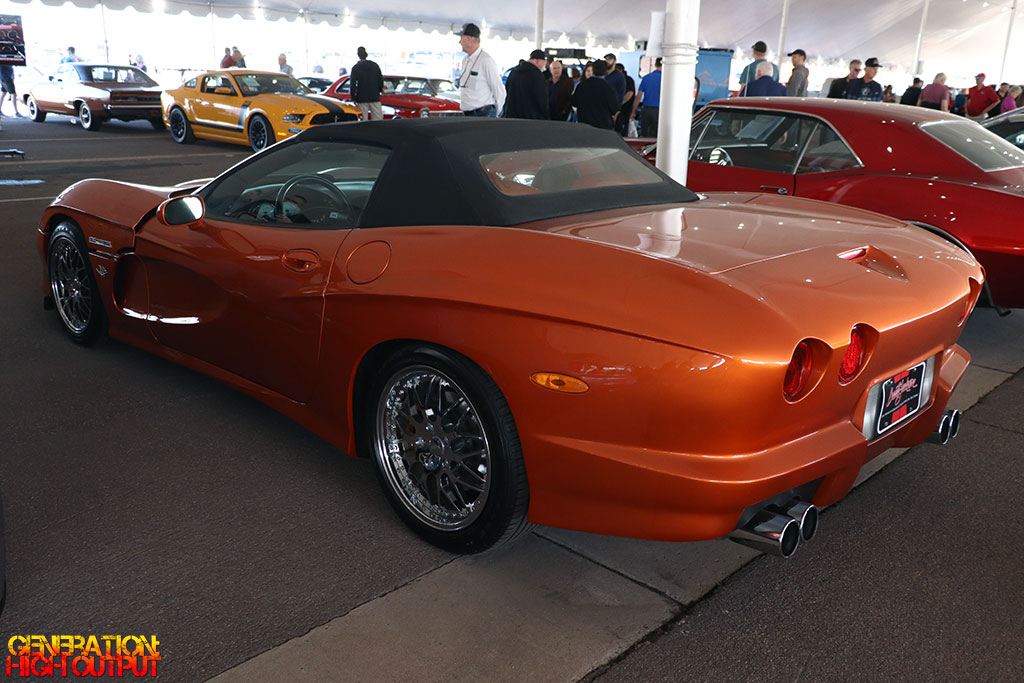
The auction description says that this 2000 Chevrolet Corvette Avelate Z06 convertible is one of 27 builds produced between 2000 and 2002. It is finished in Copper Pearl with a black convertible top. The car has a 6-speed manual transmission. It was consigned to sell at the Barrett-Jackson Scottsdale auction in January 2024.
The car has the stock windshield and side glass, though it has a custom body including door skins, hood, trunk, and front and rear bumpers. Studying the car, I see a C3-styled front end and C1-style scallops on the doors.
This car has Avelate logo floor mats and retro-style Fuel Injection and Corvette badges on the fenders. It’s got a lot of customizations that make it unique from the herd of production C5s, but do the cosmetic customizations make it any better than a regular Z06? Honestly…no, they do not.
That sentiment was reflected in the final hammer price of $29,700 which is exactly in line with the prices of a C5 Z06 on Bring A Trailer. Only super low mileage cars go for more, and this car had 31k miles at the time of auction.
The Avelate Corvette is a unique curiosity for the right buyer, and another notch in the belt of small production manufacturers who thought they could do better than the OEM.
The doom and gloom of the pandemic is over. Everywhere I turn, I am hearing news stories about travel returning to pre-pandemic numbers. The most predicted economic recession in history seems, for now at least, to have been avoided, replaced instead by the “soft landing.” Supply chains are getting back to their new normal. Consumer confidence is high, and so is consumer spending.
But this isn’t an economics website, it’s a car blog. So what does this have to do with the collector car market? Well, strong consumer confidence may have played a big role in the recent Barrett-Jackson 2024 collector car auction in Scottsdale.
Barrett-Jackson broke several of their own records for most cars sold, overall sales, and sell-through rate.
Total Consignments: In recent years, the Scottsdale auction catalog has averaged 1,600 to 1,800 vehicles. For 2024, there were a total of 2,016 vehicles consigned to sell at the auction. The previous record was 1,907 vehicles sold at the 2023 Scottsdale auction.
Sell-Through Rate: The Scottsdale 2024 auction had a 100% sell-through rate, meaning that every one of those cars sold. There were no lots which did not receive any bids.
Total Sales: Barrett-Jackson recorded automobile sales of $200.9 million and an additional $6.7 million for automobilia, for a combined auction sales of $207.6 million. The previous record was $184.2 million combined sales at the 2023 Scottsdale auction.
World Record Sales: More than 190 lots set world record prices.
In fact, demand is so high that the company has announced a second Scottsdale auction event to take place in the fall, from October 10-13 at Westworld. The fact is, the four day auction is necessary because Barrett-Jackson is hitting the limit of cars they can consign to the January auction. The second auction is necessary to meet the needs of consignors and bidders alike.
We will be there to cover the action and excitement, so subscribe to Generation High Output to stay in the loop!
Being an Oldsmobile fanatic, I subscribe to the theory that the 1949 Rocket 88 with it’s 135hp, 303 cubic inch OHV V8 is the original muscle car. To many others the original muscle car is the Pontiac GTO, and I can’t say that I have a good reason to disagree. The formula is simple: Take a mid-sized car and stick the larger engine from the full-size car in it. Add a couple extra go fast parts and a stick shift and you’re literally off to the races.
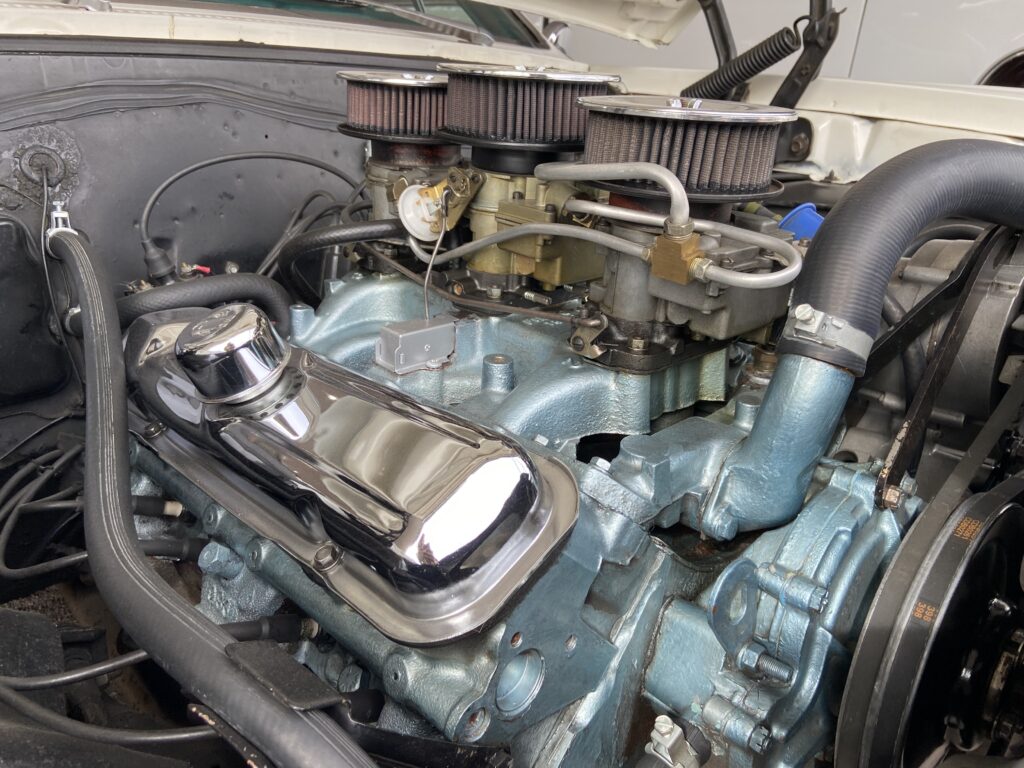
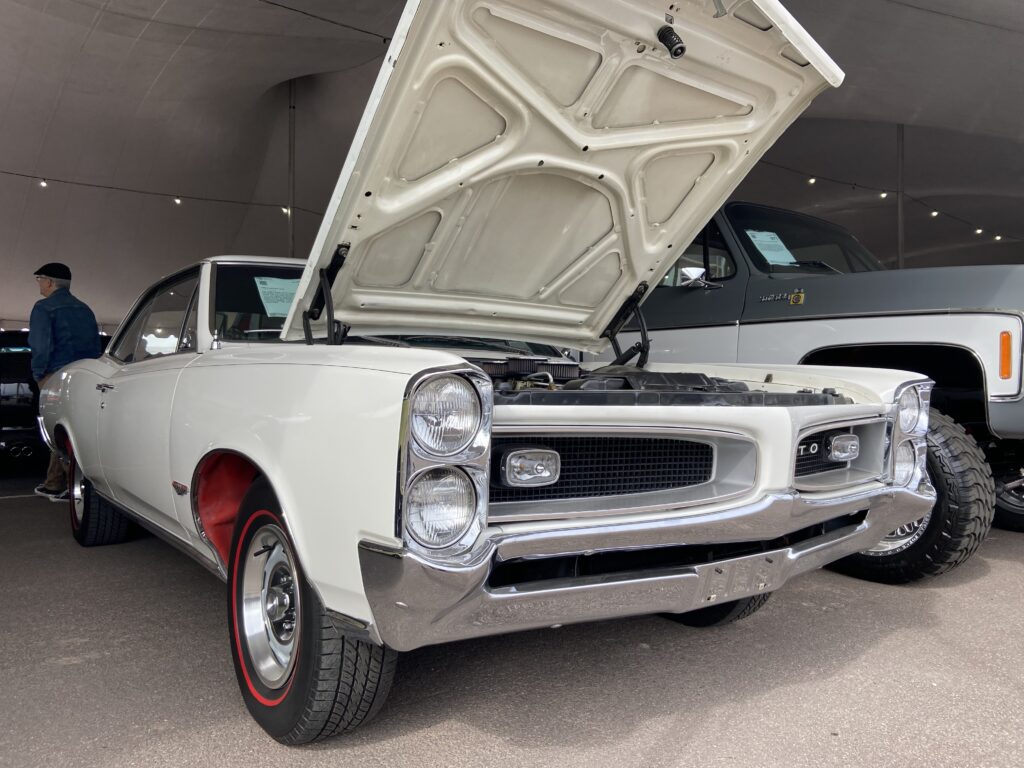
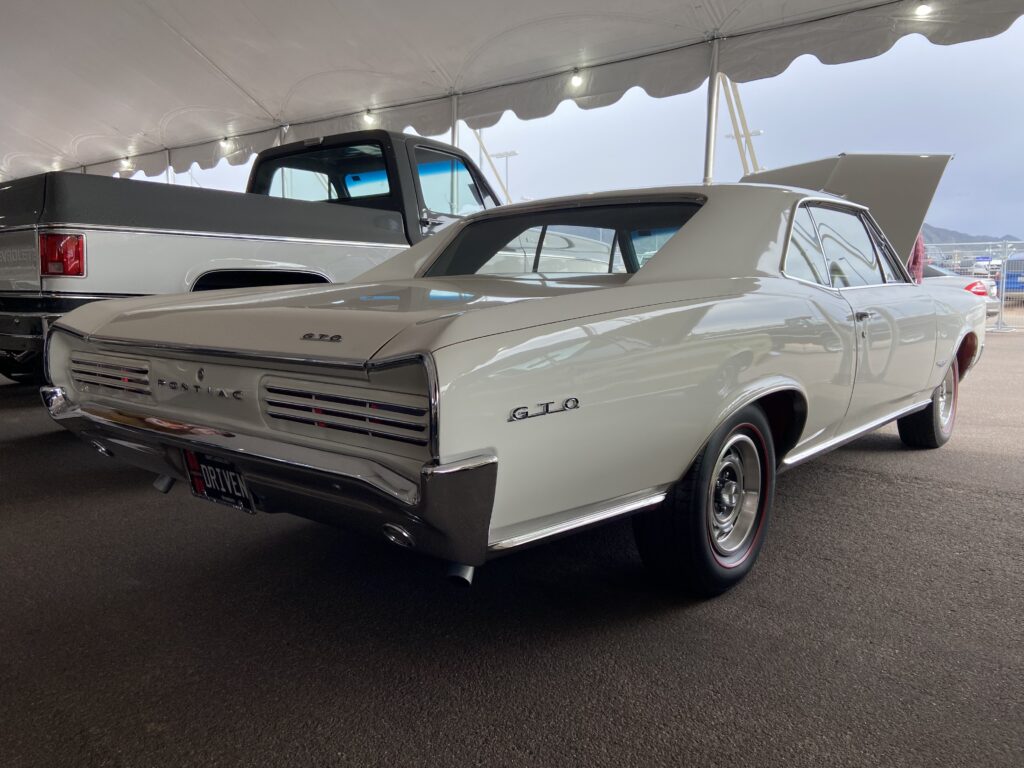
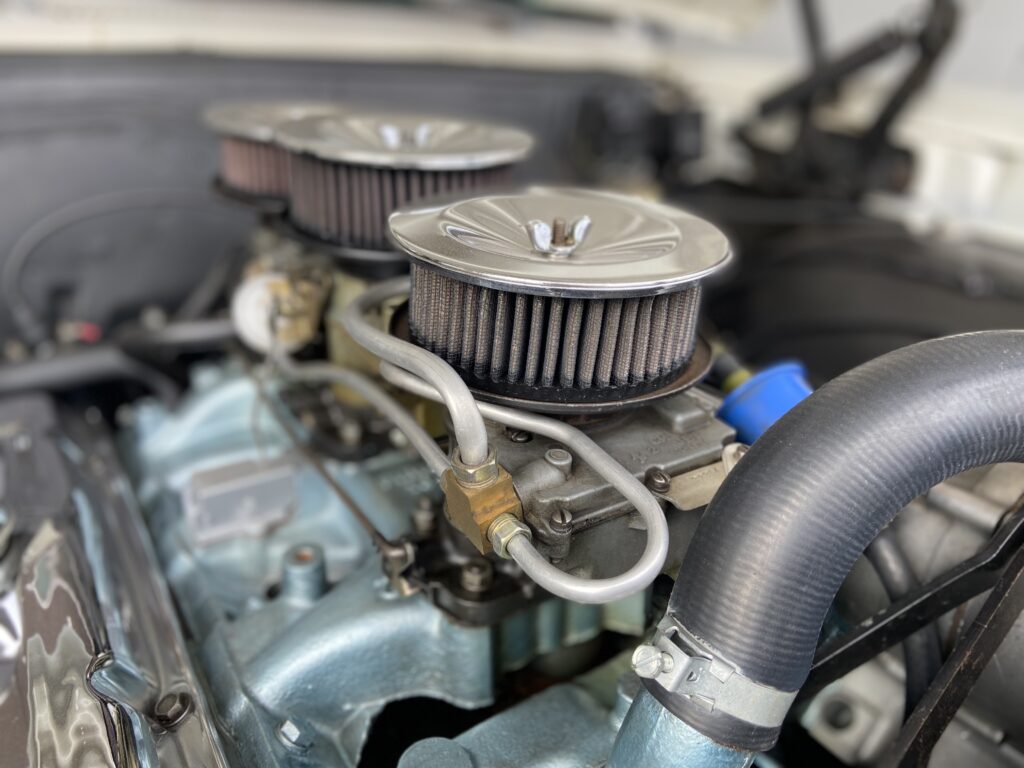
The Pontiac GTO began life in the early 60’s as a trim model of the Pontiac LeMans/Tempest. Using a creative loophole that circumvented the rule GM had about maximum displacement in midsized cars, Pontiac utilized the 389 V8 and offered it as the GTO option. I think that the Hurst 4-speed manual and tri-power carburetor setup on the 389 is the epitome of factory muscle car, and this 1966 model is the last year you could get this pairing. It was good for a gross rating of 360hp, and that could get you to the end of the 1/4 mile in 14 seconds flat.
Speaking of options, the ’66 GTO was also the first production car with a plastic grill, and this particular model came optioned with a 3.55:1 limited slip differential as well as the “Ride and Handling” package.
The GTO peaked in 1970 with the 455HO model and performance would be downhill until the GTO was relegated to a trim package on what was a badge-engineered Chevy Nova. The X-body platform Ventura took on the GTO name in 1974. An unceremonious end to the spark that ignited the muscle craze, this model would option the car with a 3-speed manual and 200hp V8.
Pontiac would then shelve the name, reviving it decades later for the Holden Monaro imports that lasted a couple years. Say what you will about the exterior styling, even the lesser 350hp 2004 GTO would lay waste to any prior car to bear the namesake. However it only remained in production in the US market until MY2006. Pontiac itself was retired not too long after in 2010.
This particular Goat was retired from the auction block at $66,000.
The transition from the C3 Corvette of 1968-1982 to the C4 Corvette of 1984-1996 was a bit of a production palpitation for Chevrolet’s flagship sportscar. Model year 1983 essentially didn’t exist and when the 1984 model finally came out it had a modern exterior and interior, new chassis and a novel 4+3 computer-controlled manual transmission with automatic overdrive.
…and also the pathetic Crossfire 350 engine carried over from the C3 Corvette. This 5.7L housed a camshaft that would soon make the 5.0L a serious performer in the third generation F-bodies. It was also topped off with a combined 750 CFM from the TBI units. By 1980’s standards this should have been a recipe for decent power. Instead RPO L83 with it’s convoluted dual-TBI cross-ram was the impetus of the bad reputation that the fourth generation Corvette received.
So how did we end up with just 205hp at 4,300 RPM? Many blame the flow potential of the intake itself, with obstructed peanut ports limiting the airflow to less than 500 CFM before it hit the heads. I would also speculate that the factory 624 heads with their low-velocity ports and primitive chamber design play a large factor in the motors gutless reputation.
That being said I have slowly come to appreciate the idiosyncrasies of the Crossfire 5.7L, even if only for it’s unique intake design and boxy cover. For performance purposes we can be thankful it was only available in the C4 for 1984. From 1985 to 1996 the TPI, LT1, LT4 and LT5 variants would emerge: Engines that would restore the Corvette’s reputation as the ultimate American sportscar. This was the generation of the naturally aspirated, all aluminum, 32-valve 405hp V8. The King of the Hill.
A hill that started as a mound back in 1984 with a paltry 205hp.
This particular 1984 C4 Corvette with it’s 700r4 automatic overdrive and 16,000 original miles finished it’s auction run at Barrett Jackson Scottsdale topping out at $13,200.


 With so much nostalgia online for the 1980s and 1990s, here’s one only the real ones will remember: the GEO automotive brand. GEO was a short-lived partnership between General Motors and three Japanese automakers: Toyota, Isuzu, and Suzuki. Sales were discontinued in the U.S. after just eight years.
 The cars were equipped with a wheezy 1.6-liter engine that coughed out about 96 horsepower on a good day. While the Tracker was light and nimble, it was very underpowered.
 Well, GEO ceased production in North America by 1998 and the remaining models were sold as Chevrolets. The Dirt Tracker was to only be a one-off concept vehicle and not a production model.