Cars and Coffee is a monthly gathering that is held in major cities around the US. This free event is open to all makes and models of vehicles, and brings together people who share a passion for cars and coffee. Most of these posts are from Cars and Coffee in Scottsdale, Arizona.


1988 Mosler Consulier GTP-LX

What if I told you that there was a supercar from the 1980s that cost less than the Lamborghini Countach and the Ferrari Testarossa and could outrun them both on a race track? And what if I told you that this car could also yield 30 miles per gallon? You would probably think I was crazy.

Well, such a car does exist and in theory, it sounds fantastic. However, there is just one drawback to the Mosler Consulier GTP…the way it looks.
Continue reading

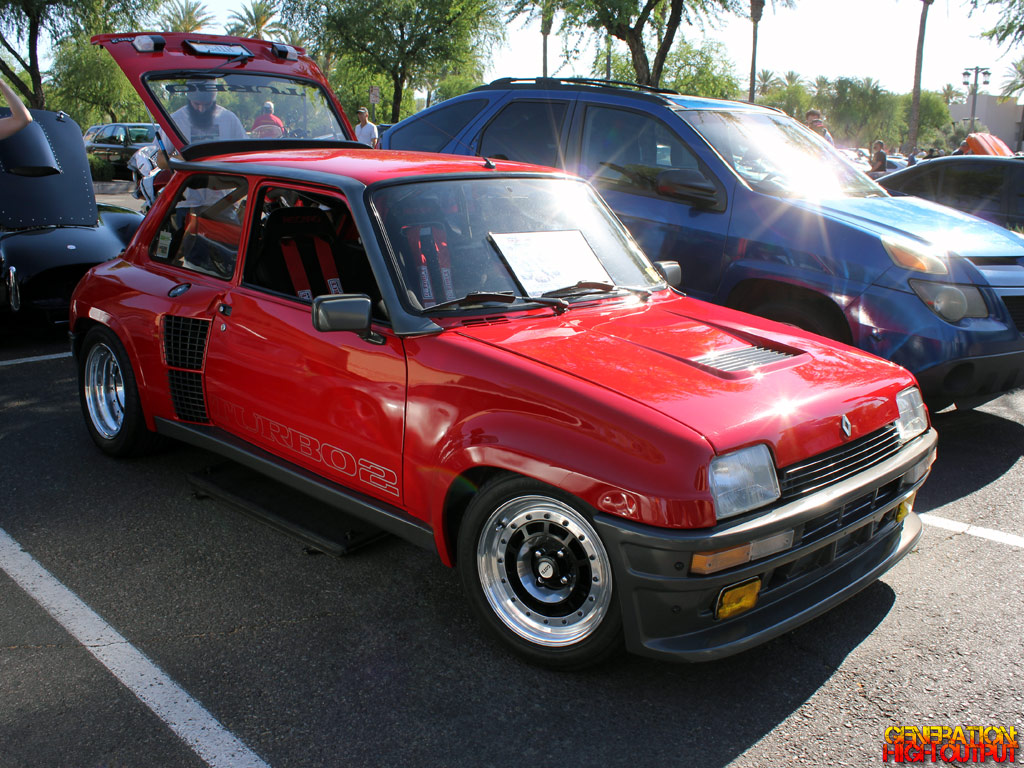
1985 Renault 5 Turbo II Rally Car

In an earlier post about the Lotus Cortina I explained the idea of homologation – whereby manufacturers must build and sell a minimum number of cars to the public in order to qualify as a “production car.” Here we have another example of a factory-built race car that was sold to the public, and this one is even more extreme.

It’s called the Renault 5 Turbo II and like many of the cars I have covered recently, this is another rare specimen from Cars and Coffee. So what’s the deal with this car, and how did it come to be?

Continue reading

Volkswagen Beetle with Chevy V8 Swap

As one of the most iconic cars in history, the Volkswagen Beetle and its air-cooled engine are revered around the world for its utter simplicity. These cars are small, efficient, and easy to work on. But when it comes to power and acceleration, they are severely lacking.

This enterprising car owner took it upon himself to do something about it. What he’s done is removed the original flat-four engine in the back of the car and replaced it with a big American V8 in the front! From my eye, it looks to be a small block Chevy motor – probably a 305 or 350.

Continue reading

1965 Oldsmobile Starfire Hardtop Coupe

Back in the early 1960s, Oldsmobile wanted to build a full size sports-luxury coupe to compete with the Ford Thunderbird. They came up with the Starfire, which borrowed its name from the Lockheed F-94 airplane of the same name. Known for its tremendous speed, the F-94 was the first US production jet to come with an afterburner.

Oldsmobile’s Starfire was based on the Eighty-Eight and when it went into production in 1961, it was the most powerful and most expensive car they offered. What made this car special was its 425 cubic inch (7.0L) Rocket V8 engine, which was only used in the Starfire and the Jetstar. With a Rochester 4-barrel carburetor, the engine put out an easy 370 horsepower.

Continue reading

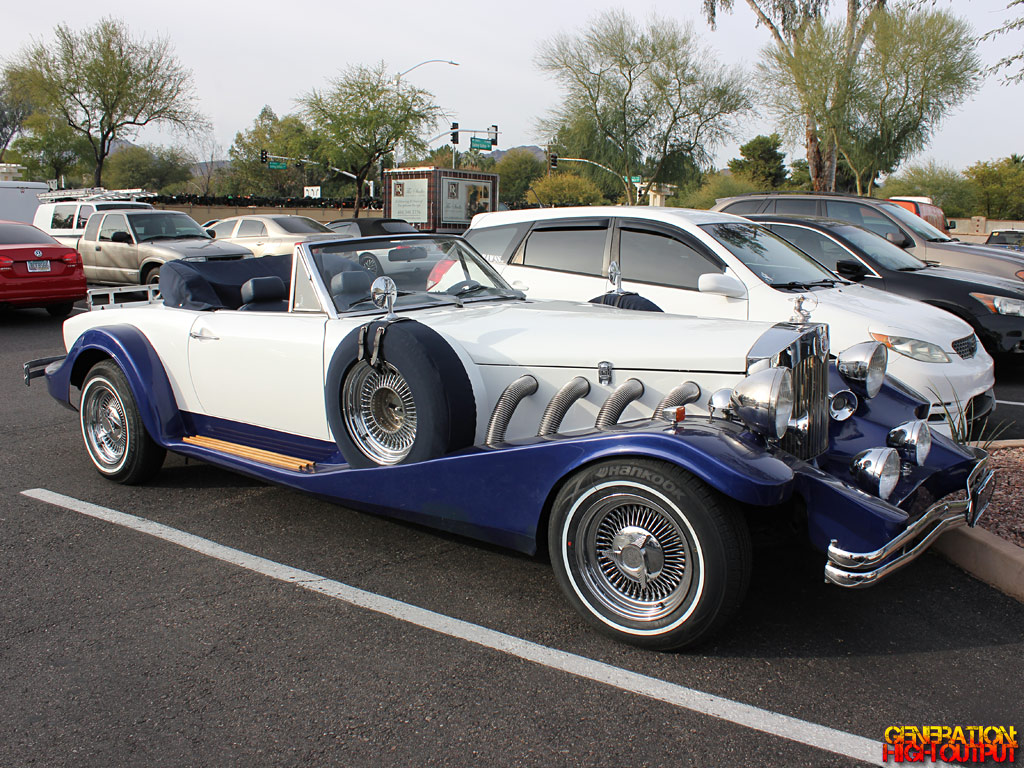
Archer Neoclassic Car

The 1970s through 1990s were a heydey of kit car manufacturing in the United States. It seemed like everybody and their brother was offering turn-key vehicles based on Chevrolet platforms. Looking back, I have to wonder if there was really enough demand in the market to support all of these companies?

The answer of course, is no. Save for a few, nearly all of the kit car manufacturers have  gone out of business. Some companies such as Zimmer have survived (in one form or another) for decades, while others were just a blip on the radar. Such was the case with Archer Coachworks out of Valparaiso, Indiana.

Continue reading

1966 Lotus Cortina MkI

Bentley. Aston Martin. Jaguar. Lotus.

They’re all British car companies, but more importanly, they all have factory-sponsored racing teams. For decades, these companies have battled it out on the racetrack in everything from Formula 1 racing to grand touring to group racing.

What these companies would typically do is take one of their production cars and modify it to compete in a specific class of racing. There is one catch, though. Auto manufacturers are required to build a minimum number of vehicles and sell them to the public in order to classify as a production car. This practice, known as homologation, means that a small number of factory-built race cars will make it out into the real world – completely road legal. This is exactly what happened in the 1960s with the Lotus Cortina.

Continue reading