If you saw my last post about the Chrysler TC by Maserati, you know the background leading up to the highly competitive luxury coupe market of the late 1980s and early 1990s. Today, we’re going to take a look at Buick’s short-lived attempt at cracking into this market segment.
The Reatta was a two-seat coupe that went on sale in 1988. Like the Chrysler TC, it was intended to be a top-of-the-line model, available at a premium price. Though the Reatta is in the same vehicle segment as the TC, Buick’s approach was completely different from Chrysler’s. Continue reading →
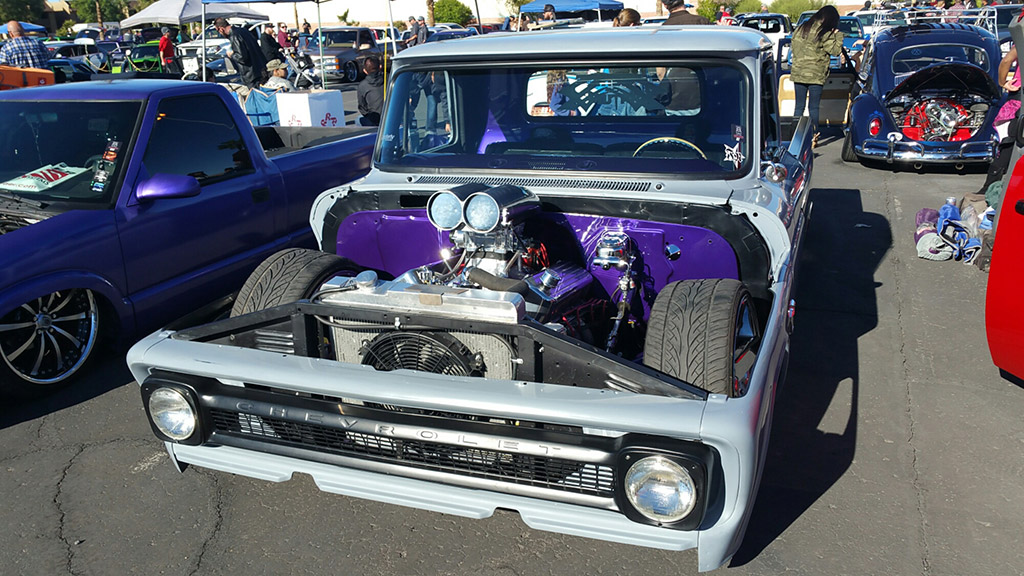
This truck feels like what would happen if for some reason all of the individual, fragmented automotive obsessions I have gone through in the past couple of years somehow manifested themselves into one fever-dream of an automotive singularity. And it turned out pretty damn cool.
Bryan bought this Mark VIII from a guy who had sucked a bunch of water into it after a heavy rain. For some reason, we felt that we needed to try and get the water out of it at 1:30 in the morning in the parking lot where the previous owner had left it.
This isn’t really a how to video. Actually, it’s kind of more of a how not to.
Do you remember Goolsby Customs from Bessemer, Alabama? A while back, we covered their 1969 Camaro Convertible build from SEMA 2013. They were back at SEMA 2015 with an all-new creation: a 1969 Ford Mustang. The car belongs to Tim and Cici Spencer, and we couldn’t wait to check it out!
Gone are the days when building a hot rod meant swapping in a junkyard motor and some bolt-ons to any old jalopy. The collector car market is now dominated by elite restoration shops that completely deconstruct and reassemble the classics of yesterday as modern hot rods. These cars are adorned with precision machined parts, exotic materials like titanium and carbon fiber, and one-off fabricated parts. In many cases, these frame-off resto-mods may take one to three years to build and cost upwards of $150,000 or more!
Hot rodding has become an over-the-top, “mine’s-bigger-than-yours” competition of insane proportions. The latest example of this comes from SpeedKore Performance in Grafton, Wisconsin. Their 1970 Dodge Charger “Tantrum” is one of the wildest custom car builds I have ever seen.
In 1970, the only people working with carbon fiber would have been the aviation industry and NASA. This space-age material is incredibly lightweight and strong. At the time this car rolled off the production line, it would have been unthinkable to have such materials in a passenger car. But that’s exactly what Speedkore have done: carbon fiber hood, front fenders, and bumpers.

 If you saw my last post about the Chrysler TC by Maserati, you know the background leading up to the highly competitive luxury coupe market of the late 1980s and early 1990s. Today, we’re going to take a look at Buick’s short-lived attempt at cracking into this market segment.