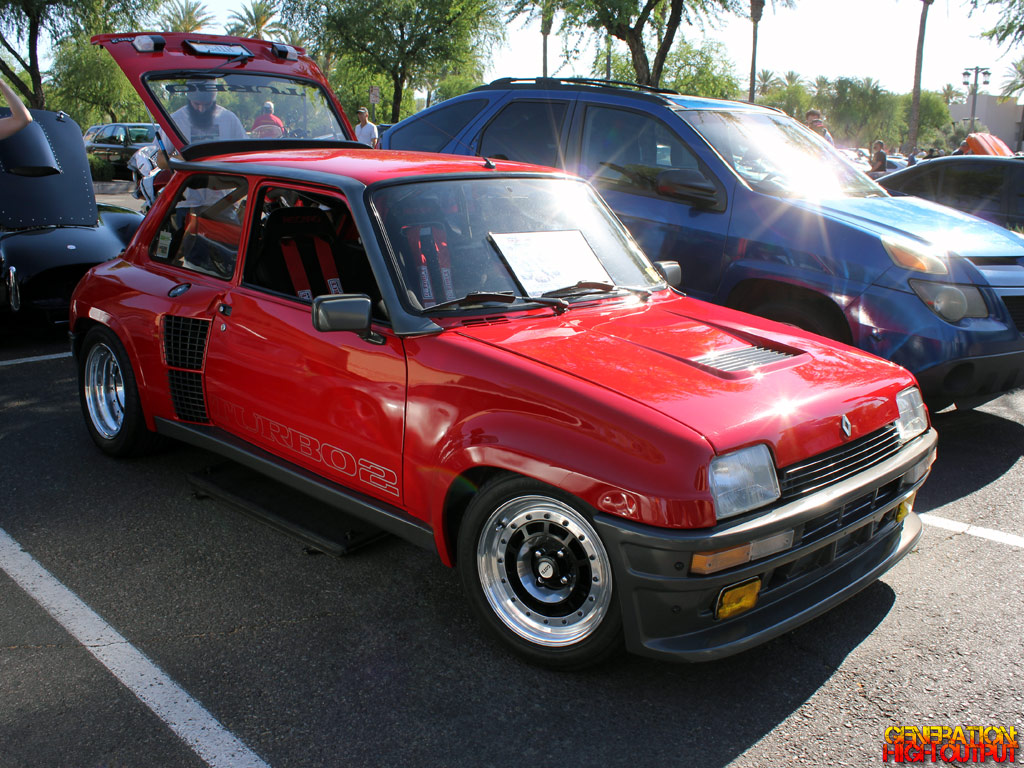
1985 Renault 5 Turbo II Rally Car

In an earlier post about the Lotus Cortina I explained the idea of homologation – whereby manufacturers must build and sell a minimum number of cars to the public in order to qualify as a “production car.” Here we have another example of a factory-built race car that was sold to the public, and this one is even more extreme.

It’s called the Renault 5 Turbo II and like many of the cars I have covered recently, this is another rare specimen from Cars and Coffee. So what’s the deal with this car, and how did it come to be?

Continue reading

Volkswagen Beetle with Chevy V8 Swap

As one of the most iconic cars in history, the Volkswagen Beetle and its air-cooled engine are revered around the world for its utter simplicity. These cars are small, efficient, and easy to work on. But when it comes to power and acceleration, they are severely lacking.

This enterprising car owner took it upon himself to do something about it. What he’s done is removed the original flat-four engine in the back of the car and replaced it with a big American V8 in the front! From my eye, it looks to be a small block Chevy motor – probably a 305 or 350.

Continue reading

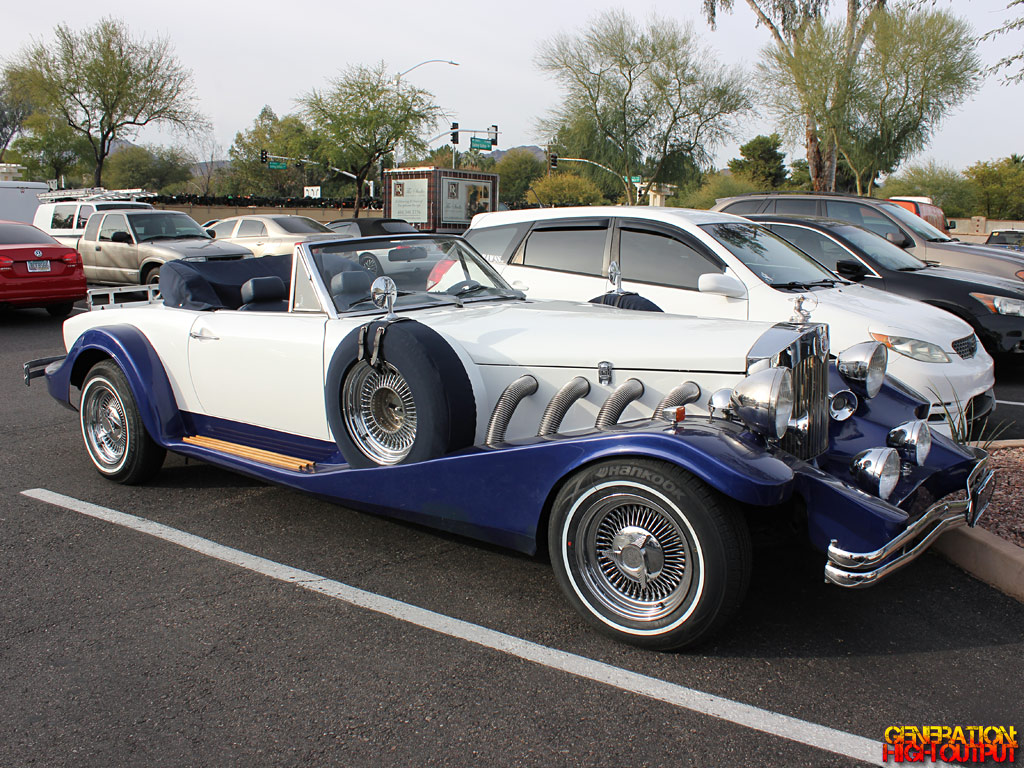
Archer Neoclassic Car

The 1970s through 1990s were a heydey of kit car manufacturing in the United States. It seemed like everybody and their brother was offering turn-key vehicles based on Chevrolet platforms. Looking back, I have to wonder if there was really enough demand in the market to support all of these companies?

The answer of course, is no. Save for a few, nearly all of the kit car manufacturers have  gone out of business. Some companies such as Zimmer have survived (in one form or another) for decades, while others were just a blip on the radar. Such was the case with Archer Coachworks out of Valparaiso, Indiana.

Continue reading

1966 Lotus Cortina MkI

Bentley. Aston Martin. Jaguar. Lotus.

They’re all British car companies, but more importanly, they all have factory-sponsored racing teams. For decades, these companies have battled it out on the racetrack in everything from Formula 1 racing to grand touring to group racing.

What these companies would typically do is take one of their production cars and modify it to compete in a specific class of racing. There is one catch, though. Auto manufacturers are required to build a minimum number of vehicles and sell them to the public in order to classify as a production car. This practice, known as homologation, means that a small number of factory-built race cars will make it out into the real world – completely road legal. This is exactly what happened in the 1960s with the Lotus Cortina.

Continue reading

1984 Toyota Celica GT Rally Car

There is a car show held once a month in Scottsdale where people gather to drink coffee and show off their high-end exotic cars. I skipped right past the rows of Ferraris and Porsches to go check out this 1984 Toyota Celica GT (yes, seriously).

I took one look at the car and could tell right away that something special was going on here. For one thing, it’s a lifted car! Aside from an AMC Eagle or a Subaru rally car, you don’t often see cars with this much ground clearance! I snapped some photos and looked around for the owner who was nowhere to be found.

Continue reading

Matte Orange 2007 Bentley Continental GT

To an average person on the street, a Bentley and a Rolls-Royce are pretty much the same thing: a very expensive car for rich people. However, the two cars actually serve very different purposes. A Rolls-Royce is a car for you to be chauffeured around in, while a Bentley is a driver’s car.

Bentley has a long tradition of racing heritage going back to the company’s founding in 1919. Bentleys won the 24 Hours of Le Mans race five times between 1924 and 1930. Facing bankruptcy during the Great Depression, Bentley was acquired by Rolls-Royce in 1931.

Continue reading