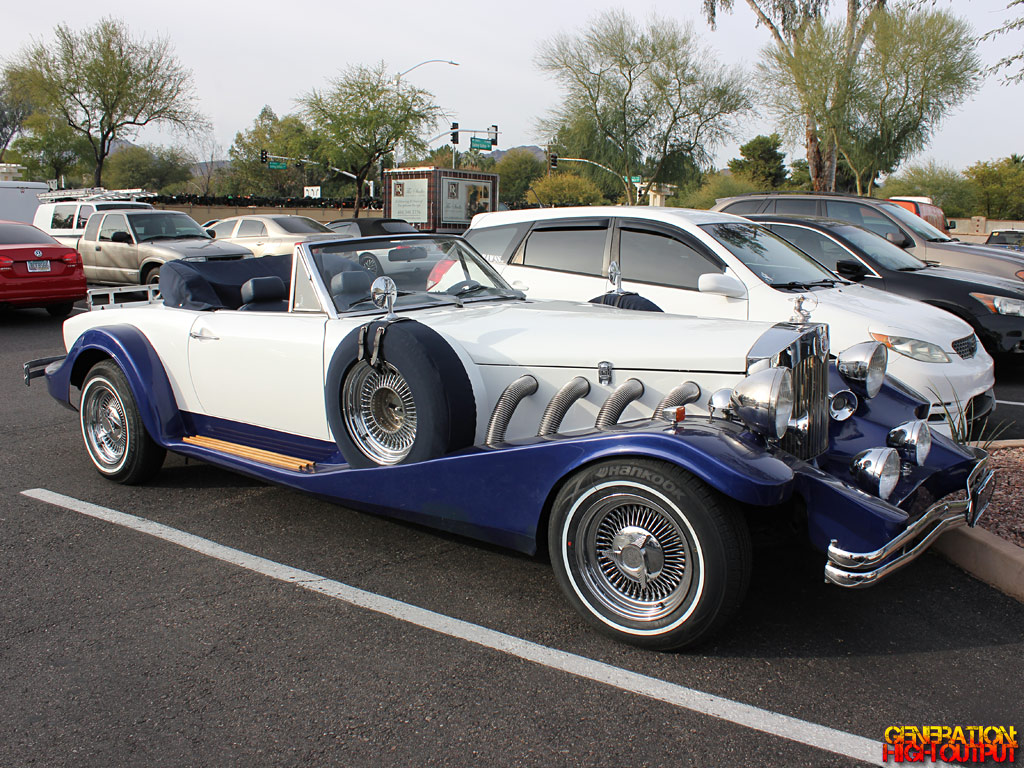
1999 Shelby Series 1 Convertible

Carroll Shelby will forever be remembered as the man who put Ford V8 engines into AC Cobras in the 1960s, and as the man who souped up Mustangs and other cars for auto manufacturers. For most of his career, Shelby advised or improved upon other people’s projects. What if he set out to design a car of his own? What would it look like? Ladies and gentlemen, the Shelby Series 1 Convertible.

This car has the distinction of being the only car designed, engineered, and built from the ground up by Carroll Shelby. It’s kind of an odd-looking car, though you can tell by looking at it that the fit and finish are too good to be a kit. Only 249 of these vehicles were produced, making them extremely rare. This luxury roadster originally cost $180,000 when it came out in 1999. This particular car belonged to Jamie Navarro, pitcher for the Milwaukee Brewers.

Continue reading

High Belt Line: A Modern Atrocity

As of this post the average age of our staff is twenty-eight, with myself being the youngest. This fact may seem like it has little to do with car design, but from the perspective of someone who goes crazy over the right shapes, I hope it foreshadows the tone of my dissenting opinion against current car aesthetics.

I hate the high belt lines and short windows on today’s cars. Continue reading

1965 Ford Mustang GTS Fastback ‘Bad Apple’

While walking around at Barrett-Jackson 2014, I spotted this ’65 Mustang Fastback nicknamed “Bad Apple.” Honestly, it looked so good I thought it was a Ringbrothers car at first glance. The shaved door handles and no side mirrors give it a really sleek, streamlined look. As it turns out, this car was actually built by Jim Green’s Performance Center in Monroe, WA.

On the one hand, this is a really nice build. The work that has gone into this car is first rate and I truly believe that it was a $200,000 build, as mentioned in the auction notes. On the other hand, this car exemplifies just how ridiculous the muscle car world has become.

Continue reading

2009 Mosler Raptor GTR Prototype

One of my favorite things about Barrett-Jackson is coming across all of the weird, limited-production, boutique cars that you just never see anywhere else. The Mosler Raptor GTR is a perfect example of this.

Started in the mid-1980s, Mosler Automotive has been the side project of hedge fund manager Warren Mosler. Unfortunately, the company seems to have dissolved in 2013. The Riviera Beach, Florida-based company made a variety of cars for the street and for the track, and one of these was the Raptor GTR.

Continue reading

2012 Falcon F7 Supercar

The history of the automobile in America is filled with dreamers who saw an existing car or idea and thought to themselves “I can do better.” People such as Henry Kaiser, John DeLorean, Malcolm Bricklin, Henrik Fisker, and countless others held that dream for a short time, only to watch it slip through their fingers. Starting a car company is really, really hard to do – even for those who are blessed with talent, ideas, money, and a whole lot of luck.

Enter Jeff Lemke, an entrepreneur from Holly, Michigan (a small town about 50 miles outside of Detroit). Lemke has years of experience in building aftermarket parts for Dodge Vipers. In 2009, he decided he wanted to do his own car and started a company called Falcon Motorsports.

Continue reading

Pagani Huayra: Insanity on Wheels

When it comes to Italian supercars, there is an unwritten social order of things. Ferrari is at the top, with decades of racing experience and some of the world’s best road-legal supercars money can buy. Lamborghini is a close second, having designed and built some of the wildest and most iconic vehicles in the world.

Both companies have been around for over 50 years. Both make very fast and very expensive cars. Both have proven that they’ve got what it takes when it comes to radical engineering and even more radical design. They’ve both got pedigree.

Then in 1992, this Lamborghini engineer by the name of Horacio Pagani decides to leave the company to do his own car. Continue reading