1953 Chevrolet Corvette CF1 Roadster by Dave Kindig

Dave Kindig became a household name in 2014 when his show “Bitchin’ Rides” debuted on TV. However, he was well-known in the custom car world long before that. At his shop in Salt Lake City, Dave and the team build, restore and modify custom cars for their clients. The show is more focused on the cars compared to Overhaulin’, which is about trying to get a car done on a tight timeline and in secret.

Fans of the show may remember that in 2021, Dave embarked on a project to do his own small-production run of cars inspired by the 1953 Chevrolet Corvette. The “CF1 Roadster” is Kindig’s take on the classic Corvette. The episodes ran in Season 8 of the show and featured the car’s debut at the 2021 SEMA Show in Las Vegas.

I was fortunate to see Chassis #07 of 10 on display at the Arizona Concours d’Elegance on January 21, 2024. It was an uncharacteristically rainy day in the desert with clouds and rainthroughout most of the day. Still, they were able to remove the plastic and exhibit the car during the show. The Arizona Concours d’Elegance provides the opportunity to admire and enjoy rare and special cars such as this, and I am grateful to the organizers and volunteers who put the event together.

Though it looks like a custom 1953 Corvette, the CF1 Roadster is a completely new car. It starts with a Roadster Shop chassis that retains the stock Corvette wheelbase, while adding modern strength and rigidity to the car.

The body features plenty of changes including a raked windshield, restyled wheel arches, custom headlamps, a redesigned grille, and much more. The entire body is made of carbon fiber and weighs just 70 lbs (32 kg) while also being incredibly strong. The new body is wider and longer than the original. There are some trick features too, such as the fuel filler and onboard trickle charger concealed behind the car’s flip-up taillights. The car is a true roadster with no soft top or cover of any kind.

Under the hood is a 427 cubic inch LS7 V8 engine that has been upgraded by Lingenfelter Performance Engineering to produce 650 horsepower and 580 lb-ft of torque. This is a huge upgrade over the ’53 Corvette’s original 150 horsepower engine. Poking out through the hood is the 8-stack EFI setup from Borla.

Other performance highlights include a floor-shifted GM 4L80E automatic transmission, independent rear suspension, and Wilwood 14-inch disc brakes mounting 6-piston front and 4-piston rear calipers. Dakota Digital gauges and a Borla exhaust that exits through the rear bumper, just as on the original Corvette.

The wheels are a unique design created by Kindig and made by EVOD. They are inspired by Lamborghini Miura wheels and are finished in gold with chrome tri-bar center caps. They measure 21″ up front and 22″ in the rear and are wrapped in Michelin Pilot Sport 4S tires.

This specific car was shown in the Dynamat booth at the 2022 SEMA Show.
At the same time Chassis #07 was on display at the Arizona Concours, CF1 Roadster Chassis #04 was just a few miles away at the Barrett-Jackson collector car auction in Scottsdale. While there are some cosmetic differences, the cars are substantially the same specification. Chassis #04 is painted in Blue Suede Blue with a white interior, while Chassis #07 is Bering Sea Blue with a tan interior. Chassis #04 sold for a staggering $605,000 at auction (including the buyer’s premium). So if you were wondering what one of these ultra-rare and bespoke roadsters is worth, there is your answer.

I think that Kindig’s take on the classic Corvette is a good one. The CF1 Roadster is a very special car that is truly a work of art on four wheels.

1937 Jaguar Custom Roadster

As a car guy, I can spot a Porsche 911, a Lamborghini or a ’69 Camaro from a mile away. What gives me pause at a car show is when there is a shape or form that I do not recognize. This was the case at Highline Autos Cars and Coffee in Phoenix, where I saw a very unique vehicle that drew me in for a closer look.

The car rides on a 1937 Jaguar chassis, however the front clip of the car (fenders, headlights, and grille) are from a Bugatti. It has big ponton fenders that evoke the streamline style of the 1930s, with covers over the rear wheels. The V-shaped frameless windshield is pure hot rod, with no roll bar to disrupt the body lines.

Entry is through a pair of windowless, low-cut doors with rear hinges. The rear of the car tapers to a boattail shape, similar to a Duesenberg or Auburn of the day.

Under the hood is a 2.6L V6 engine sourced from a 1973 Mercury Capri, coupled to an automatic transmission. A set of Stewart Warner gauges mounted in the dashboard provides vital information to the driver.

The interior is a caramel shade of leather with diamond quilted pattern on the seats and door cards. A large, wooden rimmed steering wheel looks the part of a vintage racer. The gauges and center console are accented with engine turned aluminum panels, reminiscient of the early days of aviation.

I don’t have a lot of details about the car, but it sure looked cool and drew a good amount of attention from folks at the car show.


Allard J2X MkIII: The British Roadster Reimagined

Following the end of World War II, the Allard Motor Company of London began producing high performance cars. The company made several models of cars from coupes to cabriolets to an 8-passenger estate, but they found their greatest success with light weight cars optimized for racing.

These two-seat roadsters ran in competitions throughout Europe and North America in the early 1950s. Though the company had some successful models, they were cash-strapped and were bankrupt by 1958, having produced approximately 1,900 vehicles in total.

In 1999, Roger Allard revived the Allard brand under the name Allard Motor Works. The company’s signature product is the J2X MkIII, a high-performance sports car with beautiful vintage styling. The car is a faithful replica of the original Allard J2X, but with modern (and more reliable) powertrain options.

The cars are hand-crafted in Southern California to the owner’s specifications. Due to this unique and exclusive build process, production is limited to no more than 100 vehicles per year. There are several crate engine options available from both General Motors and MOPAR, depending on the buyer’s preference.

I caught up with this sharp red Allard J2X MkIII roadster at Highline Autos Cars and Coffee in Arizona on August 6, 2022.

The two-seater car features a long hood, short rear deck, and no roof or top whatsoever. The large, flared wheel arches stick out from the car’s slender body.

The car has no heater, radio, or glove box – just a couple of gauges mounted to a beautiful engine-turned dashboard. It is finished in red with a black leather interior. This one is equipped with an automatic transmission, though I was not able to determine which engine it has.

The price of a J2X MkIII depends on options, with a base model build costing around $150,000 to $180,000. Again, keep in mind that these cars are hand-built to order, not mass-produced.

For my money, I would rather have a Superformance MkIII roadster as I prefer the look of those cars over the Allard. But the Allard certainly has its place, especially for those fans of British roadsters who have the means to enjoy it.

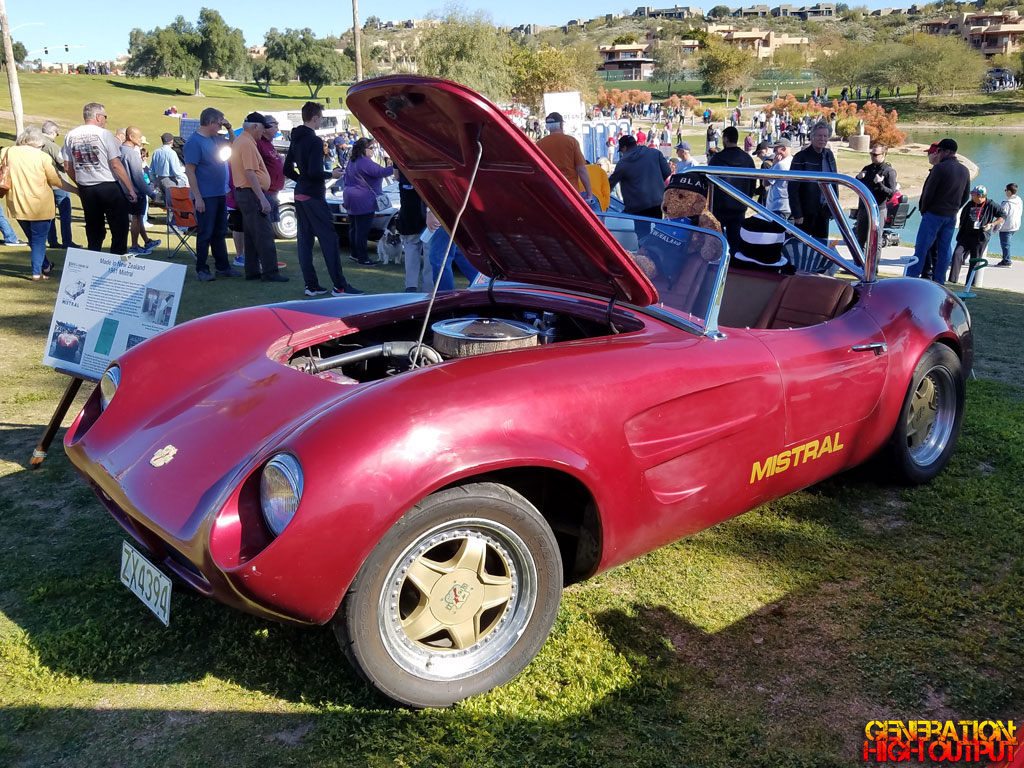
Not Sold Here: 1961 Mistral Roadster

One of my favorite local car events to attend is the Concours in the Hills car show, held each year in February in Fountain Hills, Arizona. Concours in the Hills is not a formal concours with judges in straw hats and white gloves awarding points. It is a more casual, informal event. The 2020 event was the largest ever, with more than 1,000 vehicles wrapping all the way around the perimeter of the lake and its namesake fountain. It was a stroke of good fortune that this event was able to be held in 2020 and not cancelled like so many others due to the COVID-19 pandemic.

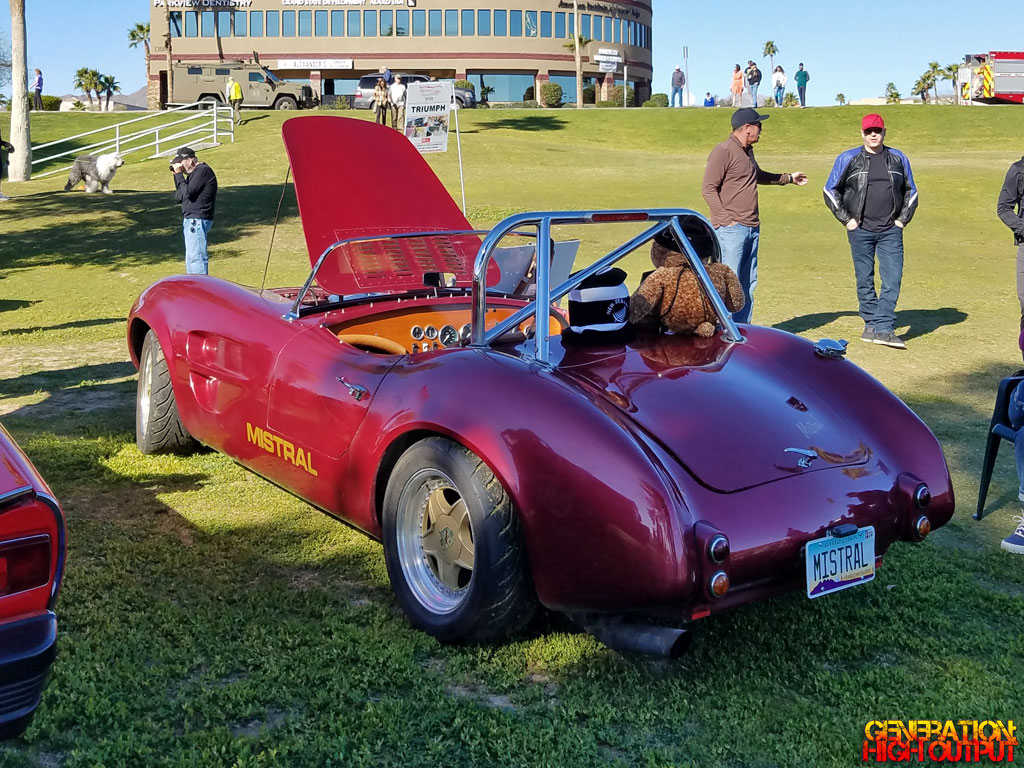
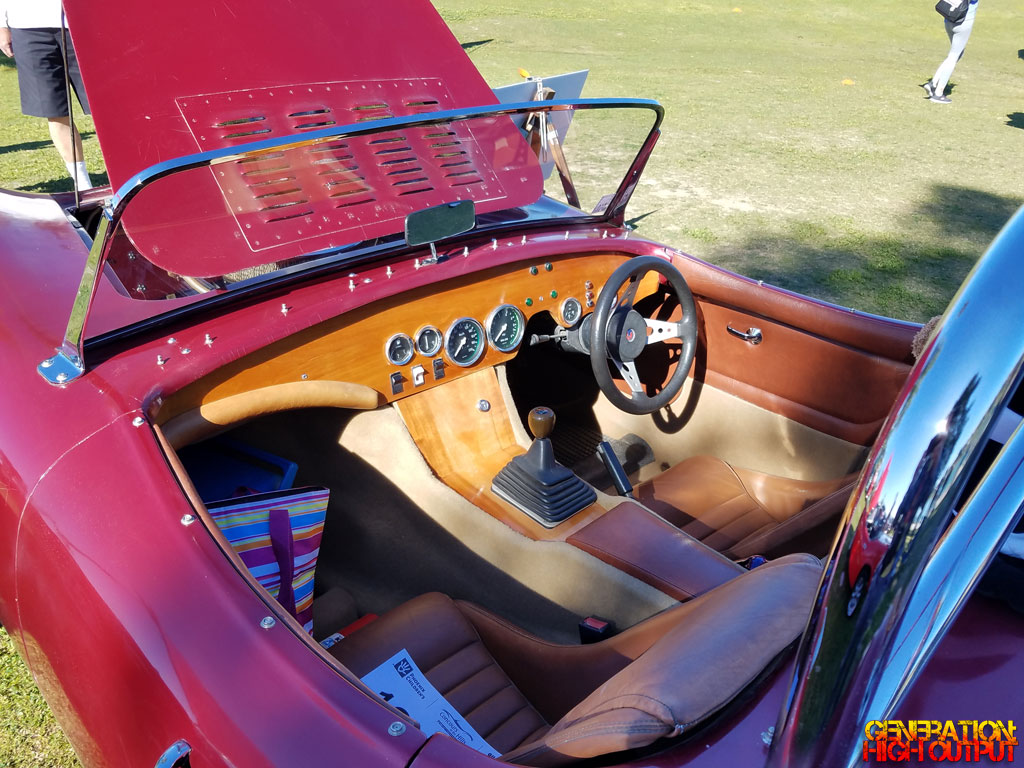
One of the first cars I saw at this year’s show was a unique little two-seater that caught my eye. Looking a bit like a Shelby Cobra or a Scarab, the car had the name “MISTRAL” in gold lettering on each side. Also, it was a right hand drive car – which are not commonly seen in the U.S.

A cheery couple was camped out next to the car in folding chairs. They had a large sign next to the car that told the history of the vehicle, which I will provide below:

“The Mistral body was designed by Bill Ashton in England during the early 1950s. Constructed out of a new material called fibre glass, it was developed to be used on Buckler and Lotus chassis in the 750 Motor Club’s 1174 Formula class. A few years after introduction it was sold to Weltex in Christchurch, New Zealand and a year later to coach builders Elmslie and Flockton in Dunedin.

Production records are gone, but there were approximately 200 total. Mistrals were sold as “rollers” ready to install the engine and transmission, which the customer specified. Because you could specify a Corvette engine and transmission (and consequently a finished weight of 1900 lbs), several were road racing in the USA during the 1958-62 era.

Although various cars like Austin and Toyotas were assembled in New Zealand, Mistral was probably the only New Zealand car company. The map of New Zealand can be seen on the insignia.”

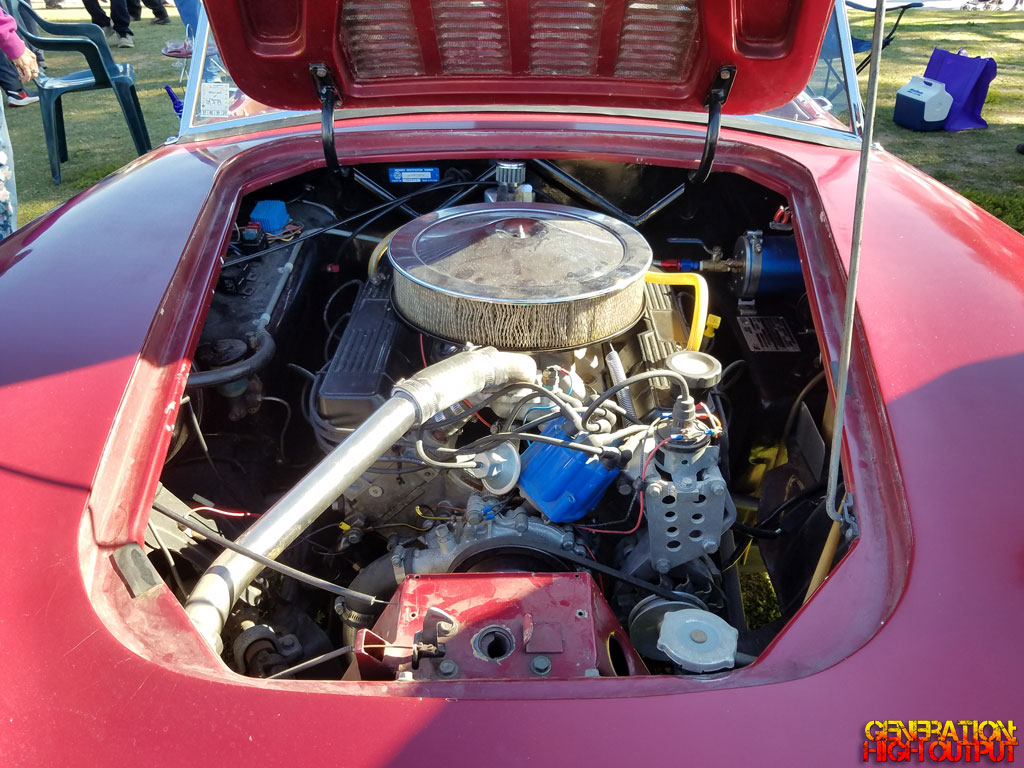
“This 1961 Mistral has evolved since it’s birth as most did. For about the last 35 years it has had a Rover V8, Toyota 5 spd., Mazda LSD, and Vauxhall front end. It raced in street legal class in New Zealand and more recently, to remain legal, had to have a taller roll bar and 3 piece wheels to accept modern tires.”

It is a very cool little car, and one that I was delighted to have seen at the car show. Thanks to the owners for bringing it out!

1993 Besasie Auto Co. Neoclassic Roadster

The market for Neoclassic cars has always been a small corner of the automotive market, going back to the industry’s roots in the 1970s. However, that did not deter former employees of Excalibur from starting their own company in the 1990s.

The Besasie Auto Company, Inc. (or BACI) was formed in Milwaukee, Wisconsin with the purpose of producing a neoclassic automobile. The company produced a total of 14 vehicles between 1993 and 1996. I believe all of them were based on the Ford Thunderbird platform. Most of them used the 5.0L V8 engine with an automatic transmission, though I did find one listing online which said the car had the 4.6L V8, which debuted in 1994. While I could not find much on the history of the company, I suspect they ran into financial troubles. If you know any details about the Besasie family, please post a comment below!

I saw this particular BACI roadster for sale at a collector car dealership in Arizona. One thing that sets this car apart from other neoclassics is the angle of the front grille. While most neoclassics use a waterfall-style grille that is perpendicular to the ground, the BACI’s grille is sharply angled and sort of resembles a 1934 Ford, though less pointy at the bottom.

Continue reading

Barrett-Jackson 2016: 1951 Cadillac Custom Roadster

1951-cadillac-deville-custom-roadster-rearThis car caught my eye while I was walking around the tents at the Barrett-Jackson collector car auction in Scottsdale this past January. The window sticker revealed frustratingly few details about this cool custom roadster.

From what I could tell, this car began life as a 1951 Cadillac DeVille and was at some point turned into a chop-top roadster. The engine has been swapped out for a Chevrolet LS V8 power plant with a 4L60E automatic transmission. The interior has been redone in tan leather while the exterior has been resprayed a laser red metallic color. Continue reading