SEMA 2018: Dodge Introduces 1,000 Horsepower “Hellephant” Crate Engine

From the time the Dodge Challenger revival was confirmed in 2006, Dodge has been on a roll with their high-performance enthusiast vehicles. When the third-generation Challenger made its debut in 2008, the 6.1L (372) SRT8 model put out a healthy 425 horsepower.

Dodge bumped it up again in 2011, when the Challenger SRT8 received a new 6.4L (392) HEMI V8 making 470 horses. In 2014, Dodge stunned the automotive world when they introduced the Hellcat with its 6.2L (376) HEMI making a staggering 707 horsepower – the most powerful production engine in a muscle car at that time. In 2017, the bar was raised yet again with the announcement of the SRT Demon, a supercharged version featuring an eye-popping 808 horsepower on 91 octane gas, or 840 horsepower on 100-octane.

How much further can they go? Well at SEMA 2018, we got an answer. Mopar fans were delighted to hear about Chrysler’s latest creation: a supercharged, all aluminum 7.0-liter (426 cubic inch) HEMI crate engine. The “Hellephant” as it is nicknamed, will produce 1,000 horsepower and 950 lb-ft of torque. It is far and away the most powerful crate engine ever offered by an OEM.

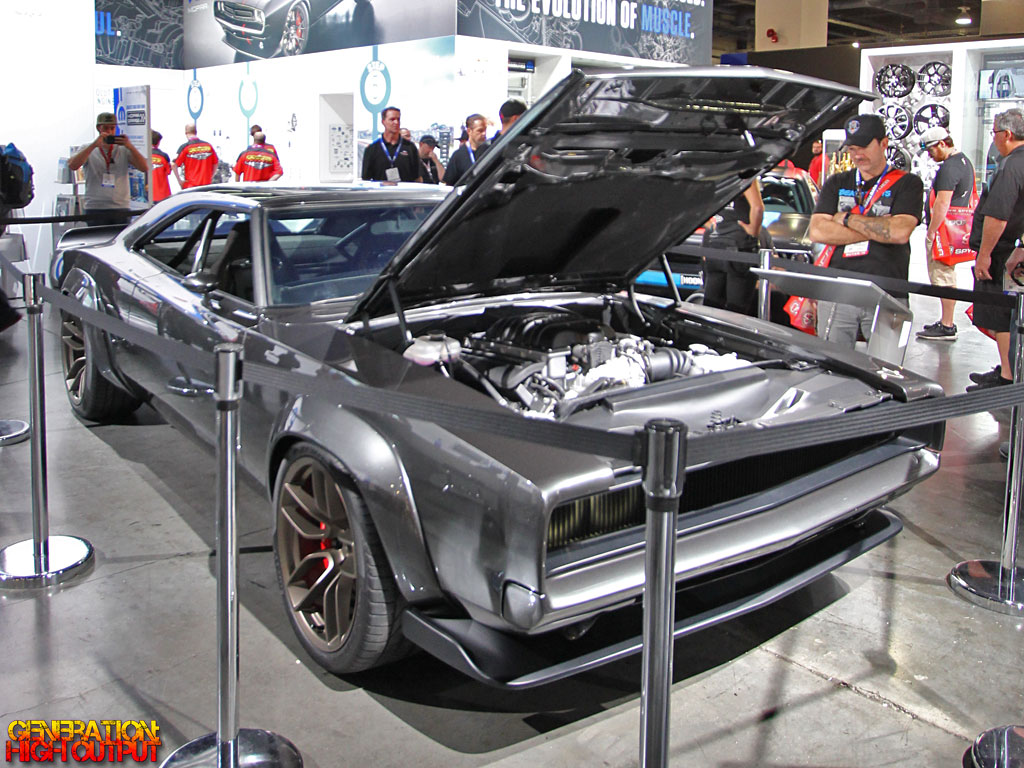
To promote the new engine, Chrysler’s Product Design Office (PDO) came up with the idea of installing the engine into a classic 1968 Dodge Charger. The “Super Charger” is equipped with a stock T-6060 six-speed manual transmission, along with a number of custom touches.

  • “De Grigio” Grey Metallic paint
  • Brembo six-piston disc brakes
  • Side mirrors from a 1971 Duster
  • 5-inch exhaust tips borrowed from the Alfa Romeo Stelvio
  • Dodge Viper steering wheel
  • Dodge Viper seats, wrapped in Alcantara with red stitching
  • Sabelt four-point racing harnesses
  • Custom roll cage with 2-inch diameter tube
  • Rear seat delete
  • LED brake lights
  • 20×11″ front wheels, 21×12″ custom rear wheels
  • lowered 3.5 inches in front, 2.5 inches in rear
  • shaved door handles, drip rails, trunk lock

Pricing for the Hellephant engine was not announced, though it will likely be more than the $19,530 price tag for the Hellcat crate engine. It is expected to be available for sale in early 2019.

Part Number Reference:

Interior
Fuel Level, Full Sweep, Electronic 2 1/16″, Black Dial – 77060043
Oil Pressure, Short Sweep, Electronic 2 1/16″, Range 0-100 psi, Black Dial – 77060045
Speedometer, In-Dash, Full Sweep, Electronic 3 3/8″, Range 0-160 mph, Black Dial – 77060055
Voltmeter, Short Sweep, Electronic, 2 1/16″, Range 8-18 volts, White Dial – 77060050
Tachometer, In-Dash, Full Sweep, Electronic 3 3/8″, Range 0-10,000 rpm, Black Dial – 77060057
Water Temperature

Performance/Engine
426 Supercharged Crate HEMI Engine Kit: 77072500
Hellephant 426 Supercharged Crate HEMI Engine: P5160194
6.2L EO Air Filter Element – 77072491
6.2L Supercharged Crate HEMI Engine FEAD Basics Kit (includes alternator, power steering pump, pulleys, and hardware) – 77072492


1979 Dodge Lil Red Express | Barrett-Jackson 2018

Available in 1978 and 1979 this truck has a reputation for being one of the fastest vehicles produced during those years. Although I’d like to be able correctly credit the reason why Dodge was able to squeeze a massive 225hp net rating out of the 360 under the hood, there’s a ton of conflicting reasons why.

Some say it was due to a loophole that allowed a lack of emissions equipment, specifically the catalytic converters. However another source claims the 1979 model has catalytic converters equipped on it, as well as a pointless 85mph speedometer.

What I can say is that Mopar was not able to match this number again until 1993 with the 230hp 5.9l Magnum V8. This truck has also fallen by the wayside along with the Warlock, Midnight Express and other Dodge trucks from this era that paved the way for trucks like the Dodge SRT-10, Ford Lightning, Silverado SS and many others.

This handsome piece of late 70’s lore sold for $20,000 in auction.

1988 Dodge Caravan SRT-4 Engine Swap

Though it may be hard to imagine a time when minivans were ever considered cool, that was certainly the case in the late 1980s and early 1990s.

In the era before SUVs and Crossovers, minivans were the hottest thing on the market. Chrysler CEO Lee Iacocca and his friend Hal Sperlich had imagined a vehicle that would hold seven passengers, have removable seats for extra cargo space, and get better gas mileage than a full-size van. Their dream became a reality in 1983, and the new Dodge Caravan and Plymouth Horizon minivans sold like hotcakes with sales topping 200,000 units in the first year alone. For the next 25 years, no one sold more minivans in America than Chrysler.

But somewhere along the way, minivans became uncool. The SUV boom of the 2000s and the Crossover Craze yielded vehicles that offered much of the same functionality without the “soccer mom” stigma of a sliding door.

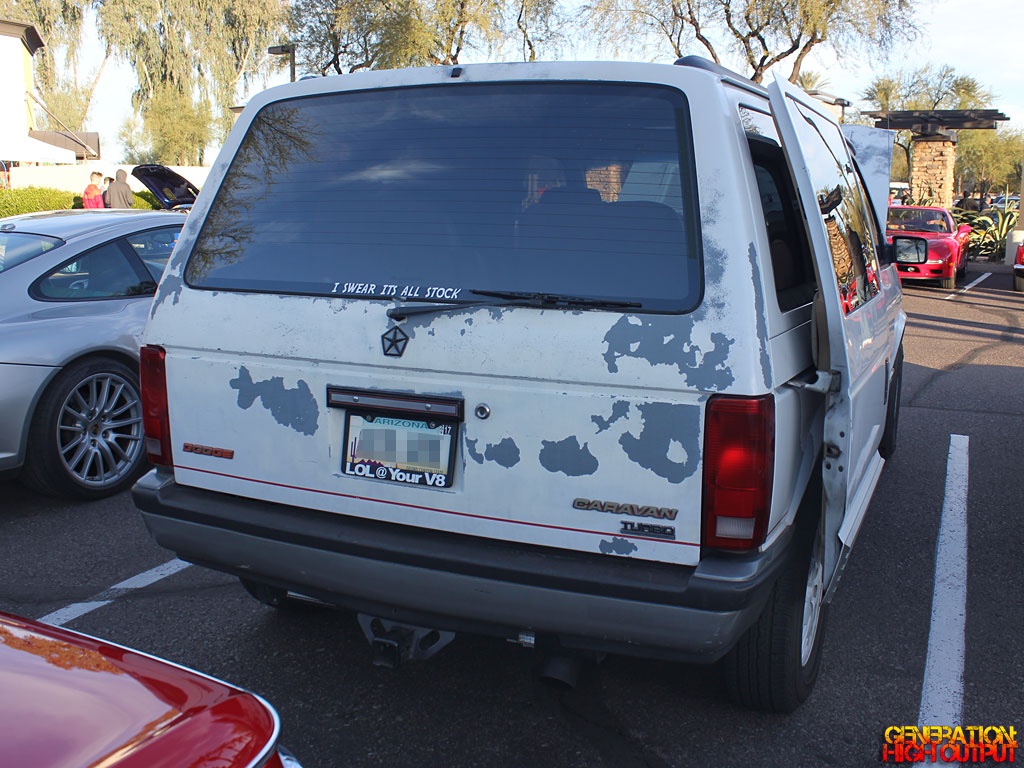
At a recent car show in Scottsdale, I saw a first-generation Dodge Caravan that really caught my eye. For starters, this was a car show that featured primarily European exotic and high-end supercars such as Ferraris and Lamborghinis. A 1988 Caravan with peeling paint definitely didn’t fit in with this crowd.

But as you might have guessed, this is no ordinary Caravan. This one has seen the original 2.5L 4-cylinder engine swapped out with a much more modern 2.4L turbocharged 4-cylinder from a 2004 Dodge SRT-4. Whereas the original engine made 100 horsepower, the new one puts out 230 horsepower in stock trim – but this one’s not stock.

With an AGP Zeta dual ball-bearing turbocharger, an air-to-water intercooler, upgraded fuel injectors, a MegaSquirt fuel management system, and a 3.5″ exhaust with Magnaflow muffler, this beast is putting down 305 horsepower and 365 lb-ft of torque at the wheels! Wow!

A spec sheet on the vehicle says it has run 12.6 in the quarter mile @ 111 mph on E85, 25 lbs of boost, and slicks. With a fast reaction time, that puts it on par with a base model C6 Corvette – for a lot less dough. It’s also been converted to 4-wheel disc brakes, with the front brakes and suspension from a 1995 Grand Caravan and the rear disc brakes from a 1993 Dodge Daytona R/T.

Part of why I love this van is because it pulls off the “sleeper” look quite well. The peeling paint and OEM-style wheels do not give any indication that this vehicle is actually quite fast, and the “Turbo” and “SRT” badges may be dismissed as purely ironic – until the turbo spools up and it blows your doors off.

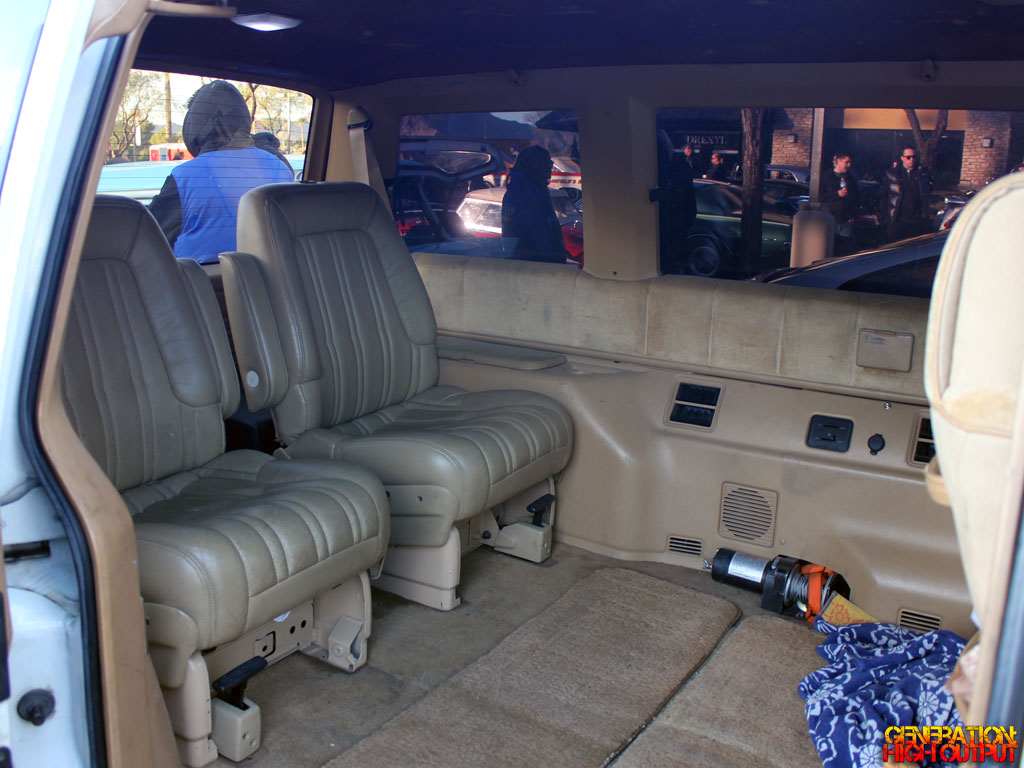
The other reason why I love this van is that a long time ago, our family had a blue 1994 Caravan which I remember fondly. This was the era before dual sliding doors, power liftgates, and fold-flat seating. These old vans are super primitive by today’s standards, but the boxy design reminds me of my childhood.

I didn’t get to talk to the owner, but if you are reading this Mr. Caravan Owner, congrats on the awesome build.

1989-1991 Chrysler TC by Maserati

The 1980s were a wild time for the Chrysler Corporation. After narrowly avoiding bankruptcy and getting a bailout from Uncle Sam in 1979, Chrysler was looking to regain its footing in the market and return to financial stability. Lee Iacocca took over as CEO and pulled off one of the greatest comebacks in the history of American business, but the road to recovery was undeniably a rocky one. We’ll get to the TC in a moment, but first, some background information is necessary.

In 1981, Chrysler revived the “Imperial” brand as a personal luxury coupe to try and compete with Lincoln. Based on the much cheaper Cordoba, the Imperial was expensive and produced a pathetic 140 horsepower from its 318 cubic inch V8 engine. While technically advanced, it was a commercial flop and Chrysler threw in the towel after just 3 years and 12,385 units produced. Continue reading

1988 Chrysler Conquest TSI with Chevy LS1 V8 Swap

1988-chrysler-conquest-tsi-ls1-v8-sideWhen you take an ordinary car and do an engine swap, it transforms the car into something cool. When you take a car that’s already cool and do an engine swap, that makes it badass!

At SEMA 2014, I saw this Chrysler Conquest TSI lined up for the Optima Ultimate Street Car Invitational. It belongs to John Lazorack of Lazorack Motorsports. As you can tell, this is no ordinary Conquest – this one is powered by an LS1 engine from a 2002 Corvette!

Continue reading