About Trevor Freeman

Trevor is a real gearhead who loves everything from classic American muscle cars to high-performance exotics. When he's not reading about cars or taking photos at a car show, he's probably out cruising around. He is currently working on restoring a 1980 Chevrolet Monza hatchback.

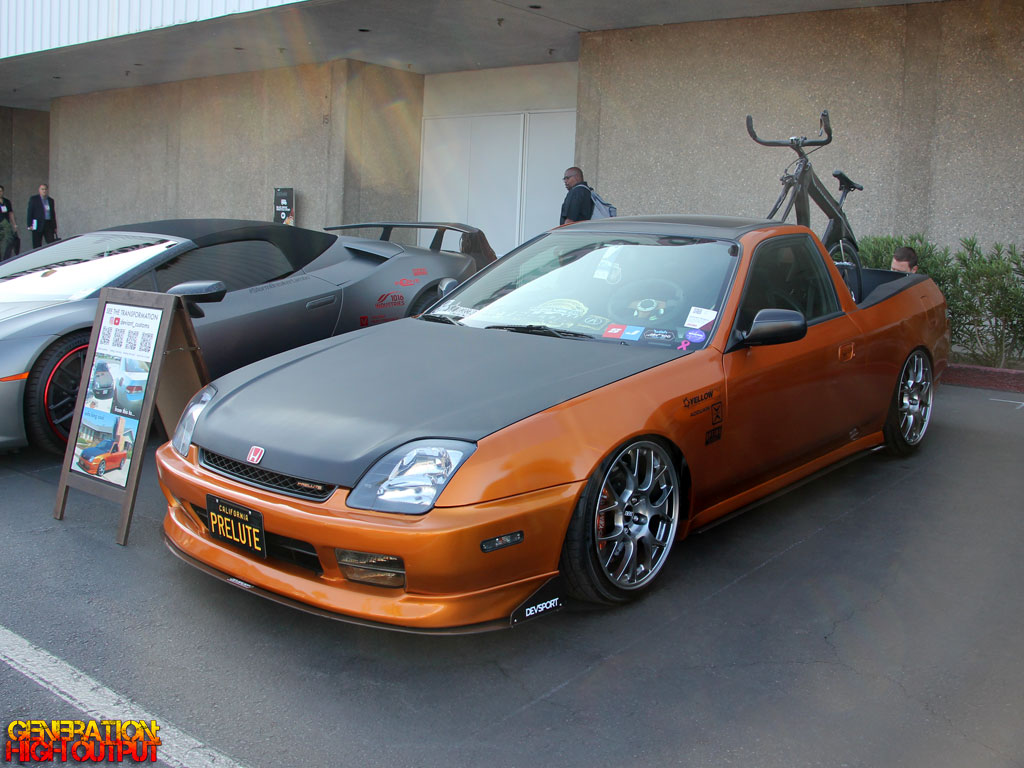
SEMA 2019: 1997 Honda Prelude Pickup Conversion “Prelute”

What do you get when you combine a pickup truck bed with a passenger car? There’s no witty punchline here – you get a car-based pickup truck or “Ute” vehicle, though few know the official name of “coupe utility” vehicle. The body style originated in Australia in the 1930s. By the 1950s, it had made its way to America as the Ford Ranchero and soon afterward, the Chevrolet El Camino.

These vehicles were in production for many years and offered a unique experience that many drivers couldn’t find elsewhere: car-like handling and size, but with the cargo carrying ability of a light pickup truck. The Ranchero ended production in 1979, and the El Camino met a similar fate in 1987.
For more than 30 years, no automobile maker has stepped forward to fill the demand for this type of vehicle in the market. As a result, a number of custom “car-based pickup trucks” have begun popping up. We’ve covered a few of them before, such as an E36 BMW Truck, Volkswagen Ute, and an Audi Ute around town.

At the 2019 SEMA Show in Las Vegas, I happened across one of the cleanest car-based pickup custom builds I have seen to date. This car began life as a 1997 Honda Prelude, and was converted by the owner Song Toh into a small pickup. In a YouTube video covering the build, Song says it took him 15 months and more than 600 hours of time to complete the build. He has also given the car the incredibly clever name of “Prelute” – a combination of “Prelude” and “ute” – the Australian term for this kind of vehicle.

I saw the vehicle on display at the 2019 SEMA Show in Las Vegas, where it had a steady crowd of admirers. The build photos on the Deviant Customs Facebook page show the progress of the car, from adding additional chassis bracing to the glossy orange wrap, doing basically all of the work himself. Congratulations on a super cool, unique, and very clean build.

Be sure to follow the owner on Instagram @deviant_customs for more updates.

SEMA Show Goes Virtual for 2020

Photo by Samantha Borges on Unsplash

The Specialty Equipment Market Association is the governing body that organizes the SEMA Show, a trade show and exposition for the automotive aftermarket industry. On August 6th, 2020, the association announced that the 2020 SEMA Show will not take place as planned. Originally scheduled to take place November 3-6, 2020, the annual event has been rescheduled as a virtual event.

First held in 1967, the SEMA Show moved to Las Vegas in 1977 where it has remained for the past 42 years. The massive trade show is one of the largest in the country, drawing more than 165,000 attendees in 2017. 25% of the attendees traveled from outside of the U.S. to attend the week-long event. The economic impact of the show is also significant, even in a city known for large trade shows and industry events. The flights, hotels, meals, and convention services have a total economic impact of $315 million, according to a 2017 article by the Las Vegas Review-Journal.

The SEMA Show covers all corners of the automotive industry, from performance and aftermarket companies, to wheel and tire manufacturers, off-road, high end stereos and equipment, tooling and equipment, and auto body and restoration shops.

SEMA typically begins weeks ahead of time, with show services staff and exhibitors setting up their booths in the massive convention center, which has more than 3.2 million square feet of exhibit space (and still growing!). The week of the show, Monday is open to members of the press. Tuesday through Friday are open to registered attendees, including buyers, exhibitors, and other attendees. The show ends with the SEMA Cruise – a parade of hundreds of show cars leaving the convention center. A new event called SEMA Ignited gives the public a chance to see some of the custom cars from the show in an evening event, held close to the convention center.

The details of how the show will transition to a virtual format have not yet been disclosed. The New Products Showcase and Education Sessions will likely be webinars or video presentations, and the networking and happy hour events could be held as virtual meetings. But for many attendees, the big feature of SEMA is the cars: more than 2,000 customized cars, trucks, vans, SUVs, and other vehicles take over the convention center are a huge draw for companies showcasing their products.

Generation: High Output has covered the SEMA show since 2012, and we look forward to bringing you coverage of the automotive aftermarket industry again this year.

1981 Phillips Berlina – The Neoclassic Corvette

One of the most iconic cars ever created is the Mercedes-Benz S-Series. Produced between 1927 and 1933, these cars were the top performers of their time. The legacy of the Mercedes S, SS, and SSK cars lives on today, many decades after production ended.

In the 1970s and 1980s, a number of companies sprouted up to produce replicas of these famed automobiles. Excalibur, Classic Tiffany, Gatsby, Clenet, Besasie, and many others each took a turn at creating their modernized version of the classic Mercedes roadster.

In 1980, Charles W. Phillips of Pompano Beach, Florida decided to set about producing a replica of the 1934-36 Mercedes 540K Roadster, which was the follow-up to the famous S-Series cars. Neoclassic automobiles often use the chassis and powertrain of a mass-produced car, combined with custom bodywork. The Phillips Berlina is no exception. It has a fiberglass body riding on top of a stretched Chevrolet Corvette C3 chassis. This car, a 1981 model, wears a lovely shade of red with a white vinyl top.

Though it had a Chevrolet V8 engine under the hood, the Berlina Coupe produced just 190-200 horsepower. Factoring in the additional weight of the body and chassis, this is probably one of the slowest Corvettes around. But this is not a car to be driven swiftly or aggressively, this car is all about style.

The round headlamps, oversize horns, running boards, and spare wheels mounted on the fenders hearken back to the pre-war motoring era, when automobile ownership was reserved for the wealthy elite. With the long hood and short deck, it definitely resembles the Mercedes-Benz 540K. Look closely though and you can see the doors, windshield, and interior are unmistakably Corvette.

The stretched wheelbase really throws off the proportions of the car. It must have an absolutely terrible turning radius! Look at how ridiculous it looks from the side. The car’s 185/65R14 tires up front look especially small beneath the large wheel arches.

It does not appear as though there is a trunk or any kind of access through the rear bodywork. Not that Corvettes are particularly spacious cars to begin with, but from the looks of it, it wouldn’t have been that hard to make an opening rear hatch.

From what I can tell, the company wasn’t in business very long. Only 78 of these cars were produced between 1980 and 1983. If you have any more details about the Phillips Berlina Coupe, please post a comment below!

2022 Update

Another 1981 Phillips Berlina popped up for sale at the Barrett-Jackson Scottsdale 2022 collector car auction! Lot #646 is a 1981 Berlina Custom Coupe painted a gold/tan color over tan interior and showing 16,228 miles on the odometer. The car sold for $22,000 (including buyer’s premium). Interestingly, some of the words I wrote about this car in my 2020 post made it onto the vehicle description in the auction catalog!

Not Sold Here: 1961 Mistral Roadster

One of my favorite local car events to attend is the Concours in the Hills car show, held each year in February in Fountain Hills, Arizona. Concours in the Hills is not a formal concours with judges in straw hats and white gloves awarding points. It is a more casual, informal event. The 2020 event was the largest ever, with more than 1,000 vehicles wrapping all the way around the perimeter of the lake and its namesake fountain. It was a stroke of good fortune that this event was able to be held in 2020 and not cancelled like so many others due to the COVID-19 pandemic.

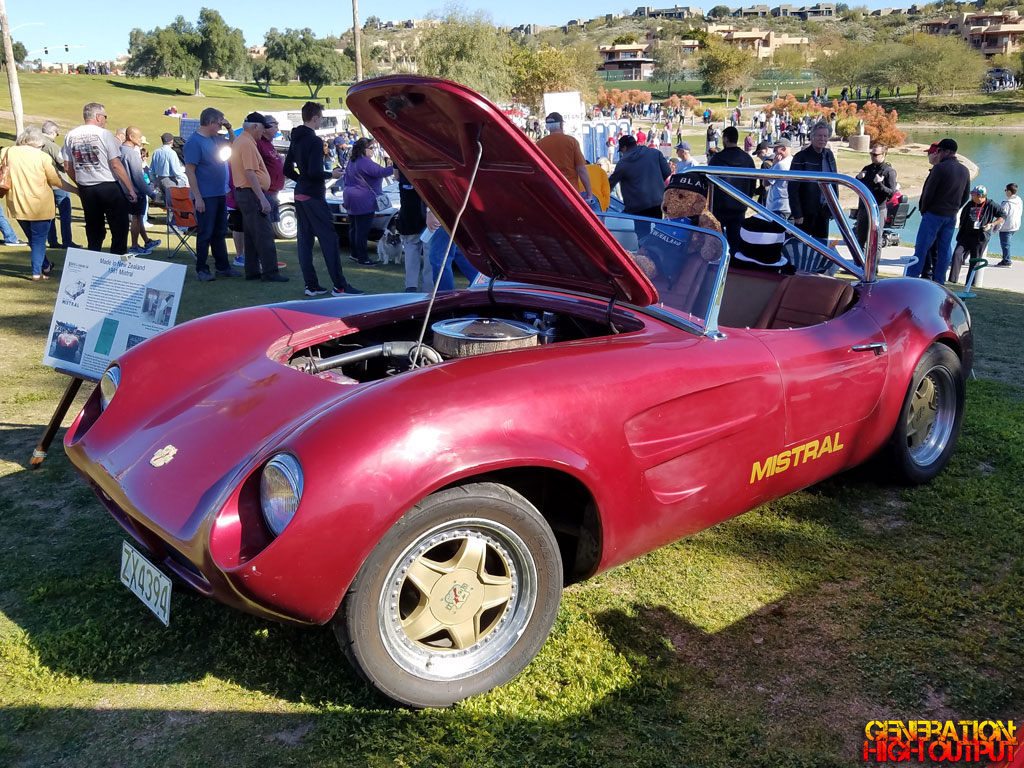
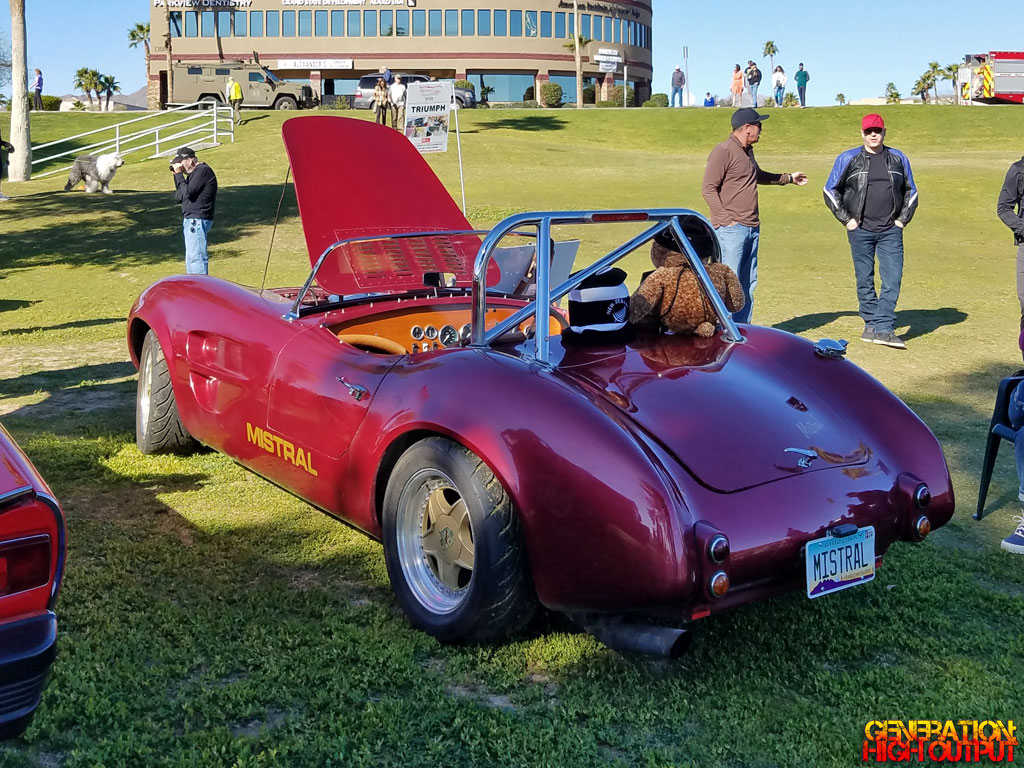
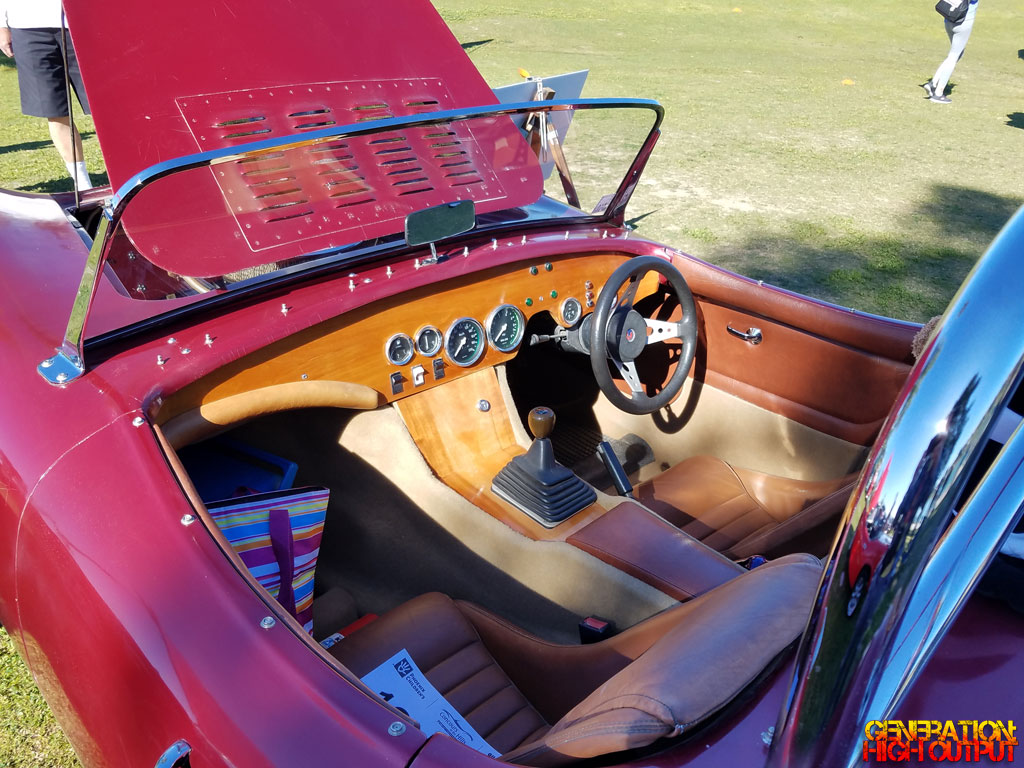
One of the first cars I saw at this year’s show was a unique little two-seater that caught my eye. Looking a bit like a Shelby Cobra or a Scarab, the car had the name “MISTRAL” in gold lettering on each side. Also, it was a right hand drive car – which are not commonly seen in the U.S.

A cheery couple was camped out next to the car in folding chairs. They had a large sign next to the car that told the history of the vehicle, which I will provide below:

“The Mistral body was designed by Bill Ashton in England during the early 1950s. Constructed out of a new material called fibre glass, it was developed to be used on Buckler and Lotus chassis in the 750 Motor Club’s 1174 Formula class. A few years after introduction it was sold to Weltex in Christchurch, New Zealand and a year later to coach builders Elmslie and Flockton in Dunedin.

Production records are gone, but there were approximately 200 total. Mistrals were sold as “rollers” ready to install the engine and transmission, which the customer specified. Because you could specify a Corvette engine and transmission (and consequently a finished weight of 1900 lbs), several were road racing in the USA during the 1958-62 era.

Although various cars like Austin and Toyotas were assembled in New Zealand, Mistral was probably the only New Zealand car company. The map of New Zealand can be seen on the insignia.”

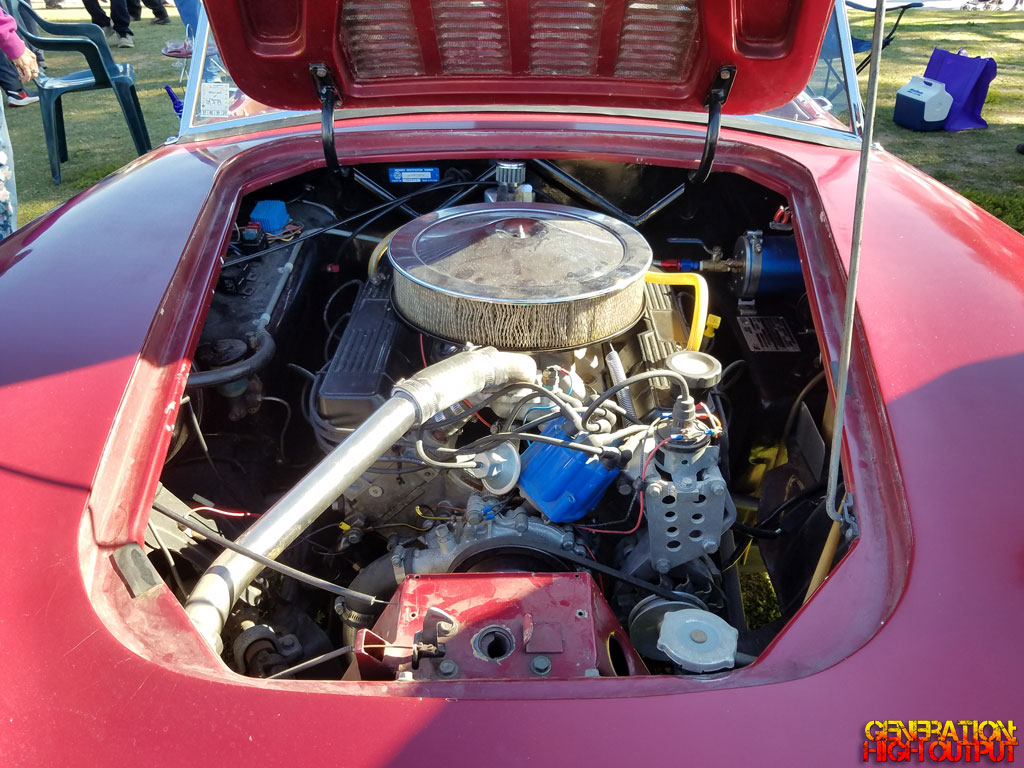
“This 1961 Mistral has evolved since it’s birth as most did. For about the last 35 years it has had a Rover V8, Toyota 5 spd., Mazda LSD, and Vauxhall front end. It raced in street legal class in New Zealand and more recently, to remain legal, had to have a taller roll bar and 3 piece wheels to accept modern tires.”

It is a very cool little car, and one that I was delighted to have seen at the car show. Thanks to the owners for bringing it out!

DF Goblin Kit Car (Chevy Cobalt)

While most of the world’s mass-produced automobiles have the engine in the front, many high-performance sports cars have the engine in the middle of the car. The advantage of this design (engine behind the driver) is better weight distribution and handling. For anyone looking to purchase a mid-engine sports car, there are many different options to choose from across a wide variety of price points, ranging from $200,000 and up to less than $25,000.

$200,000 and up – Most Ferrari models, most Lamborghini models, Porsche 918, McLaren, etc.

$100,000 to $200,000 – Ford GT, Acura NSX, Audi R8

$50,000 to $100,000 – Chevrolet Corvette C8, Factory Five GTM, Grullon GT8, Lotus Exige, Alfa Romeo 4C

$25,000 to $50,000 – Lotus Elise, DeLorean DMC12, Porsche 914

$25,000 and Under – Pontiac Fiero, Toyota MR2, Fiat X1/9

The cars in this last group – the Pontiac Fiero, Toyota MR2, and Fiat X1/9 (or even a very ratty Porsche 914) are the most accessible to car enthusiasts. There are many examples of these cars available to buy under $25,000 – which sounds like a lot for a project car, but is actually quite affordable in the world of mid-engine cars. Indeed, Fieros are commonly available for $10,000 or less.

But now, there is a new contender in the mid-engine car market. Meet the DF Goblin from Red Oak, Texas (a suburb of the Dallas-Fort Worth metro area). The Goblin is a kit car – you assemble it yourself using parts from a donor car.

While other donor cars use parts from high performance cars such as the Chevrolet Corvette or Ford Mustang, the Goblin is based around the 2005-2010 Chevrolet Cobalt/Pontiac G5. Yes, the cheap commuter car that replaced the Cavalier. THAT Cobalt.

The philosophy behind the Goblin can be summed up in three words: low, light, and quick. While the base model Cobalt had a 2.2L Ecotec engine that produced 155 horsepower, the manufacturer states that 155 horsepower feels incredibly quick in a car that weighs just 1500 lbs (680 kg).

The car is designed to be affordable and easy for a DIY mechanic to build in their home garage. The kit is $6,800 and a donor car can be purchased for $500-1000 in many cases. The Goblin kit includes a fully welded mild steel chassis with no welding or fabrication skills required. A person with regular tools can swap over the engine and transmission, wiring harness, suspension, brakes, steering and fuel system from the donor car to the Goblin chassis.

Owners looking for more power can scout for a Cobalt SS (which was supercharged in 2005-2007 and turbocharged from 2008-2010). However, the company emphasizes building a base model Cobalt to start with and that bolt ons can be added later as needed.

I saw one of these kits completed at a local Cars and Coffee event in Scottsdale. I have to say that it sounds very appealing, given the abundance of cheap Chevrolet Cobalts out there.

While it’s easy to dismiss the car as a knockoff of the Ariel Atom, keep in mind that the Ariel Atom 4 starts at $74,750 – nearly 10 times the cost of the Goblin kit. The Goblin, very similar in appearance, can be built for a fraction of the price.

To be fair, the Ariel Atom makes 320 horsepower from a turbocharged 2.0L Honda engine, compared to the Goblin’s 155 HP (or 260 HP with Cobalt SS donor car). The Atom 4 will do 0-60 mph in 2.8 seconds, whereas the Goblin does 0-60 mph in 4.7 seconds. Both are significantly faster than say, a 2019 Toyota 86, which does 0-60 in 6.4 seconds.

For the price, I would say that the Goblin is in a whole new class of its own: Mid-Engine Sports Cars for Well Under $25,000. It seems like an incredible value for the money. I would love to take a spin in one and see how much fun they are!

For the off-road enthusiasts, be sure to check out the Goblin A/T, an off-road version which is a modern interpretation of the VW-based rail buggy cars.

https://dfkitcar.com/

1986 Zimmer Quicksilver Neoclassic Car

In the 1970s, there was a short-lived niche market for classic-style automobiles. Several boutique manufacturers such as Excalibur, Clenet, and others set about building modern interpretations of these 1920s style cars in low volumes. Primarily based on full size platforms from GM and Ford, these Neoclassic cars combined classic styling elements with the reliability of a modern (at the time) powertrain.

There are certain elements common to neoclassic cars: they are usually built by hand in low numbers, and have wire wheels, round headlamps, flared fenders, and of course, a waterfall grille. Many of these cars were upgraded with leather, real wood, and other high quality materials that commanded a premium price. The Zimmer Motorcar company, founded in New York in 1978, was one of the leading companies that produced these neoclassic cars.

The company’s star product was the 1920s style Zimmer Golden Spirit, which was based on the Ford Mustang platform. It was their most successful car, with approximately 1,500 units built between 1978 to 1988.

The follow up to the Golden Spirit was the Quicksilver. This car was based on the Pontiac Fiero, a unique mid-engine compact car from General Motors. Fieros were a popular platform for kit cars and customs, due to the fact that all of the car’s body panels could be unbolted and a rolling chassis/tub was easy to build around.

Produced from 1984-1988, the Zimmer Quicksilver was on the tail end of the neoclassic car trend. Its design was noticeably more subtle than other neoclassics of the 1970s and 80s. Gone are the round headlamps, replaced by pop-up headlamps. The step-side fenders common to other neoclassics have been replaced by more modestly flared wheel arches. The car does still have a waterfall grille, and plenty of chrome trim added.

This particular car is a 1986 Zimmer Quicksilver, which came up for auction at the RM Sotheby’s Scottsdale auction in January 2020. According to the listing, this car is a one-owner example with just 464 miles on the odometer. The red leather interior and engine bay shine like new, despite the car being 34 years old. In spite of the car’s old-world look, there is no hiding the fact that this is an 80’s GM car with pop-up headlights and a very square, angular interior.

From a sales perspective, the Quicksilver was not as successful as the Golden Spirit. Whereas 1,500 Golden Spirits were produced, an article on ConsumerGuide.com says that only 170 Quicksilvers were built during the four year production run, making this quite a rare car.

Sotheby’s appraisal estimated the car’s value at $40 to $50,000 dollars. The final sale price at auction was $21,280 (including buyer’s premium), possibly due to an uncertain economic outlook in early 2020, and possibly due to the rarity of the car and collectors who are unfamiliar with the Zimmer name. The value of used neoclassic cars varies wildly, depending on build quality, condition, maintenance, and other factors.

This is an interesting car that is quite possibly the fanciest, most luxurious Pontiac Fiero that money can buy.

https://rmsothebys.com/en/auctions/az20/arizona/lots/r0149-1986-zimmer-quicksilver/841861