With so much nostalgia online for the 1980s and 1990s, here’s one only the real ones will remember: the GEO automotive brand. GEO was a short-lived partnership between General Motors and three Japanese automakers: Toyota, Isuzu, and Suzuki. Sales were discontinued in the U.S. after just eight years.
One of the better-selling GEO models was the Tracker, a mini SUV that initially was a four-wheel drive vehicle, with a two-wheel drive model introduced later.
The cars were equipped with a wheezy 1.6-liter engine that coughed out about 96 horsepower on a good day. While the Tracker was light and nimble, it was very underpowered.
Jon Moss was the head of GM’s Special Vehicle Group. They cooked up a one-off concept called the GEO Dirt Tracker. The original 95 horsepower engine was replaced with a 3.4-liter L32 V6 engine from the Chevrolet Camaro making 200 horsepower.
Coupled to this is a 4-speed automatic transmission, and an all-wheel drive transfer case from an Oldsmobile Bravada.
What they created is a capable off-roader that can sprint from 0 to 60 in 8.5 seconds. The vehicle was reviewed by Motor Trend Magazine in August 1996, and they praised the Dirt Tracker, calling it a “well-finished machine that presents some tantalizing possibilities for a toughened Tracker image.”
Well, GEO ceased production in North America by 1998 and the remaining models were sold as Chevrolets. The Dirt Tracker was to only be a one-off concept vehicle and not a production model.
This 1-of-1 concept car recently appeared at the Barrett-Jackson Scottsdale Fall 2024 auction with just 1,365 miles on it. Barrett-Jackson is one of the only places you can see and bid on concept vehicles like this one!
This unique car sold for $12,100, including the buyer’s premium.
The Chevrolet Corvair was produced by General Motors from 1960-1969. Though it featured many innovations that were ahead of its time, the car was done in by a wave of accusations that it was unsafe to drive.
In the many decades since, General Motors has gone on to re-introduce discontinued names such as the Camaro and the Malibu, but they have not taken another look at the Corvair. Well, someone else decided to do it for them!
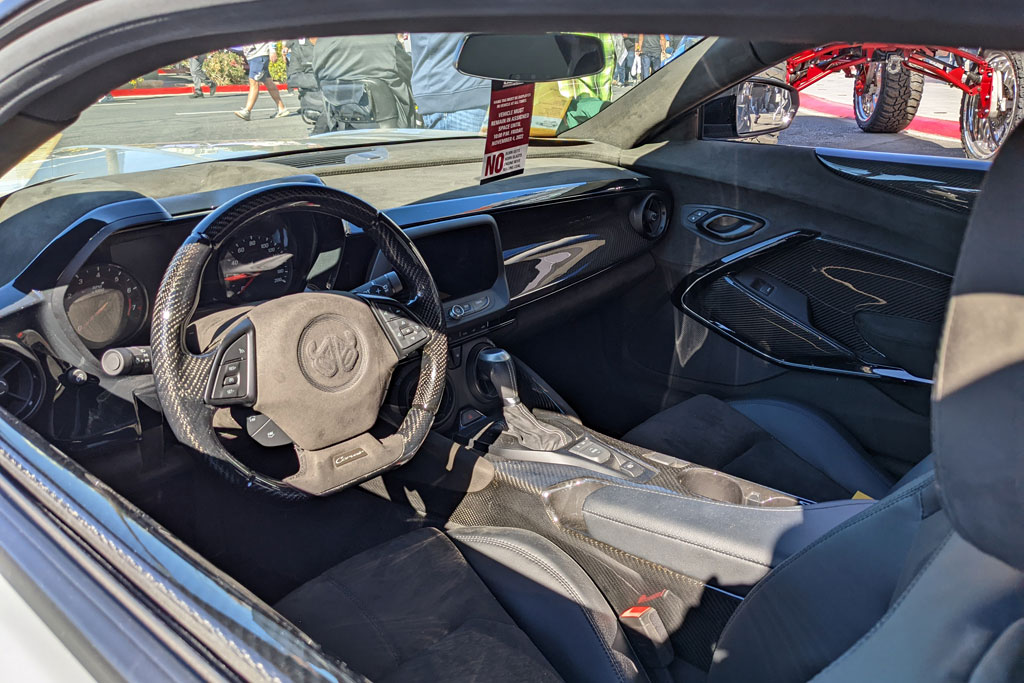
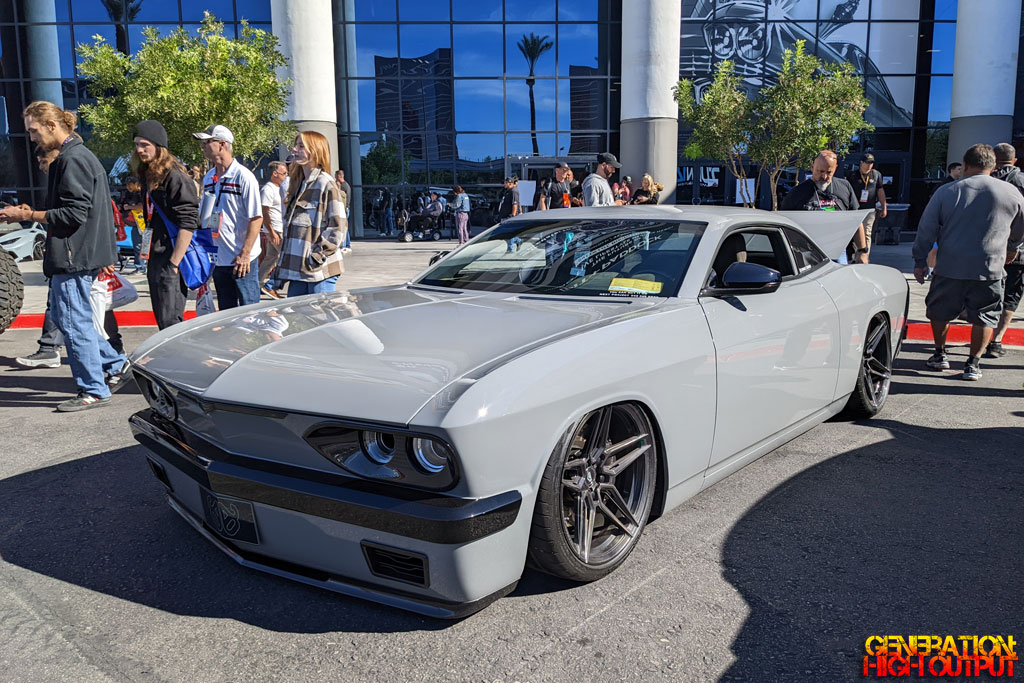
At the 2022 SEMA Show in Las Vegas, I happened upon this “2020 Corvair Custom” by NewRide, a French-based company. The car pairs a 1966 Corvair coupe body with a 2018 Camaro SS chassis. Finished in Audi non-metallic gray, the car has a very unique look.
The car borrows its headlights from a Dodge Demon, taillights from the Ferrari 812 Superfast, and side mirrors come from a 2020 VW Polo. Pretty much everything else is custom, from the bumpers to the rear glass to the headlight and taillight surrounds. The car was completed by Romain Roulleau of the Burgundy region of France. He estimates that more than 5,600 man hours of labor went into creating this one-of-a-kind custom car.
Under the hood is GM’s standard 6.2L V8 LT1 engine producing 455 horsepower. It rumbles via a custom stainless steel exhaust. A set of Vossen Evo-1R wheels are wrapped in Michelin Pilot Sport Cup 2 tires, concealing the EBC Disc Brakes. The whole car rides comfortably on AirLift Performance bags and can be slammed to the ground at the touch of a button.
For more on this build including an album of build pictures, please visit https://www.newride.fr/ or follow @corvair2020newride on Instagram.
Drew Scott is one half of the famous duo “Property Brothers” which he has co-hosted with his twin brother Jonathan for 14 seasons on HGTV. The popularity of the series has inspired a number of spin-offs and specials, all of them centered on renovating houses.
In a two-hour special that will air on Discovery+ on Saturday, December 18, 2021, we will see a different side of Drew as he pursues another of his passions beyond house flipping. Called Drew Scott’s Dream Car, the special will show Drew Scott teaming up with master mechanic and builder Art Anstead to build his dream car.
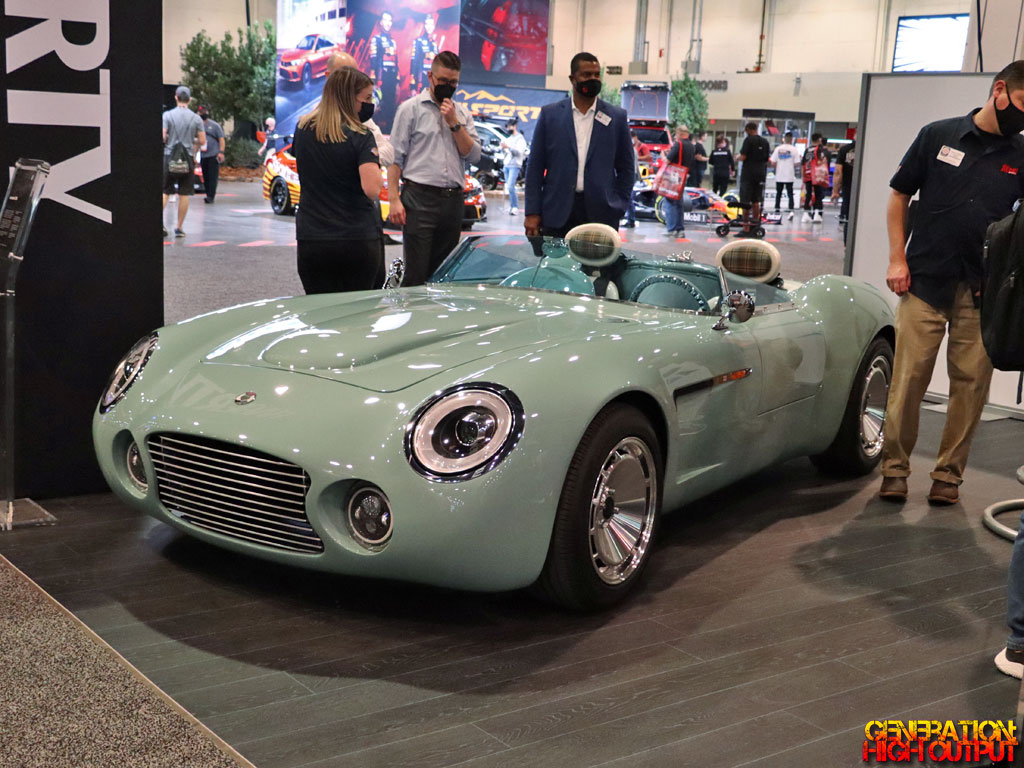
I saw the finished vehicle on display at the Hagerty Automotive booth at the 2021 SEMA Show in Las Vegas. Let’s take a quick tour of this very unique car.
It’s called the Lanark DS and it is a two-seater roadster which was inspired by European sports cars of the 1950s and 1960s. The car is a one-off built using a one piece composite body shell over a custom tubular space frame chassis. The finished car weighs 2,600 lbs (1200 kg).
The car’s powertrain is sourced from a Tesla, meaning this is a fully electric car. It will launch the little car from 0-60 mph in 2.9 seconds with a top speed of 150 mph and a redline of 18,000 rpm. The 220 kW motor produces the equivalent of 294 hp with 245 lb-ft at the motor and 2200+ lb-ft at the wheel. The car reportedly has a range of 300 miles, enough to drive from Los Angeles to Las Vegas before needing a recharge.
The car also has 4-wheel disc brakes, adjustable coilovers and a double wishbone suspension setup. The exterior is finished in a unique blue-green aqua color.
I like this little car. The doors and rear haunches remind me of a Kaiser Darrin, but I can also see the influence of European cars like OSCA, Lancia, Ferrari, and others in the front end. The wrap-around windshield is a very cool style element.
With the Tesla powertrain, it sounds like this car will be very quick once you mash the pedal to the floor. What are your thoughts on this one-off Lanark DS?
During his lifetime, Carroll Shelby accomplished more than most men could in two lifetimes. He was a test pilot in the Army Air Corps during the second World War, he was a Formula One racing driver, and would later go on to found Shelby American in 1962. Even people who do not know much about Carroll Shelby the man know him for his creations: the Shelby Cobra, the Shelby Mustang, and of course, for his work with Ford on the Le Mans-winning GT40.
These cars have taken on a mystical aura over the decades, with originals skyrocketing in value and plenty of replica and tribute cars rushing in to fill demand in the market. Shelby’s dedication to building high performance cars has earned the brand enormous respect and prestige among enthusiasts and collectors.
But I’m willing to bet that even the most die-hard Carroll Shelby fan has probably not heard of the Shelby Lonestar before. I will admit that I hadn’t heard of it until I was standing in front of the car earlier this year in Arizona.
I am a Carroll Shelby fan, having toured the factory in Las Vegas and having attended the largest gathering of GT40s in half a century at the 2016 Pebble Beach Concours d’Elegance. But the story of the Shelby Lonestar was one I had not heard before, and it’s worth sharing.
Towards the end of his contract with Ford, Shelby American began working on the next evolution of the Shelby Cobra, a car that was referred to internally as the “Cobra Mk III.” Shelby hired British designer Len Bailey, who had designed the GT40 Mk III and GT40 Mirage.
It is no coincidence that the car resembles a GT40, using a similar tube chassis design with riveted aluminum body work. The mid-engine, two-seater is powered by a Ford 289 V8 engine producing 320 horsepower and paired with a 5-speed ZF gearbox. The Halibrand wheels and Smiths gauges round out the car’s provenance as a born racer. Shelby had intended to call the car a Cobra, but the name belonged to Ford. Shelby opted to call the car Lonestar, an homage to his home state of Texas.
This particular car was featured on the cover of Shelby’s parts catalog, on a poster, and was featured on the cover of Autoweek magazine in December of 1967. One version of the story says that U.S. safety regulations halted the car’s production; another says that Ford declined to finance production of the car. In any case, the idea of a Mark III Cobra was abandoned after this one and only prototype was built.
The car sat in storage until October 1968, when it was advertised for sale in Autoweek magazine for the sum of $15,000 (equivalent to $110,000 in 2019). It did not sell, and changed hands a few more times before being purchased by Michael and Christa Shoen in 1975.
The Shoens sought the expert help of Cobra restoration expert Geoff Howard of Danbury, CT for help with the restoration – which ended up taking nearly a decade. The completed car is 95% original, aside from a missing front bumper which had to be painstakingly re-created. The Shelby Lonestar made its debut at the Amelia Island Concours d’Elegance in 2018 to great acclaim.
I saw the car at a few shows in February 2019, now in its new home in Paradise Valley, Arizona. This is easily the rarest car to bear the Shelby name and although it doesn’t have the racing pedigree of the GT40, this one-off is the kind of rare treat enthusiasts fawn over. It sounds as though the car has finally found the loving home and the appreciation it deserves, and will hopefully bring the owner and Shelby fans lots of joy for years to come.
The purpose of concept cars is to show what technologies, designs, and ideas might be incorporated into production cars in the not-too-distant future. While many of these vehicles rarely make it past the design process, they do occasionally contain elements that trickle down to mass-produced cars.
I was fortunate to attend the 2019 Consumer Electronics Show in Las Vegas. While it mostly focuses on smartphones and wearable tech, there is a significant portion of the show dedicated to cars. Here are some notable concept cars that I spotted at #CES2019. The Audi AICON is a 2+2 autonomous luxury sedan. Powered by four electric motors, the vehicle is projected to have a range of 450 miles between charges, with an 80% charge taking just 30 minutes.
Byton is a Chinese electric vehicle manufacturer based in Nanjing. Founded by former BMW and Nissan executives, the company hopes to begin selling its first models in China later this year. The Byton K-Byte is a luxury sedan with Level 4 autonomous driving and a 325 mile range. It has LiDAR modules mounted on both the left and right front fenders.
I could have gone over the top with a Luby’s trim level of this car but decided to go with the safer bet Bing Cruiser. Don’t get me wrong, I like Lincoln. In fact, I drive a Lincoln. But let’s face it, they have a long way to go to shed the geezer image, if that’s what they are even planning to do? Continue reading →

 With so much nostalgia online for the 1980s and 1990s, here’s one only the real ones will remember: the GEO automotive brand. GEO was a short-lived partnership between General Motors and three Japanese automakers: Toyota, Isuzu, and Suzuki. Sales were discontinued in the U.S. after just eight years.
 The cars were equipped with a wheezy 1.6-liter engine that coughed out about 96 horsepower on a good day. While the Tracker was light and nimble, it was very underpowered.
 Well, GEO ceased production in North America by 1998 and the remaining models were sold as Chevrolets. The Dirt Tracker was to only be a one-off concept vehicle and not a production model.