Cadillac El Clasico – The SuperFly El Dorado

The 1970s were truly a decade of excess. I have chronicled this in previous posts such as the Custom Cloud and the 1970’s revival of the Stutz Blackhawk. This decade was also a popular time for neo-classic automobiles, which I have also written about extensively for this site. Today we feature another artifact of this decade that I recently came across at a car show: the Cadillac El Clasico.

It’s hard not to use terms like “pimp mobile” or “pimp car” when admiring this vehicle, as it certainly looks like the product of one person with too much money and questionable taste. However, these cars were actually converted in small numbers by Wisco Corp., a coachbuilder formerly located in Roseville, Michigan. One source I read said that approximately 100 vehicles were given the “El Clasico” treatment, though I was unable to verify this.

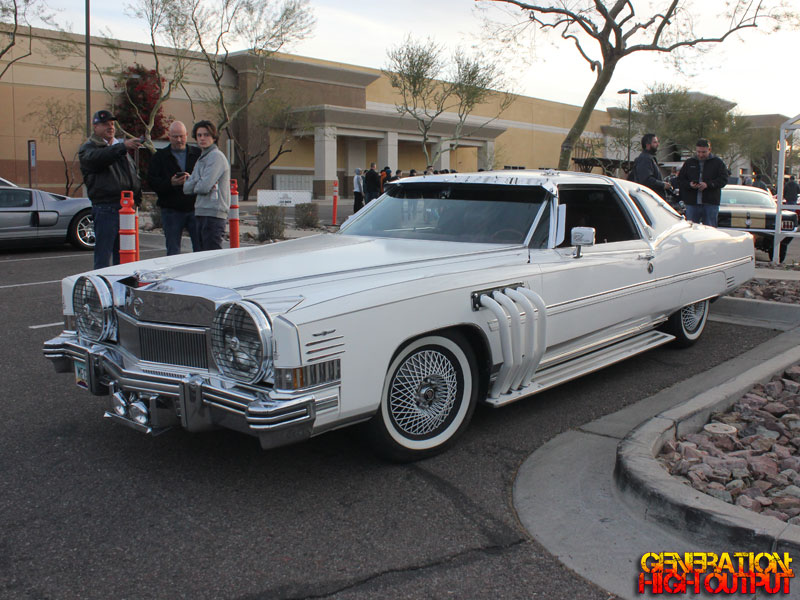
Wisco took a car that was already a standard of luxury and prestige and just added MORE to it. More chrome, more trim, more everything. The car’s exterior is extremely busy. Most notable are the completely unnecessary exhaust header extensions that exit through the front fenders and pass through the running boards to the rear of the vehicle. The hood was not open on this car, so I could not verify if they were functional or simply a decoration.

Up at the front, an oversize waterfall grille and hood ornament are all done in chrome. The standard headlights are shrouded by oversize covers that resemble a 1920s car. A pair of fog lights were also added. Again, “more is more” was the mantra here.

With so much chrome, the fixed exterior windshield visor was probably a necessity to prevent the driver being blinded by the glare of his own vehicle.
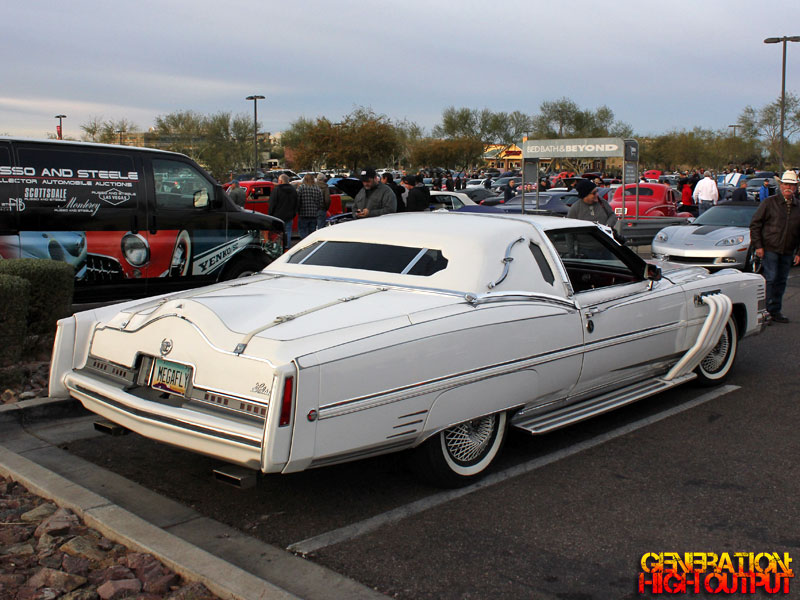
From the rear, the car has a vinyl roof with a Landau bar, and miles of chrome trim adorning the body lines, window trim, and just generally stuck on all over the place – such as behind the rear wheel arches. It has running boards, similar to those found on full size vans. It has decorative trunk straps similar to the Excalibur, though these are not functional. The car sports dual exhaust with horizontal tips. The wheels are quite unusual and I don’t know how to describe them other than white wire wheels.

Interestingly, this car does not have a Continental Kit at the rear, which would have involved relocating the license plate. It also does not have spare wheels mounted on the fenders, another common feature on neoclassic cars.

The interior is actually the most tasteful part of this car. It seems to have been updated with a leather trimmed center console integrating an iPad. The dark red and black leather upholstery looks right at home with the 1970s era wood. I would have expected this car to have swivel seats and an all white leather interior!

A brand-new 1972 Cadillac ElDorado 2-door hardtop coupe would have cost about $7,360 when new. The Wisco conversion added about $3,630 to the price, for a total of $10,990 in 1972 dollars. Adjusted for inflation, this car would cost the equivalent of $66,705 in 2018.

There’s not a ton of information about Wisco or these El Clasico Cadillac conversions online, so if you have any information, please do share it with us!

Grullon GT8 GP Kit Car vs Factory Five GTM


There is no question that the Chevrolet Corvette is an American legend. It is steeped in tradition, history, and has a true racing provenance. The Corvette is one of the great American sports cars of all time. Dollar for dollar, it’s hard to imagine a car that offers a better value and is both docile enough for everyday use, but performs outstandingly well on a track.

But there is one drawback – Corvettes are everywhere. Every car show in every city has dozens of Vette owners and if you go to a lot of car shows like I do, Corvettes are quite commonplace. They don’t draw crowds of admirers with camera phones the way a flashy new European exotic car does.

Now I am not hating on Corvettes, I like them a lot. But there are a lot of people in the world who aren’t content to blend in – they need to stand out. They need a car that makes a statement about them as an individual – a reflection of their personality. A car like the Grullon GT8 will definitely stand out in a crowd, as this one did at my local Cars and Coffee show in Scottsdale.
The Grullon GT8 is a kit car manufactured by DDR Motorsport in Miami, Florida. While the Grullon looks as exotic as anything from Italy, it is based on the 1997-2002 Chevrolet Corvette C5. It has vertical doors, sharp angles, a roof scoop, and a massive fixed wing in the rear. It will draw as much attention as a Ferrari or Lamborghini for a fraction of the price.

But wait, isn’t there already a C5-based kit car? You are correct – the GTM Supercar from Factory Five Racing has been out for years and comes from a highly reputable and established company. As far as I can tell, the Grullon is a direct competitor to the GTM that appears to be trying to undercut them on price.


Let’s take a look at some figures and do a comparison of the Factory Five GTM vs the Grullon GT8:

Factory Five GTM Grullon GT8
Parent Company Factory Five Racing DDR Motorsport
Based In Wareham, MA (USA) Miami, FL (USA)
Year Established 1995 2001
Base Price $24,990 $17,995
Kit Includes Tubular spaceframe chassis
All body panels
All DOT glass
Steering system
Fuel, Brake, Pedal system
Cooling system
Complete interior kit
Complete electrical kit
Full exhaust system
Full wiring harness
Relocation brackets, mounting hardware
Tubular spaceframe chassis
Fiberglass body panels
Custom Fuel Tank
Front and side glass
Front and rear lights
Cooling System
Dashboard
Center Console
Hardware
Does Not Include Engine
Transaxle
Fuel Tank
Front & Rear Suspension
Wheels and Tires
Engine
Transaxle
Front & Rear Suspension
Steering System
Seats
Gauges
Side View Mirrors
Wiring Harness
Wheels and Tires
Assembly Time Approx. 600 hours ??
Curb Weight 2,400 lbs (1089 kg) 2,700 lbs (1225 kg)
Road Legal In: USA, Canada, International USA, Canada, International

The Grullon sounds enticing, coming in at $6,995 below the price of the Factory Five kit. However, it does not include a number of components such as an exhaust system, seats, gauges, rack and pinion steering, engine wiring harness, and some other items. With the Factory Five kit, some of these are included and some of them come from the donor car. The Grullon does come with its own custom fuel tank, while the GTM adapts the OEM fuel tank from the donor car.

Both cars would be a significant project for someone who is handy with tools and willing to do most of the work themselves. With both kits, the purchaser needs to find their own engine and transaxle as well as a lot of parts from a donor C5 Corvette. Then factoring in things like paint, vehicle inspection and registration, and other costs for hardware, etc. it can really add up. Factory Five estimates that most of their customers spend $35,000 to $50,000 for a completed vehicle – but of course that could go up depending on your specific wants or needs. I could not find a total cost to build estimate on DDR’s website.

The Grullon that I saw at my local car show is actually the upgraded GT8 Grand Prix model, which features numerous carbon fiber body panels in addition to fiberglass. The GT8 GP kit starts at $26,405 as of 2019.

If you want a head-turning car that won’t break the bank, a Corvette-based kit car may be what you’re looking for. With two different kits available, I would encourage potential buyers to do their research before picking one. While I cannot personally vouch for either one, it is interesting to see another option enter the market.

Have You Driven A Mazda Lately? (Craigslist)

Sometime in the mid 80’s Ford chose to improvise rather than adapt or overcome. Instead of predicting the market shift or adapting while it was Ford sat around and watched the Japanese gobble up their cash. They decided that to beat the Japanese at their own game they would be the Japanese at their own game. Continue reading

1994 Chevrolet S-10 Custom Truck

During the 1950s and 1960s, the Kustom Kar scene in Southern California was in its heyday. Guys like Sam Barris, Ed “Big Daddy” Roth, Von Dutch, and Gene Winfield were customizing and modifying cars in extreme new ways. With chopped roofs, shaved trim and smoothed sheet metal work, these customized cars came to be known as “lead sleds.” A favorite vehicle of choice in the scene was the 1949-1951 Mercury coupe.

What these builders would do is combine parts from different cars in order to make a truly unique creation. For example, a Kustom Kar might use a Ford grille and headlight trim rings, a Lincoln bumper, Cadillac taillights, and side mirrors from a Buick. Smooth chrome hubcaps and “lake pipe” side exhausts are other design elements common with these cars.

This is what a proper kustom build looks like. 1951 Kaiser

While the idea of building a “parts bin” hot rod has been around for decades, you don’t really see this happening with modern cars.

Perhaps there is just too much plastic or the labor involved is too intense, but people don’t really swap mirrors, door handles, taillights, and other parts on cars these days. That’s what makes this truck so interesting.

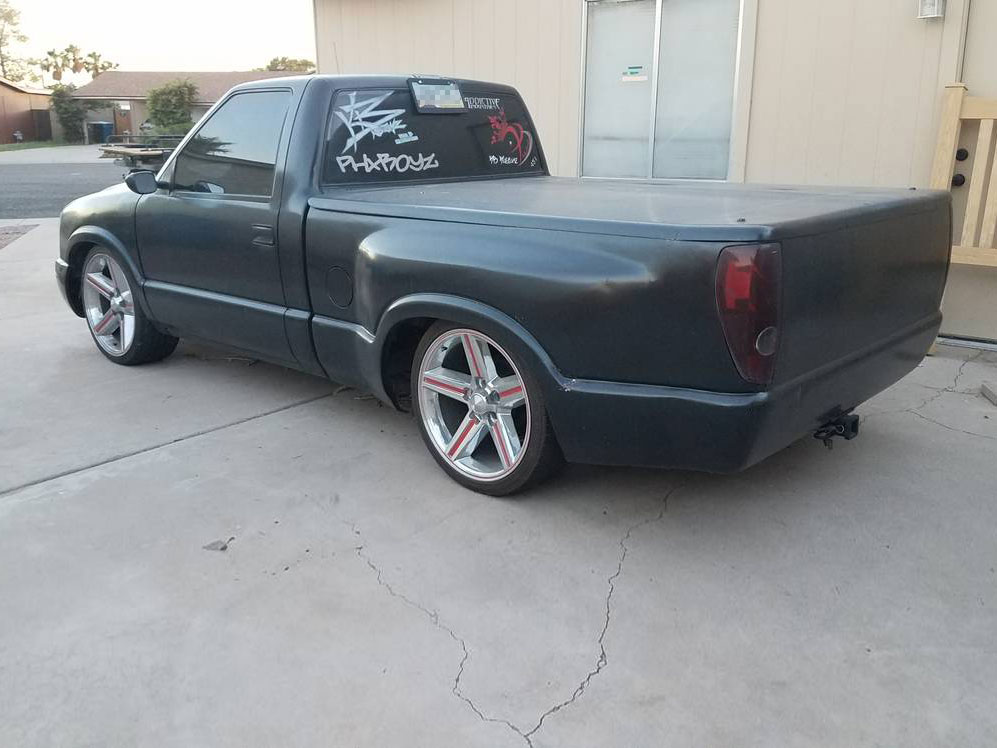
This truck appeared for sale on our local craigslist about two months ago. As you can tell, it looks very different from a conventional S-10 pickup. There has been a ton of body work done to this truck, with every panel modified in some way.

According to the listing, this truck has the HID headlights from a 2011 GMC Sierra with a custom front grille. The front bumper and hood are from a Ford Ranger Edge pickup. The side view mirrors are from a Suzuki Hayabusa sport bike!

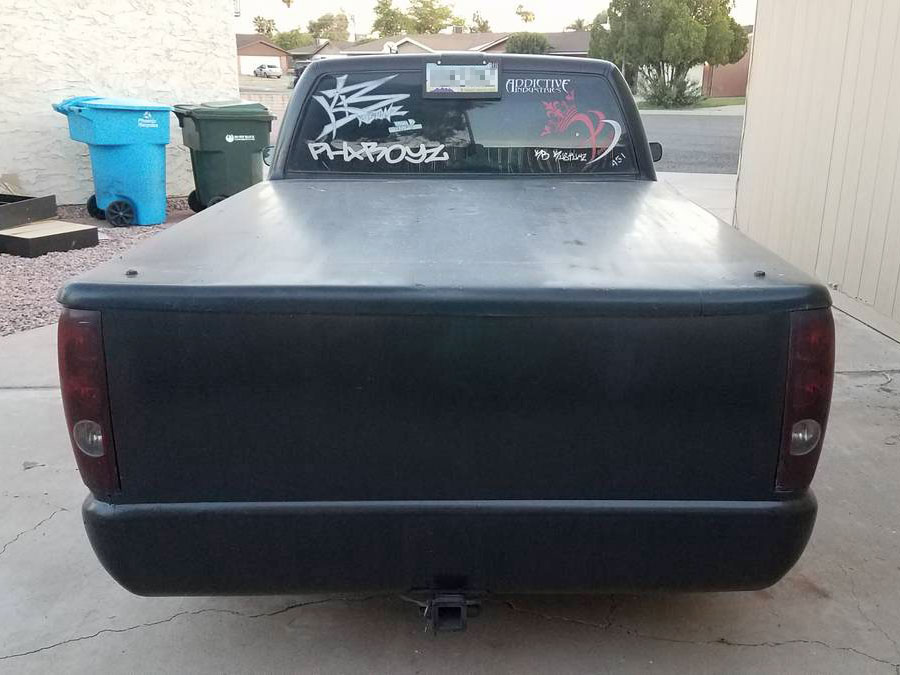
Moving to the rear of the truck, the bed is also highly customized. A fleetside bed was turned into a dually-style bed, and taillights from a Chevrolet Colorado pickup were swapped over. The tailgate and rollpan have all been shaved and smoothed into one big seamless piece. The whole thing is riding on a set of 20-inch IROC style wheels, similar to what would have come on a third-gen Camaro but larger than the O.E. size.

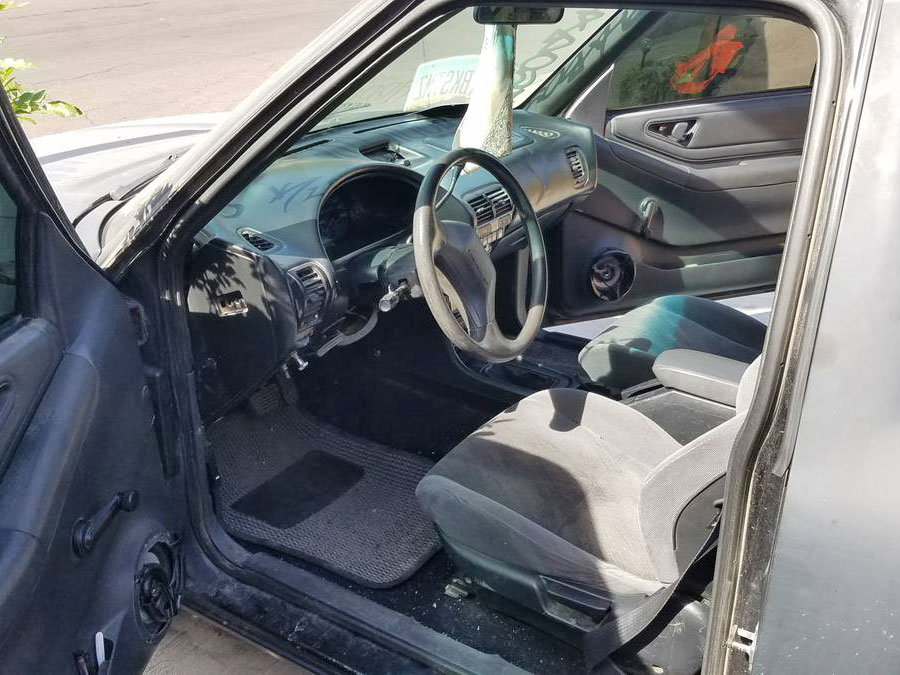
Finally, we move to the interior which features the seats, dashboard, and center console from an Acura Integra. The listing states that the gauges are hooked up and that it has working air conditioning with a brand new compressor.

I’ve got to say that looking at the pictures of this truck confuses my brain. The headlights and bed make it look like a full-size truck, but it’s not. The cab and the taillights are both from a compact pickup, and the interior doesn’t look like it would be in a truck at all.

I’m really kind of wondering what kind of person would build this truck. It must be someone with access to a lot of late-model parts, who maybe works at an auto salvage or recycling center?

The idea of combining parts from Chevrolet, GMC, Ford, and Acura into one vehicle sounds like it just wouldn’t work at all, but somehow this person has pulled it off. In Phoenix, there is no shortage of lifted and Pre-runner/baja style trucks that never ever leave the pavement. This truck is truly original, and it doesn’t look like everything else out there.


1988 Dodge Caravan SRT-4 Engine Swap

Though it may be hard to imagine a time when minivans were ever considered cool, that was certainly the case in the late 1980s and early 1990s.

In the era before SUVs and Crossovers, minivans were the hottest thing on the market. Chrysler CEO Lee Iacocca and his friend Hal Sperlich had imagined a vehicle that would hold seven passengers, have removable seats for extra cargo space, and get better gas mileage than a full-size van. Their dream became a reality in 1983, and the new Dodge Caravan and Plymouth Horizon minivans sold like hotcakes with sales topping 200,000 units in the first year alone. For the next 25 years, no one sold more minivans in America than Chrysler.

But somewhere along the way, minivans became uncool. The SUV boom of the 2000s and the Crossover Craze yielded vehicles that offered much of the same functionality without the “soccer mom” stigma of a sliding door.

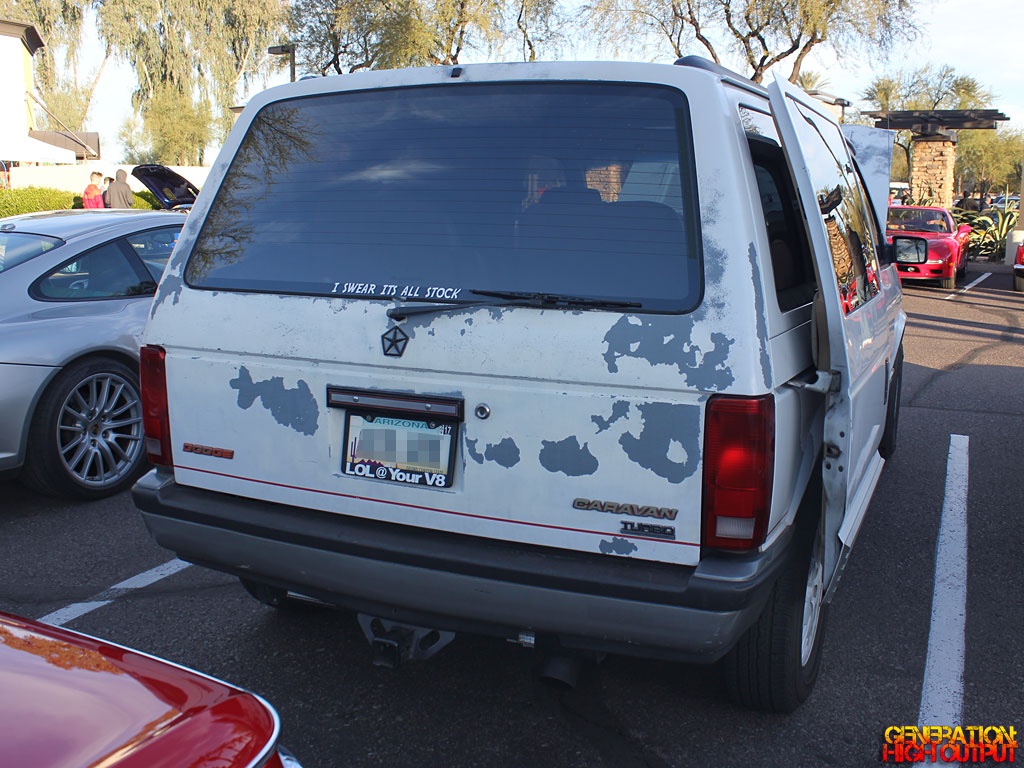
At a recent car show in Scottsdale, I saw a first-generation Dodge Caravan that really caught my eye. For starters, this was a car show that featured primarily European exotic and high-end supercars such as Ferraris and Lamborghinis. A 1988 Caravan with peeling paint definitely didn’t fit in with this crowd.

But as you might have guessed, this is no ordinary Caravan. This one has seen the original 2.5L 4-cylinder engine swapped out with a much more modern 2.4L turbocharged 4-cylinder from a 2004 Dodge SRT-4. Whereas the original engine made 100 horsepower, the new one puts out 230 horsepower in stock trim – but this one’s not stock.

With an AGP Zeta dual ball-bearing turbocharger, an air-to-water intercooler, upgraded fuel injectors, a MegaSquirt fuel management system, and a 3.5″ exhaust with Magnaflow muffler, this beast is putting down 305 horsepower and 365 lb-ft of torque at the wheels! Wow!

A spec sheet on the vehicle says it has run 12.6 in the quarter mile @ 111 mph on E85, 25 lbs of boost, and slicks. With a fast reaction time, that puts it on par with a base model C6 Corvette – for a lot less dough. It’s also been converted to 4-wheel disc brakes, with the front brakes and suspension from a 1995 Grand Caravan and the rear disc brakes from a 1993 Dodge Daytona R/T.

Part of why I love this van is because it pulls off the “sleeper” look quite well. The peeling paint and OEM-style wheels do not give any indication that this vehicle is actually quite fast, and the “Turbo” and “SRT” badges may be dismissed as purely ironic – until the turbo spools up and it blows your doors off.

The other reason why I love this van is that a long time ago, our family had a blue 1994 Caravan which I remember fondly. This was the era before dual sliding doors, power liftgates, and fold-flat seating. These old vans are super primitive by today’s standards, but the boxy design reminds me of my childhood.

I didn’t get to talk to the owner, but if you are reading this Mr. Caravan Owner, congrats on the awesome build.

2016 Ford Shelby GT-H Mustang

2016-ford-shelby-hertz-gth-mustang-frontWhen you hear the words “rental car,” what comes to mind? Perhaps a gutless econobox with a hard plastic interior that you rented at the airport in some other city? Well folks, this is no ordinary rental car. It’s a 2016 Shelby GT-H, and it’s a fresh take on an old idea: a race car that you can rent for a day. Continue reading