PPE 1970 Chevelle Duramax 6.6L Swap with Twin Turbos

ppe-1970-chevelle-duramax-swap-profileWhen it comes to muscle cars, swapping out the engine is a great way to get more power. But you won’t find a 350, 383, or even a 454 cubic inch engine under the hood of this 1970 Chevelle. That’s because it’s powered by a 6.6L (403 cid) Chevrolet Duramax engine. That’s right, a diesel-powered muscle car!

As if that weren’t wild enough, the car also sports a custom twin turbo setup with two Garrett T-38R turbos pushing 30lbs of boost into the motor. Altogether, this little Chevelle makes 950 HP and 1,800 lb-ft of torque!

Continue reading

Datsun 240Z with Chevy V8 Swap

datsun-240z-v8-profileYesterday’s post featured a Nissan 280ZX with a Chevrolet LS1 motor. If you take that same concept and turn back the clock, you would have this car: a Datsun 240Z with a small block Chevrolet engine.

I crossed paths with this car at a show in Scottsdale. Unfortunately I did not get to meet the owner, so I don’t have too many details about the vehicle.

Continue reading

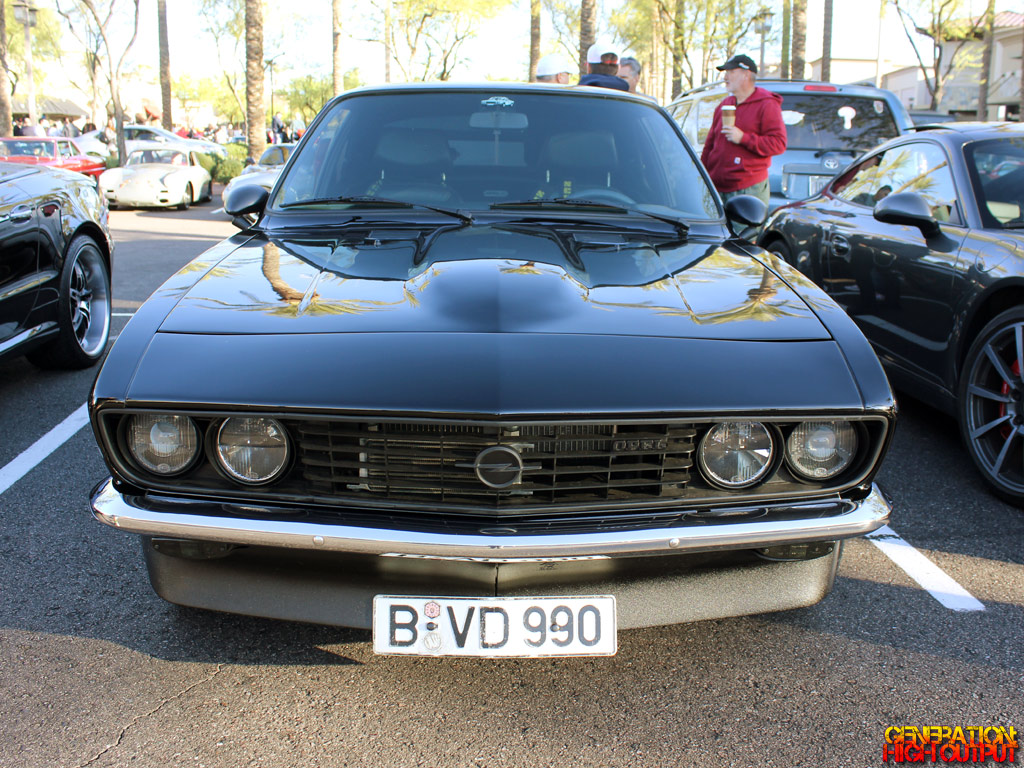
1971-1975 Opel Manta

opel-manta-frontIn the United States, there are stereotypes associated with drivers of certain types of cars.

For example, if you drive an air-cooled Volkswagen, people may assume you are a hippie. If you drive a BMW, people will assume you are both affluent and inconsiderate – the type of driver who would change lanes without signaling. And finally, if you drive a Honda Civic or other “tuner” car, you might be associated with street racing punks.

I have recently learned that such car/driver stereotypes are not unique to the U.S. In fact, there’s a popular one in Germany about Opel Manta drivers: that they are dull, lower-class, macho guys who drive aggressively, love their cars, and have a blonde girlfriend who works as a hairdresser.

Continue reading

1969 Opel GT 1.1L Coupe

1969-opel-gt-frontToday’s post is about an interesting little car from Opel, the German arm of General Motors. The Opel GT was a small, sporty car with an inline 4-cylinder engine that was produced from 1968 to 1973.

There were two engine choices available: a 1.1L engine and a larger 1.9L engine. The 1.1L engine made 67 horsepower and 62 lb-ft of torque and was coupled to a 4-speed manual. The 1.9L engine could be ordered with an optional 3-speed automatic transmission if desired. Buyers overwhelmingly chose the larger motor, causing Opel to discontinue the 1.1L engine after 1970.

Continue reading

Jet Industries Electravan 600

jet-electravan-600-profileElectric cars such as the Tesla Model S and Nissan Leaf are all the rage these days. These sexy cars offer zero emissions, good fuel economy, and near-silent operation. But there was a time not long ago when electric vehicles were not sexy or cool.

Early electric vehicles were converted from gasoline-powered vehicles using primitive chargers and batteries. They were a novelty item, mostly reserved for hippies and fringe-thinkers. They lacked the mass-market appeal of today’s sophisticated alt-fuel vehicles. Let’s revisit those times for a moment to take a look at once such vehicle: the Electravan.

Continue reading

1972-1973 Citroen SM Coupe

citroen-sm-sideIf there’s one thing you don’t see a whole lot of in America, it’s French cars. I’ve crossed paths with a few Citroens before including the Traction Avant and the Chevrolet V8-swapped DS that formerly belonged to Alice Cooper. Today I present another of Citroen’s automotive oddities: the 1973-1973 SM coupe.

The SM was Citroen’s attempt at making a sporty 2-door car based on the popular DS. Though it was sold in Europe and the rest of the world, the SM was only available in the U.S. for two years, making this a very rare car. Sales in the United States totaled 1,250 in 1972 and 1,150 in 1973, for a grand total of just 2,400 vehicles. The car was not imported after that because it did not meet the newly-enacted 5 mph safety bumper standards passed by the NHTSA.

Continue reading