
 Every year at SEMA you get used to the usual pattern.
Rat Rods. Diesel swaps. Twin turbo setups making 1500 horsepower. Restomods that cost more than a house. And then, buried somewhere between the corporate booths and the endless rows of first-gen Camaros, you find something that makes you stop walking for a second and just stare at it like you’re trying to figure out if it’s real or if you are just dehydrated after spending too long in the Las Vegas sun.
This year, that thing was a 2017 Lincoln Continental with a V10 shoved into it.
Not swapped in. Not “cleanly integrated.” Shoved in. With intent.
Built by Diego and Jack over at Build It Yourself (@biy_buildityourself), this Continental has been their personal 3-year quest to answer a question nobody asked:
“What if we took a modern front-wheel-drive luxury sedan and turned it into something that sounds like it escaped a prototype F1 testing program?”
And then, instead of stopping there…they kept going.
The Engine Situation Is Completely Unreasonable
Under the hood sits a 6.8L V10 sourced from a Ford truck. That alone would be enough for most people to call it a day, post a YouTube video, and go buy another project car to ruin. But that’s not what happened.
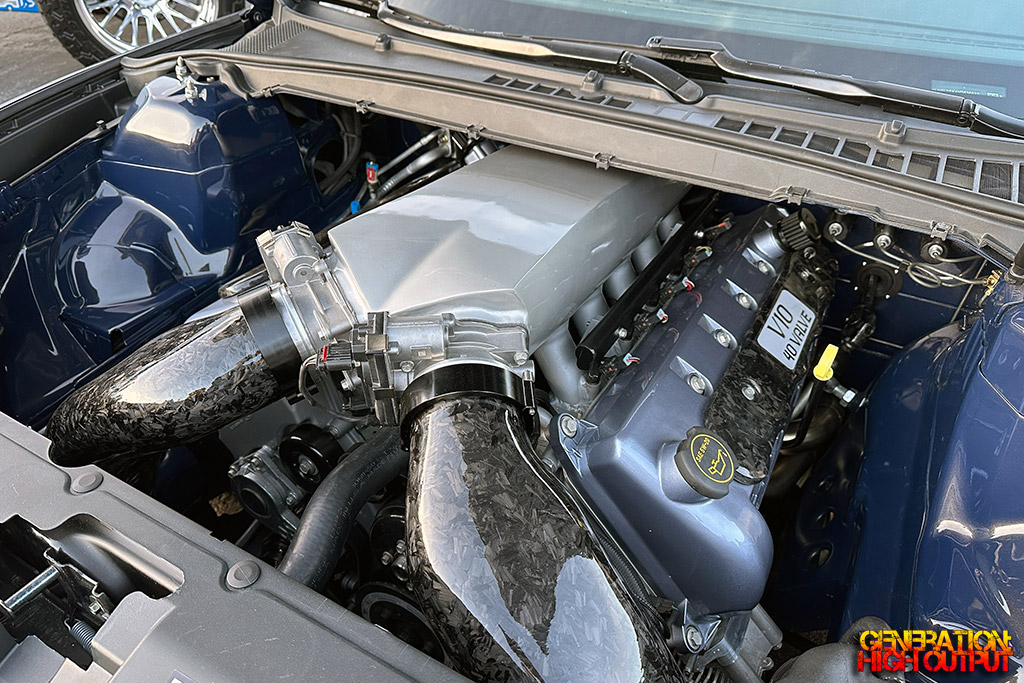
They went full send and built custom cylinder heads by literally cutting up and welding together four Ford V8 heads into two 4-valve heads for a V10. The result is what they’re calling the world’s first Ford 6.8L 4-valve V10.
As if that weren’t enough, the guys also fabricated custom camshafts, and a custom intake manifold for the engine. The whole thing runs on a FuelTech FT550 standalone ECU.
This is so much more than an engine swap, it’s re-engineering the entire car for a purpose it was never meant to serve.
At some point you have to assume they stopped asking “should we?” and switched entirely to “how hard could it be?”
Re-Engineered for Performance
From the factory, this Continental was front-wheel drive with an automatic transmission. Now it’s rear-wheel drive with a manual.
The guys swapped in a Getrag MT82 6-speed, which required fabricating a transmission tunnel into the floor pan like it was no big deal.
There’s something deeply amusing about a modern luxury sedan being forcibly converted into a layout it never had any intention of accepting. It’s like convincing a well-dressed accountant to start drifting.
 The Subtle Parts That Are Not Subtle At All
Underneath all of this chaos is a Mustang subframe, because apparently nothing says “this belongs together” like mixing luxury sedans with pony car suspension geometry.
The full custom exhaust system has been fabricated to the point where it sounds like an F1 car. It sounds absolutely unreal coming from a sedate-looking sedan.
There are also a number of 3D printed components throughout the build, such as the custom intake ducts. It’s satisfying how this build combines traditional fabrication and modern prototyping methods, like 3D scanning and design.
It Still Looks Like a Lincoln (Which Is the Weirdest Part)
The most unsettling part of the whole thing is that, from a distance, it still looks like a normal 2017 Continental. It has the stock body lines, and even retains the stock wheels. The only hint (aside from the sound) is the custom front bumper with forged carbon fiber air dam and accents.
And then you realize that underneath what looks like a quiet luxury sedan is a hand-built mechanical science experiment.
That mismatch is what makes it interesting.
Built in a Garage. Not a Facility. A Garage.
The part that sticks the most is not the spec sheet, it’s the origin story. This wasn’t built by a manufacturer, or a professional race shop, or a corporate-backed SEMA program with a marketing department and a render artist.
It was built by two guys in a home garage in Michigan. Which raises the uncomfortable question of what exactly separates “professional engineering” from “extremely determined individuals with too many tools and access to YouTube.”
Because at a certain point, the line gets blurry. And this car is way past that line.
Recognition at SEMA
Somehow, among everything else at the 2025 show, this Continental earned Pick of the Show from automotive photographer Larry Chen.
Which feels appropriate. Not because it’s perfect, but because it’s exactly the kind of thing that makes SEMA still worth walking through—something that shouldn’t exist, does exist, and forces you to rethink what is possible for a production car platform.
Final Thoughts
A modern Lincoln Continental was never supposed to become a V10, rear-wheel-drive, manual-transmission, garage-built engineering thesis with welded cylinder heads and an F1 soundtrack.
But that’s kind of the point.
This isn’t really about performance numbers or refinement or even whether it makes sense.
It’s about two people looking at a normal car and deciding, very calmly and very deliberately, that it wasn’t interesting enough yet.
And then fixing that problem the hard way.
Follow Build It Yourself:
https://www.youtube.com/@biy_buildityourself
https://www.instagram.com/biy_buildityourself/


