Cars and Coffee is a monthly gathering that is held in major cities around the US. This free event is open to all makes and models of vehicles, and brings together people who share a passion for cars and coffee. Most of these posts are from Cars and Coffee in Scottsdale, Arizona.


Aston Martin Valkyrie Spider “Legend” at Highline Cars & Coffee

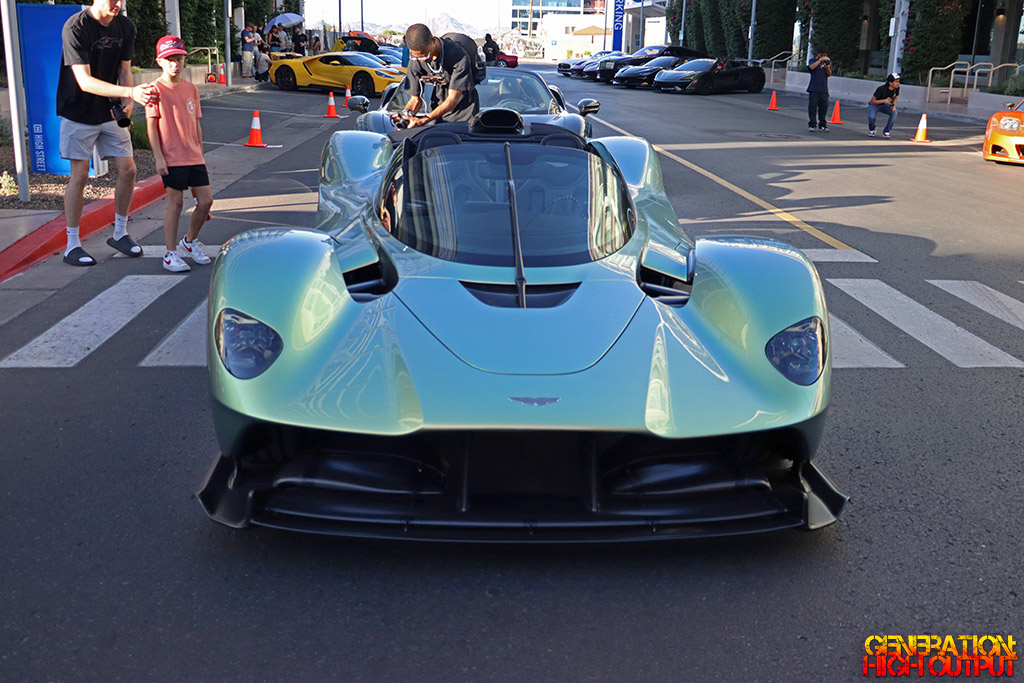
On Saturday, August 2, 2025, the Arizona car community witnessed something extraordinary at the Highline Autos Cars and Coffee in Scottsdale. Among the lineup of exotics and classics, one car stood above the rest: an Aston Martin Valkyrie Spider finished in stunning chromaflair paint called “Verdant Jade.”

Nicknamed Legend,” this example is 1 of just 85 Valkyrie Spiders built worldwide. Though it was never sold in the U.S., this one was imported under the Show and Display rule, making it one of only a handful of these cars in the country. Recently delivered by Miller Motorcars, it belongs to Justin Choi, a tech entrepreneur and avid collector with a taste for rare and uniquely customized exotic cars.

According to his profile, Justin Choi is a multi-exit founder who loves to build up companies and people. When he is not working at one of his business ventures, he is also a serious car enthusiast.

Choi’s garage includes some heavy hitters: a right-hand drive Honda NSX-R and a 2020 Ford GT. According to his Instagram profile, he has a Pagani Utopia Roadster in Habanero Red and a DeTomaso P72 on order. Like the Valkyrie, these are top-tier dream cars in terms of performance and design.
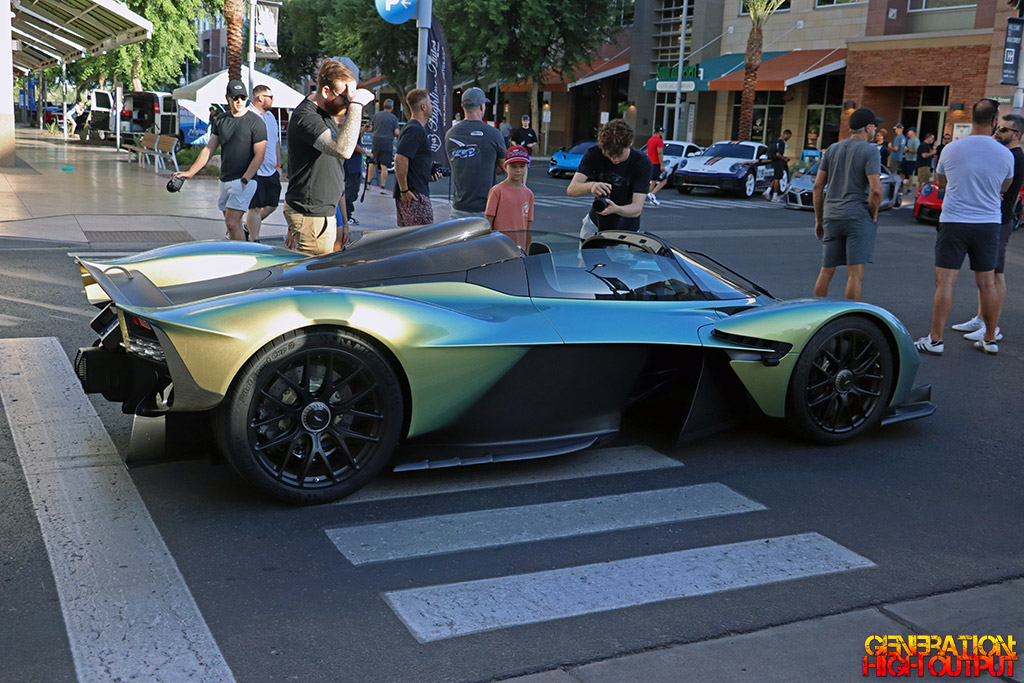
Custom paintwork has become something of a calling card for Choi. He made waves in 2020 with his Ford GT featuring a one-off, factory-commissioned Mystichrome paint job that cost a reported $100,000. The theme continues with the Valkyrie Spider. Verdant Jade is a shimmering, color-shifting hue that moves from green to gold with a base of steel blue, creating an effect that changes constantly under different lighting.

The Valkyrie is one of the most ambitious projects ever attempted by Aston Martin. First teased in 2016 and revealed in 2017, the car finally began production in late 2021, finishing in December 2024.

The Valkyrie (and its related models, the Valkyrie Spider and AMR Pro), were developed with Red Bull Racing as a track-focused hypercar that provides a Formula 1-inspired driving experience. The engineering and aerodynamics in this car are unlike any other car on the road today.
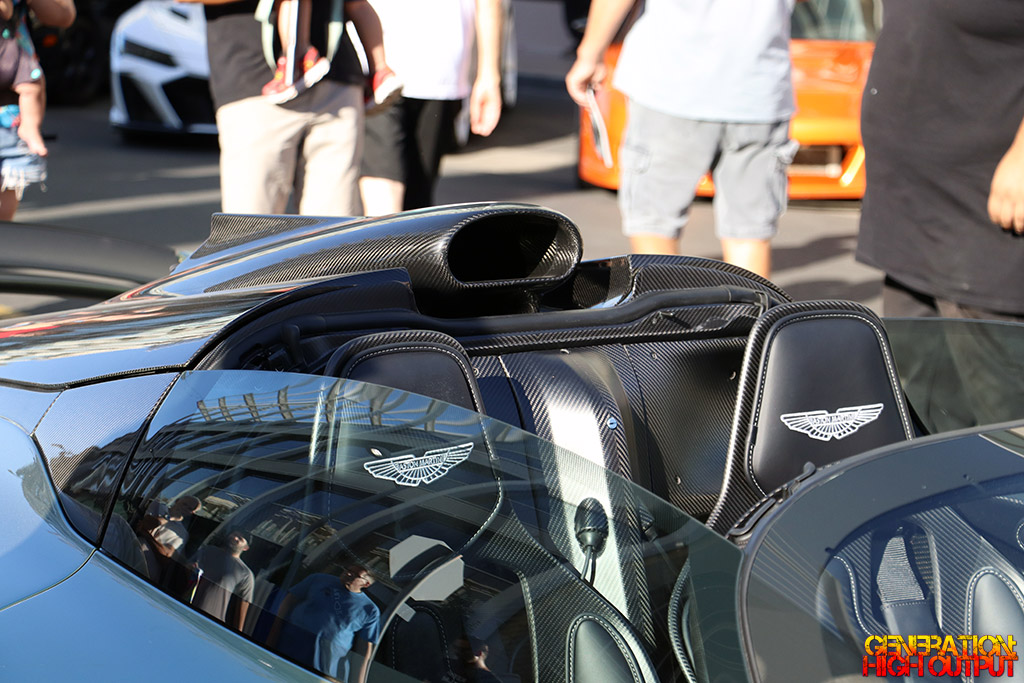
Powering the car is a naturally aspirated 6.5-liter Cosworth V12 engine, paired with a hybrid system, delivering a combined 1,100 horsepower. This allows it to blast from 0-60 in 2.5 seconds, with a top speed of 217 mph with the roof on, and 205 mph with the roof removed.

The Spider version enhances the thrill with its removable roof panels, giving occupants full immersion in the sound of the V12 revving beyond 11,000 rpm.

With a production run of just 275 Valkyries, only 85 are the Spider model, making this a rare and special car to see.

The Valkyrie Spider was undoubtedly the show stopper at the recent August 2025 Highline Autos Cars & Coffee event. Because I got there early, I was able to get some decent photos before the crowd got too big.
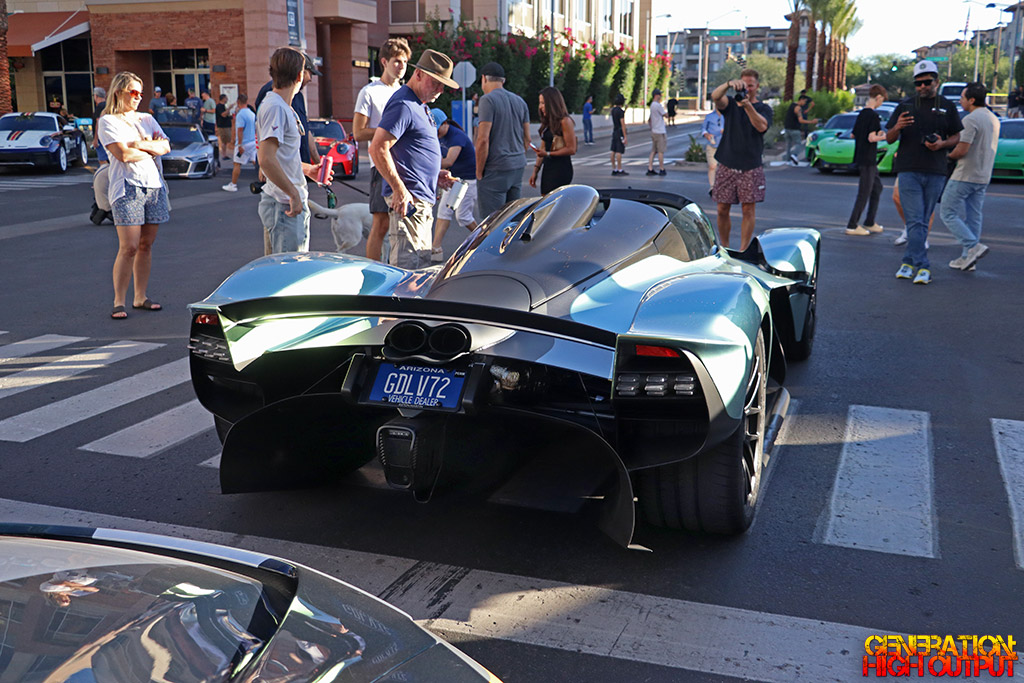
Even among Lamborghinis, Ferraris, Porsches, and McLarens, the Valkyrie had a presence that really stood out. Absolutely everyone had to stop and grab a picture of this crazy hypercar, which is valued at approximately $4 million.

For those who knew what they were looking at, they appreciated the rarity of seeing such a car on American roads. Because of federal regulations, the Valkyrie Spider cannot be fully homologated here, meaning Choi’s example is one of the very few brought in under the Show and Display exemption.

The name “Legend” feels fitting. For Aston Martin, the Valkyrie is already a landmark car, combining F1 engineering into a road-legal chassis. For Choi, it is another milestone as a collector of rare and exotic cars with wild custom configurations.

I was grateful for the opportunity to see the car in person, and the photos barely begin to convey how crazy it is in real life.

1937 Jaguar Custom Roadster

As a car guy, I can spot a Porsche 911, a Lamborghini or a ’69 Camaro from a mile away. What gives me pause at a car show is when there is a shape or form that I do not recognize. This was the case at Highline Autos Cars and Coffee in Phoenix, where I saw a very unique vehicle that drew me in for a closer look.

The car rides on a 1937 Jaguar chassis, however the front clip of the car (fenders, headlights, and grille) are from a Bugatti. It has big ponton fenders that evoke the streamline style of the 1930s, with covers over the rear wheels. The V-shaped frameless windshield is pure hot rod, with no roll bar to disrupt the body lines.

Entry is through a pair of windowless, low-cut doors with rear hinges. The rear of the car tapers to a boattail shape, similar to a Duesenberg or Auburn of the day.

Under the hood is a 2.6L V6 engine sourced from a 1973 Mercury Capri, coupled to an automatic transmission. A set of Stewart Warner gauges mounted in the dashboard provides vital information to the driver.

The interior is a caramel shade of leather with diamond quilted pattern on the seats and door cards. A large, wooden rimmed steering wheel looks the part of a vintage racer. The gauges and center console are accented with engine turned aluminum panels, reminiscient of the early days of aviation.

I don’t have a lot of details about the car, but it sure looked cool and drew a good amount of attention from folks at the car show.


DF Goblin Kit Car (Chevy Cobalt)

While most of the world’s mass-produced automobiles have the engine in the front, many high-performance sports cars have the engine in the middle of the car. The advantage of this design (engine behind the driver) is better weight distribution and handling. For anyone looking to purchase a mid-engine sports car, there are many different options to choose from across a wide variety of price points, ranging from $200,000 and up to less than $25,000.

$200,000 and up – Most Ferrari models, most Lamborghini models, Porsche 918, McLaren, etc.

$100,000 to $200,000 – Ford GT, Acura NSX, Audi R8

$50,000 to $100,000 – Chevrolet Corvette C8, Factory Five GTM, Grullon GT8, Lotus Exige, Alfa Romeo 4C

$25,000 to $50,000 – Lotus Elise, DeLorean DMC12, Porsche 914

$25,000 and Under – Pontiac Fiero, Toyota MR2, Fiat X1/9

The cars in this last group – the Pontiac Fiero, Toyota MR2, and Fiat X1/9 (or even a very ratty Porsche 914) are the most accessible to car enthusiasts. There are many examples of these cars available to buy under $25,000 – which sounds like a lot for a project car, but is actually quite affordable in the world of mid-engine cars. Indeed, Fieros are commonly available for $10,000 or less.

But now, there is a new contender in the mid-engine car market. Meet the DF Goblin from Red Oak, Texas (a suburb of the Dallas-Fort Worth metro area). The Goblin is a kit car – you assemble it yourself using parts from a donor car.

While other donor cars use parts from high performance cars such as the Chevrolet Corvette or Ford Mustang, the Goblin is based around the 2005-2010 Chevrolet Cobalt/Pontiac G5. Yes, the cheap commuter car that replaced the Cavalier. THAT Cobalt.

The philosophy behind the Goblin can be summed up in three words: low, light, and quick. While the base model Cobalt had a 2.2L Ecotec engine that produced 155 horsepower, the manufacturer states that 155 horsepower feels incredibly quick in a car that weighs just 1500 lbs (680 kg).

The car is designed to be affordable and easy for a DIY mechanic to build in their home garage. The kit is $6,800 and a donor car can be purchased for $500-1000 in many cases. The Goblin kit includes a fully welded mild steel chassis with no welding or fabrication skills required. A person with regular tools can swap over the engine and transmission, wiring harness, suspension, brakes, steering and fuel system from the donor car to the Goblin chassis.

Owners looking for more power can scout for a Cobalt SS (which was supercharged in 2005-2007 and turbocharged from 2008-2010). However, the company emphasizes building a base model Cobalt to start with and that bolt ons can be added later as needed.

I saw one of these kits completed at a local Cars and Coffee event in Scottsdale. I have to say that it sounds very appealing, given the abundance of cheap Chevrolet Cobalts out there.

While it’s easy to dismiss the car as a knockoff of the Ariel Atom, keep in mind that the Ariel Atom 4 starts at $74,750 – nearly 10 times the cost of the Goblin kit. The Goblin, very similar in appearance, can be built for a fraction of the price.

To be fair, the Ariel Atom makes 320 horsepower from a turbocharged 2.0L Honda engine, compared to the Goblin’s 155 HP (or 260 HP with Cobalt SS donor car). The Atom 4 will do 0-60 mph in 2.8 seconds, whereas the Goblin does 0-60 mph in 4.7 seconds. Both are significantly faster than say, a 2019 Toyota 86, which does 0-60 in 6.4 seconds.

For the price, I would say that the Goblin is in a whole new class of its own: Mid-Engine Sports Cars for Well Under $25,000. It seems like an incredible value for the money. I would love to take a spin in one and see how much fun they are!

For the off-road enthusiasts, be sure to check out the Goblin A/T, an off-road version which is a modern interpretation of the VW-based rail buggy cars.

https://dfkitcar.com/

Grullon GT8 GP Kit Car vs Factory Five GTM


There is no question that the Chevrolet Corvette is an American legend. It is steeped in tradition, history, and has a true racing provenance. The Corvette is one of the great American sports cars of all time. Dollar for dollar, it’s hard to imagine a car that offers a better value and is both docile enough for everyday use, but performs outstandingly well on a track.

But there is one drawback – Corvettes are everywhere. Every car show in every city has dozens of Vette owners and if you go to a lot of car shows like I do, Corvettes are quite commonplace. They don’t draw crowds of admirers with camera phones the way a flashy new European exotic car does.

Now I am not hating on Corvettes, I like them a lot. But there are a lot of people in the world who aren’t content to blend in – they need to stand out. They need a car that makes a statement about them as an individual – a reflection of their personality. A car like the Grullon GT8 will definitely stand out in a crowd, as this one did at my local Cars and Coffee show in Scottsdale.
The Grullon GT8 is a kit car manufactured by DDR Motorsport in Miami, Florida. While the Grullon looks as exotic as anything from Italy, it is based on the 1997-2002 Chevrolet Corvette C5. It has vertical doors, sharp angles, a roof scoop, and a massive fixed wing in the rear. It will draw as much attention as a Ferrari or Lamborghini for a fraction of the price.

But wait, isn’t there already a C5-based kit car? You are correct – the GTM Supercar from Factory Five Racing has been out for years and comes from a highly reputable and established company. As far as I can tell, the Grullon is a direct competitor to the GTM that appears to be trying to undercut them on price.


Let’s take a look at some figures and do a comparison of the Factory Five GTM vs the Grullon GT8:

Factory Five GTM Grullon GT8
Parent Company Factory Five Racing DDR Motorsport
Based In Wareham, MA (USA) Miami, FL (USA)
Year Established 1995 2001
Base Price $24,990 $17,995
Kit Includes Tubular spaceframe chassis
All body panels
All DOT glass
Steering system
Fuel, Brake, Pedal system
Cooling system
Complete interior kit
Complete electrical kit
Full exhaust system
Full wiring harness
Relocation brackets, mounting hardware
Tubular spaceframe chassis
Fiberglass body panels
Custom Fuel Tank
Front and side glass
Front and rear lights
Cooling System
Dashboard
Center Console
Hardware
Does Not Include Engine
Transaxle
Fuel Tank
Front & Rear Suspension
Wheels and Tires
Engine
Transaxle
Front & Rear Suspension
Steering System
Seats
Gauges
Side View Mirrors
Wiring Harness
Wheels and Tires
Assembly Time Approx. 600 hours ??
Curb Weight 2,400 lbs (1089 kg) 2,700 lbs (1225 kg)
Road Legal In: USA, Canada, International USA, Canada, International

The Grullon sounds enticing, coming in at $6,995 below the price of the Factory Five kit. However, it does not include a number of components such as an exhaust system, seats, gauges, rack and pinion steering, engine wiring harness, and some other items. With the Factory Five kit, some of these are included and some of them come from the donor car. The Grullon does come with its own custom fuel tank, while the GTM adapts the OEM fuel tank from the donor car.

Both cars would be a significant project for someone who is handy with tools and willing to do most of the work themselves. With both kits, the purchaser needs to find their own engine and transaxle as well as a lot of parts from a donor C5 Corvette. Then factoring in things like paint, vehicle inspection and registration, and other costs for hardware, etc. it can really add up. Factory Five estimates that most of their customers spend $35,000 to $50,000 for a completed vehicle – but of course that could go up depending on your specific wants or needs. I could not find a total cost to build estimate on DDR’s website.

The Grullon that I saw at my local car show is actually the upgraded GT8 Grand Prix model, which features numerous carbon fiber body panels in addition to fiberglass. The GT8 GP kit starts at $26,405 as of 2019.

If you want a head-turning car that won’t break the bank, a Corvette-based kit car may be what you’re looking for. With two different kits available, I would encourage potential buyers to do their research before picking one. While I cannot personally vouch for either one, it is interesting to see another option enter the market.

Not Sold Here: Honda Beat

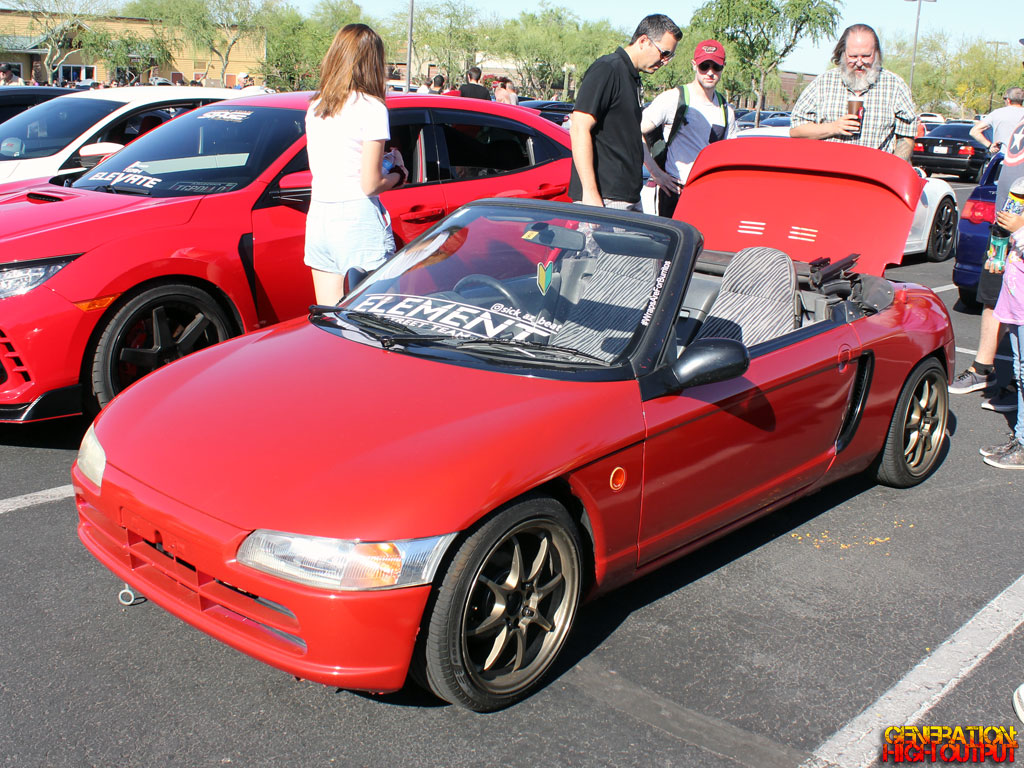
In today’s edition of Not Sold Here, we are featuring the Honda Beat. The Beat is a special class of super small vehicles for which there is no equivalent in the United States. Smaller than a subcompact, these cars are often called “kei cars” in Japan. I featured another Japanese vehicle, the Subaru Microvan, a few years ago. The difference is that the Subaru was actually imported to the U.S. while the Honda Beat was not.

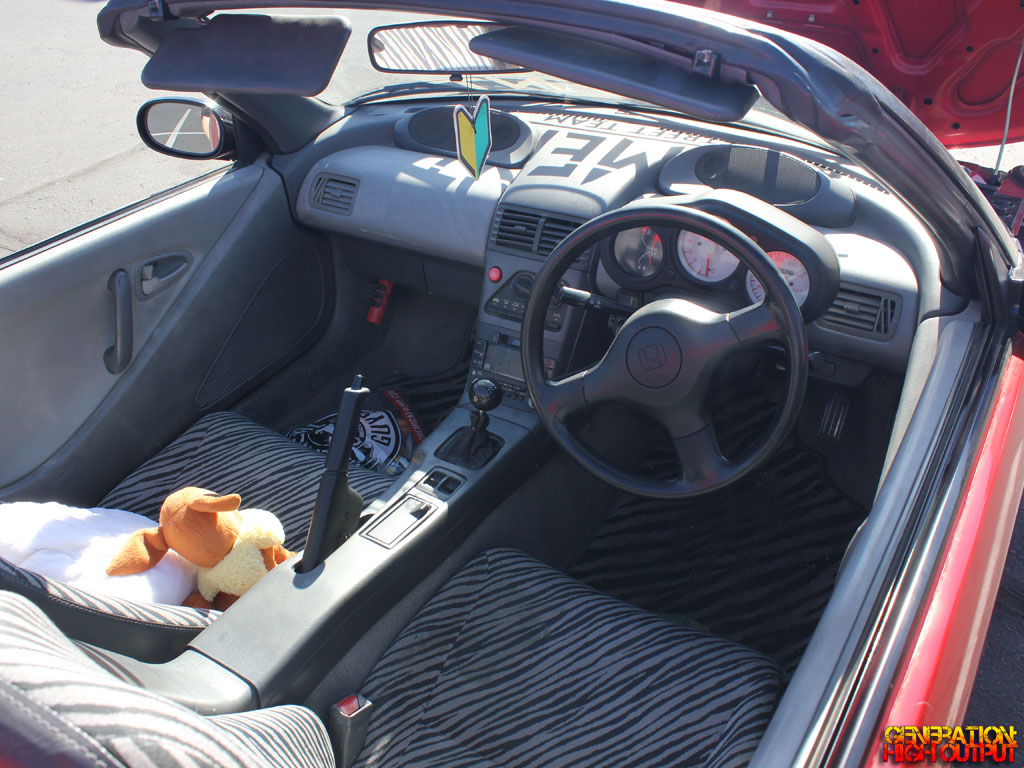
I ran across this Honda Beat at the monthly Cars and Coffee gathering in Scottsdale. It is unbelievably small in person. Although it’s hard to visualize, the Honda Beat is nearly 10 inches narrower and 400 lbs lighter than the original Mazda Miata. It really is like a street legal go-kart. The philosophy behind these kei cars is to have small, efficient transportation for the narrow streets and crowded cities of Japan. As such, they were not designed to be particularly sporty. The inline 3-cylinder engine displaces 656 cc (40.0 cubic inches) and puts out a whopping 63 horsepower. The Honda Beat was only available with a 5-speed manual transmission.

There is a law in the United States that allows vehicles 25 years or older to be imported and driven on the roads, even though the vehicles do not meet US Federal crash test standards. This “show and display” law is the reason why you might be seeing more R32 Skylines and other right-hand drive Japanese vehicles at your favorite car shows. It is very likely that this Honda was imported under that same law.

About 34,000 of these cars were built during the production run from 1991 to 1996. It is unknown how many of them have made it to the U.S., but I’m certain the number is quite small. The car drew a huge number of curious onlookers at the show – much more than some of the brand new exotics and supercars that cost many times what this vehicle is worth.

This is a very unique car and I’m glad to have run across it at the Saturday Motorsports Gathering put on by Scuderia Southwest.

Intermeccanica Indra 2+2 Coupe

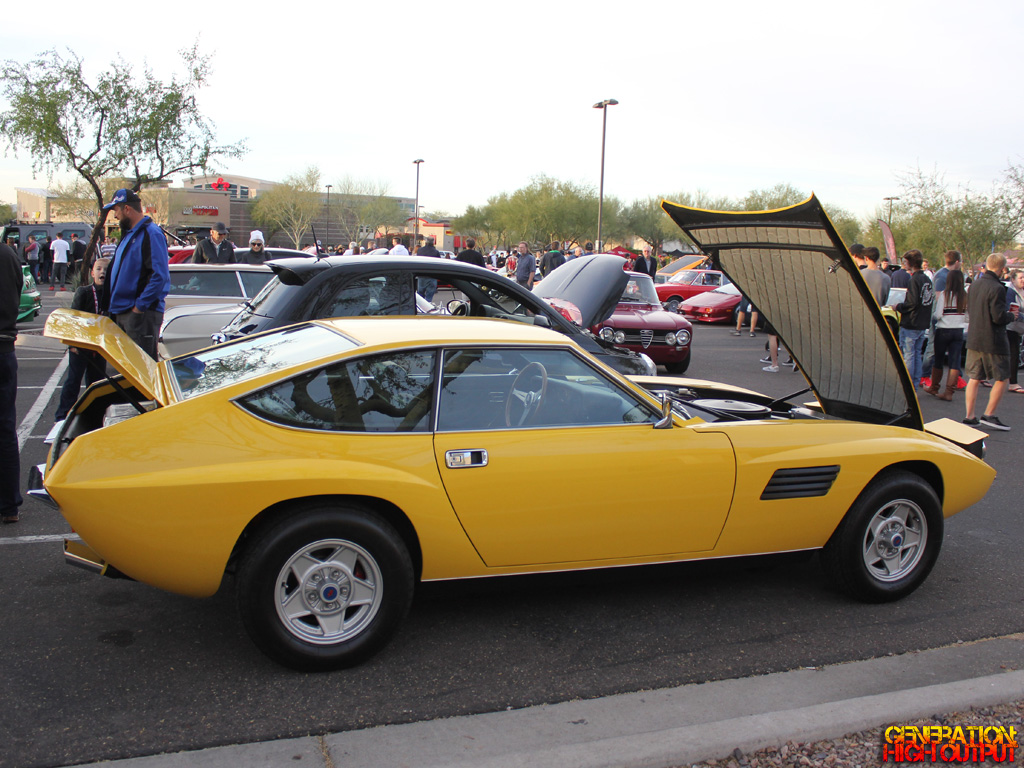
Now HERE’s something you don’t see every day! In fact, I would be quite surprised if you had heard of an Intermeccanica Indra before. I certainly had not, until I was standing in front of this one at the monthly Cars and Coffee car show in Scottsdale, Arizona. I was vaguely familiar with Intermeccanica because of the Italia, the car which took me years to figure out what it was.

Founded in Torino, Italy in 1959, the company began producing small numbers of sports cars such as the Apollo GT. I think the design of the Indra is very representative of what was happening in Italy in the 1970s. You can see a little bit of everything in this car, yet it doesn’t look like a carbon copy of a Ferrari, Lamborghini, or DeTomaso. The Intermeccanica has some distinct design elements, like the shape of the quarter windows, the flares over the wheel arches, and the vents on the front fenders.
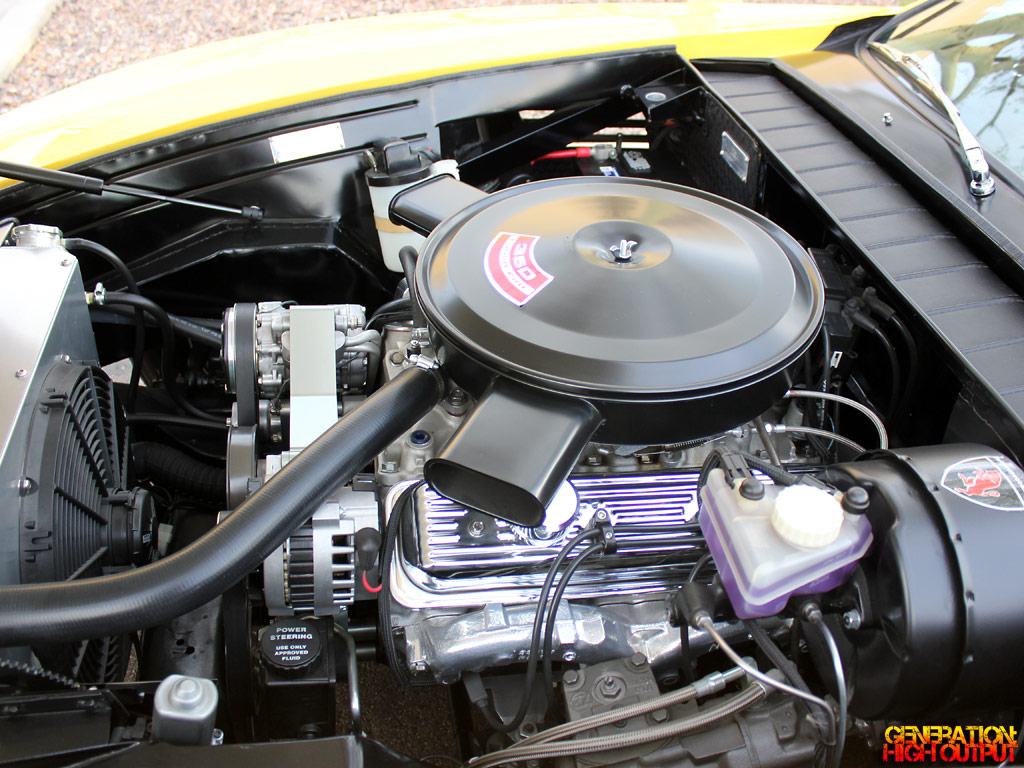
The Indra is an exceptionally rare car, with only 127 examples completed between early 1971 and mid-1974. According to the website intermeccanica.org, the breakdown was approximately 60 convertibles, 40 coupes and 27 two plus twos. That makes this yellow 2+2 the rarest of the rare! This one is well-equipped with an automatic transmission, power windows, air conditioning, a stereo, and a full complement of gauges.With a Chevrolet 350 under the hood, maintenance is both affordable and easy on the powertrain. I spent a few minutes chatting with the owner of this wonderful and unique car. He told me the car has had a complete restoration on the paint and body, with everything sorted out. Standing next to it, I can attest that for a 1970s Italian car, this one was in stunning condition.

The one custom touch the owner made was to have the Intermeccanica logo embroidered on the seats – he said it didn’t come that way from the factory, but he really liked it.

The car was on Dealer plates from South Dakota. A sign in the trunk said that the car was restored by Executive Touch Restorations in Sioux Falls, and that the paint and body work was done by Pierre’s Body Shop, also in Sioux Falls.

It rides on a set of Cromodora 6Jx14H2 14-inch wheels with period-correct Michelin XWX tires.

I really enjoyed learning about this interesting piece of automotive history, and I hope that you enjoyed reading about it!