Not Sold Here: 1961 Mistral Roadster

One of my favorite local car events to attend is the Concours in the Hills car show, held each year in February in Fountain Hills, Arizona. Concours in the Hills is not a formal concours with judges in straw hats and white gloves awarding points. It is a more casual, informal event. The 2020 event was the largest ever, with more than 1,000 vehicles wrapping all the way around the perimeter of the lake and its namesake fountain. It was a stroke of good fortune that this event was able to be held in 2020 and not cancelled like so many others due to the COVID-19 pandemic.

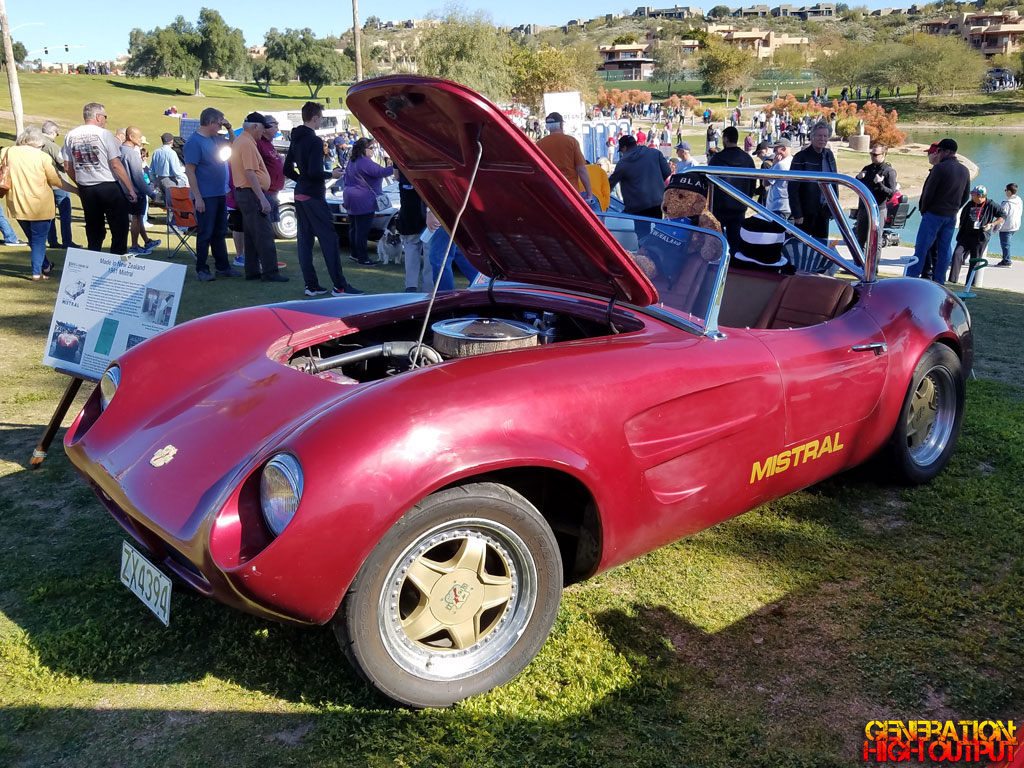
One of the first cars I saw at this year’s show was a unique little two-seater that caught my eye. Looking a bit like a Shelby Cobra or a Scarab, the car had the name “MISTRAL” in gold lettering on each side. Also, it was a right hand drive car – which are not commonly seen in the U.S.
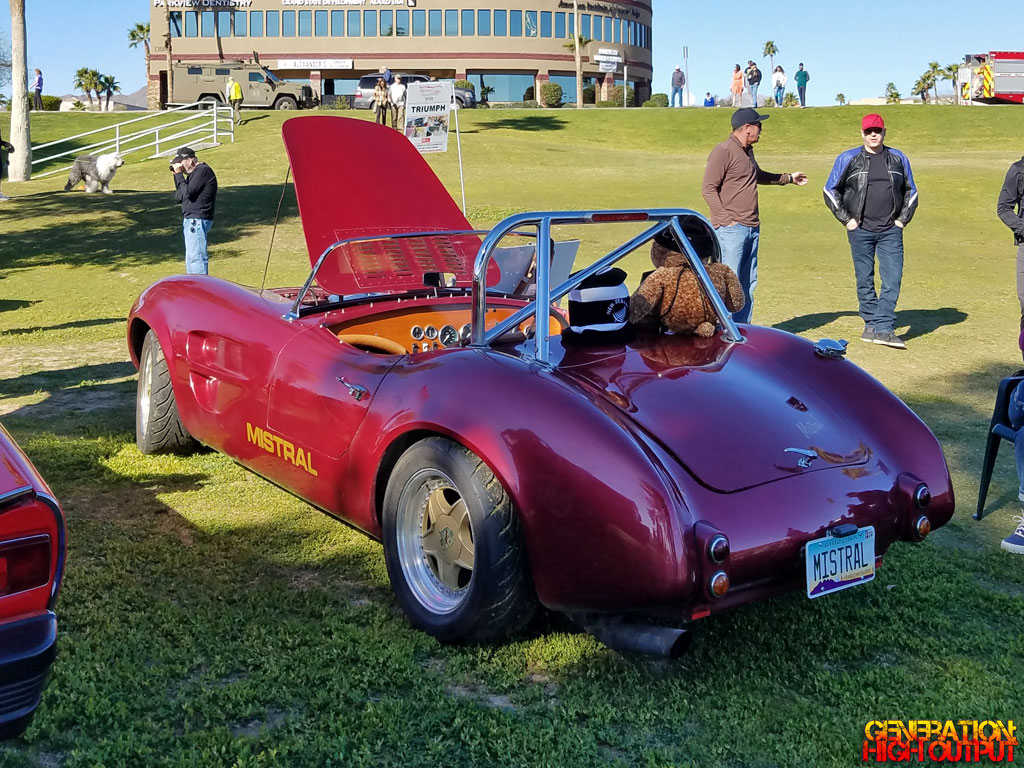
A cheery couple was camped out next to the car in folding chairs. They had a large sign next to the car that told the history of the vehicle, which I will provide below:

“The Mistral body was designed by Bill Ashton in England during the early 1950s. Constructed out of a new material called fibre glass, it was developed to be used on Buckler and Lotus chassis in the 750 Motor Club’s 1174 Formula class. A few years after introduction it was sold to Weltex in Christchurch, New Zealand and a year later to coach builders Elmslie and Flockton in Dunedin.

Production records are gone, but there were approximately 200 total. Mistrals were sold as “rollers” ready to install the engine and transmission, which the customer specified. Because you could specify a Corvette engine and transmission (and consequently a finished weight of 1900 lbs), several were road racing in the USA during the 1958-62 era.

Although various cars like Austin and Toyotas were assembled in New Zealand, Mistral was probably the only New Zealand car company. The map of New Zealand can be seen on the insignia.”
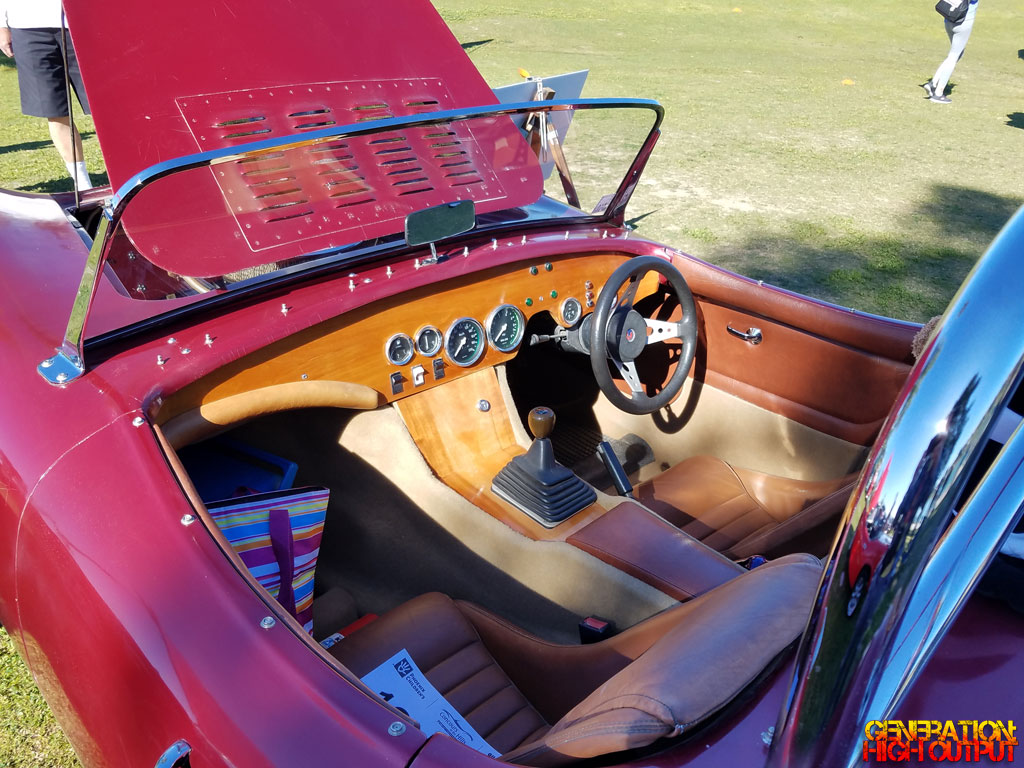
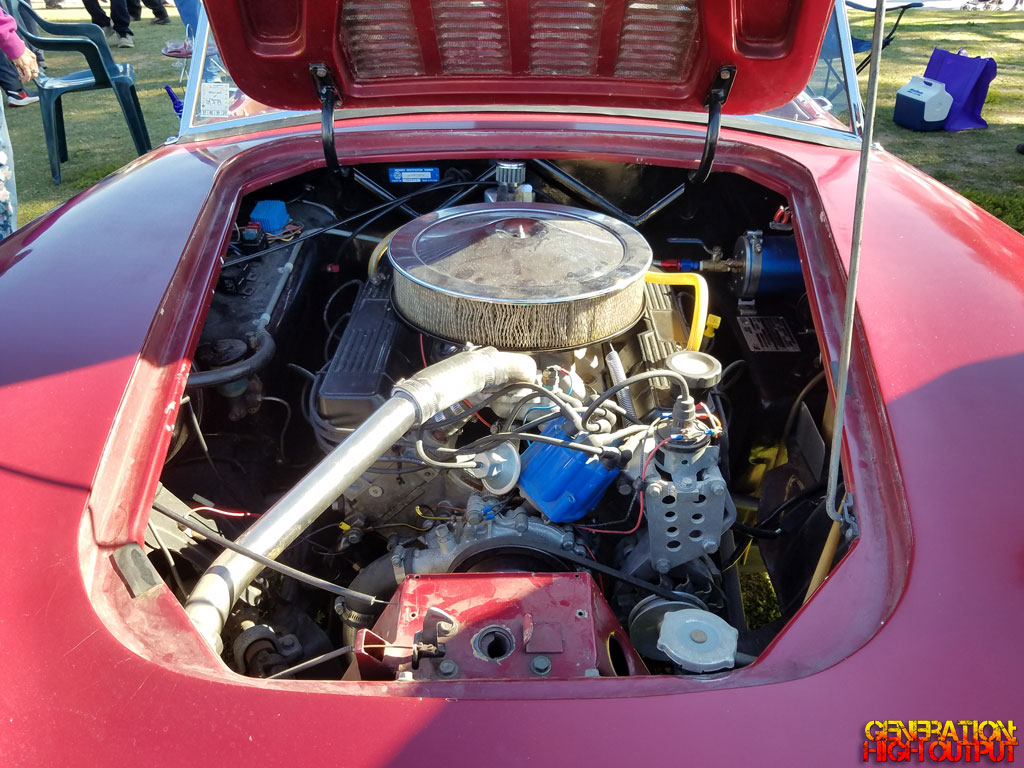
“This 1961 Mistral has evolved since it’s birth as most did. For about the last 35 years it has had a Rover V8, Toyota 5 spd., Mazda LSD, and Vauxhall front end. It raced in street legal class in New Zealand and more recently, to remain legal, had to have a taller roll bar and 3 piece wheels to accept modern tires.”
It is a very cool little car, and one that I was delighted to have seen at the car show. Thanks to the owners for bringing it out!

The Very Rarest: 1966 Shelby Lonestar Concept Car

During his lifetime, Carroll Shelby accomplished more than most men could in two lifetimes. He was a test pilot in the Army Air Corps during the second World War, he was a Formula One racing driver, and would later go on to found Shelby American in 1962. Even people who do not know much about Carroll Shelby the man know him for his creations: the Shelby Cobra, the Shelby Mustang, and of course, for his work with Ford on the Le Mans-winning GT40.

These cars have taken on a mystical aura over the decades, with originals skyrocketing in value and plenty of replica and tribute cars rushing in to fill demand in the market. Shelby’s dedication to building high performance cars has earned the brand enormous respect and prestige among enthusiasts and collectors.

But I’m willing to bet that even the most die-hard Carroll Shelby fan has probably not heard of the Shelby Lonestar before. I will admit that I hadn’t heard of it until I was standing in front of the car earlier this year in Arizona.

I am a Carroll Shelby fan, having toured the factory in Las Vegas and having attended the largest gathering of GT40s in half a century at the 2016 Pebble Beach Concours d’Elegance. But the story of the Shelby Lonestar was one I had not heard before, and it’s worth sharing.

Towards the end of his contract with Ford, Shelby American began working on the next evolution of the Shelby Cobra, a car that was referred to internally as the “Cobra Mk III.” Shelby hired British designer Len Bailey, who had designed the GT40 Mk III and GT40 Mirage.

It is no coincidence that the car resembles a GT40, using a similar tube chassis design with riveted aluminum body work. The mid-engine, two-seater is powered by a Ford 289 V8 engine producing 320 horsepower and paired with a 5-speed ZF gearbox. The Halibrand wheels and Smiths gauges round out the car’s provenance as a born racer. Shelby had intended to call the car a Cobra, but the name belonged to Ford. Shelby opted to call the car Lonestar, an homage to his home state of Texas.

This particular car was featured on the cover of Shelby’s parts catalog, on a poster, and was featured on the cover of Autoweek magazine in December of 1967. One version of the story says that U.S. safety regulations halted the car’s production; another says that Ford declined to finance production of the car. In any case, the idea of a Mark III Cobra  was abandoned after this one and only prototype was built.

The car sat in storage until October 1968, when it was advertised for sale in Autoweek magazine for the sum of $15,000 (equivalent to $110,000 in 2019). It did not sell, and changed hands a few more times before being purchased by Michael and Christa Shoen in 1975.

The Shoens sought the expert help of Cobra restoration expert Geoff Howard of Danbury, CT for help with the restoration – which ended up taking nearly a decade. The completed car is 95% original, aside from a missing front bumper which had to be painstakingly re-created. The Shelby Lonestar made its debut at the Amelia Island Concours d’Elegance in 2018 to great acclaim.

I saw the car at a few shows in February 2019, now in its new home in Paradise Valley, Arizona. This is easily the rarest car to bear the Shelby name and although it doesn’t have the racing pedigree of the GT40, this one-off is the kind of rare treat enthusiasts fawn over. It sounds as though the car has finally found the loving home and the appreciation it deserves, and will hopefully bring the owner and Shelby fans lots of joy for years to come.

Read More:

https://web.archive.org/web/20190521003002/http://thecobraferrariwars.com/cobra3.html

https://autoweek.com/article/car-life/throttle-back-thursday-lonestar-was-gt40-based-cobra-successor-shelby-should-have

Grullon GT8 GP Kit Car vs Factory Five GTM


There is no question that the Chevrolet Corvette is an American legend. It is steeped in tradition, history, and has a true racing provenance. The Corvette is one of the great American sports cars of all time. Dollar for dollar, it’s hard to imagine a car that offers a better value and is both docile enough for everyday use, but performs outstandingly well on a track.

But there is one drawback – Corvettes are everywhere. Every car show in every city has dozens of Vette owners and if you go to a lot of car shows like I do, Corvettes are quite commonplace. They don’t draw crowds of admirers with camera phones the way a flashy new European exotic car does.

Now I am not hating on Corvettes, I like them a lot. But there are a lot of people in the world who aren’t content to blend in – they need to stand out. They need a car that makes a statement about them as an individual – a reflection of their personality. A car like the Grullon GT8 will definitely stand out in a crowd, as this one did at my local Cars and Coffee show in Scottsdale.
The Grullon GT8 is a kit car manufactured by DDR Motorsport in Miami, Florida. While the Grullon looks as exotic as anything from Italy, it is based on the 1997-2002 Chevrolet Corvette C5. It has vertical doors, sharp angles, a roof scoop, and a massive fixed wing in the rear. It will draw as much attention as a Ferrari or Lamborghini for a fraction of the price.

But wait, isn’t there already a C5-based kit car? You are correct – the GTM Supercar from Factory Five Racing has been out for years and comes from a highly reputable and established company. As far as I can tell, the Grullon is a direct competitor to the GTM that appears to be trying to undercut them on price.


Let’s take a look at some figures and do a comparison of the Factory Five GTM vs the Grullon GT8:

Factory Five GTM Grullon GT8
Parent Company Factory Five Racing DDR Motorsport
Based In Wareham, MA (USA) Miami, FL (USA)
Year Established 1995 2001
Base Price $24,990 $17,995
Kit Includes Tubular spaceframe chassis
All body panels
All DOT glass
Steering system
Fuel, Brake, Pedal system
Cooling system
Complete interior kit
Complete electrical kit
Full exhaust system
Full wiring harness
Relocation brackets, mounting hardware
Tubular spaceframe chassis
Fiberglass body panels
Custom Fuel Tank
Front and side glass
Front and rear lights
Cooling System
Dashboard
Center Console
Hardware
Does Not Include Engine
Transaxle
Fuel Tank
Front & Rear Suspension
Wheels and Tires
Engine
Transaxle
Front & Rear Suspension
Steering System
Seats
Gauges
Side View Mirrors
Wiring Harness
Wheels and Tires
Assembly Time Approx. 600 hours ??
Curb Weight 2,400 lbs (1089 kg) 2,700 lbs (1225 kg)
Road Legal In: USA, Canada, International USA, Canada, International

The Grullon sounds enticing, coming in at $6,995 below the price of the Factory Five kit. However, it does not include a number of components such as an exhaust system, seats, gauges, rack and pinion steering, engine wiring harness, and some other items. With the Factory Five kit, some of these are included and some of them come from the donor car. The Grullon does come with its own custom fuel tank, while the GTM adapts the OEM fuel tank from the donor car.

Both cars would be a significant project for someone who is handy with tools and willing to do most of the work themselves. With both kits, the purchaser needs to find their own engine and transaxle as well as a lot of parts from a donor C5 Corvette. Then factoring in things like paint, vehicle inspection and registration, and other costs for hardware, etc. it can really add up. Factory Five estimates that most of their customers spend $35,000 to $50,000 for a completed vehicle – but of course that could go up depending on your specific wants or needs. I could not find a total cost to build estimate on DDR’s website.

The Grullon that I saw at my local car show is actually the upgraded GT8 Grand Prix model, which features numerous carbon fiber body panels in addition to fiberglass. The GT8 GP kit starts at $26,405 as of 2019.

If you want a head-turning car that won’t break the bank, a Corvette-based kit car may be what you’re looking for. With two different kits available, I would encourage potential buyers to do their research before picking one. While I cannot personally vouch for either one, it is interesting to see another option enter the market.

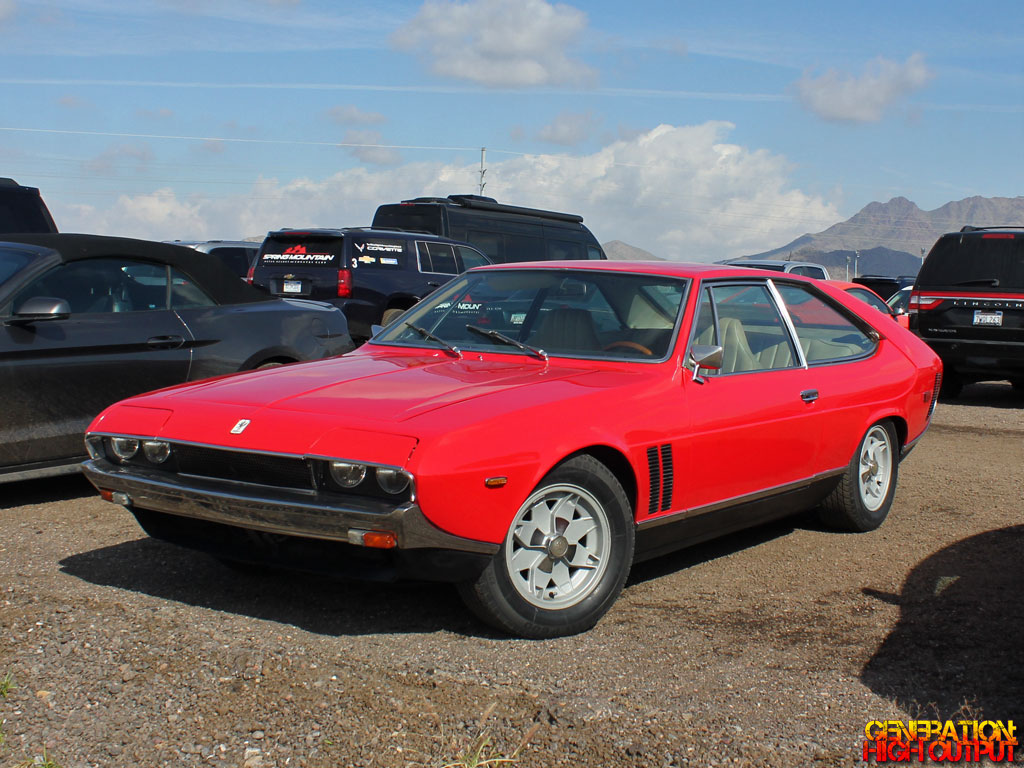
1969-1974 Iso Rivolta Lele


When thinking about Italian cars, brands such as Ferrari and Lamborghini probably come to mind. But there are many, many others – Maserati, Fiat, Lancia, Abarth, Alfa Romeo, to name several. But there are also the lesser-known Italian marques like DeTomaso, Intermeccanica, and Iso.

Today’s post is about that last one – Iso. Founded in 1939, they made cars and motorcycles in Italy through 1974 when the company went bankrupt. I have previously written about the Iso Rivolta Fidia S4, which was briefly the world’s fastest 4-door car when it was introduced in the late 1960s. Around the same time, Iso was also manufacturing this car, the Lele. With its 2+2 layout, it would likely have been a competitor to the Lamborghini Espada, another Grand Tourer. The Lele was one of the last models that Iso made before shutting down production entirely.


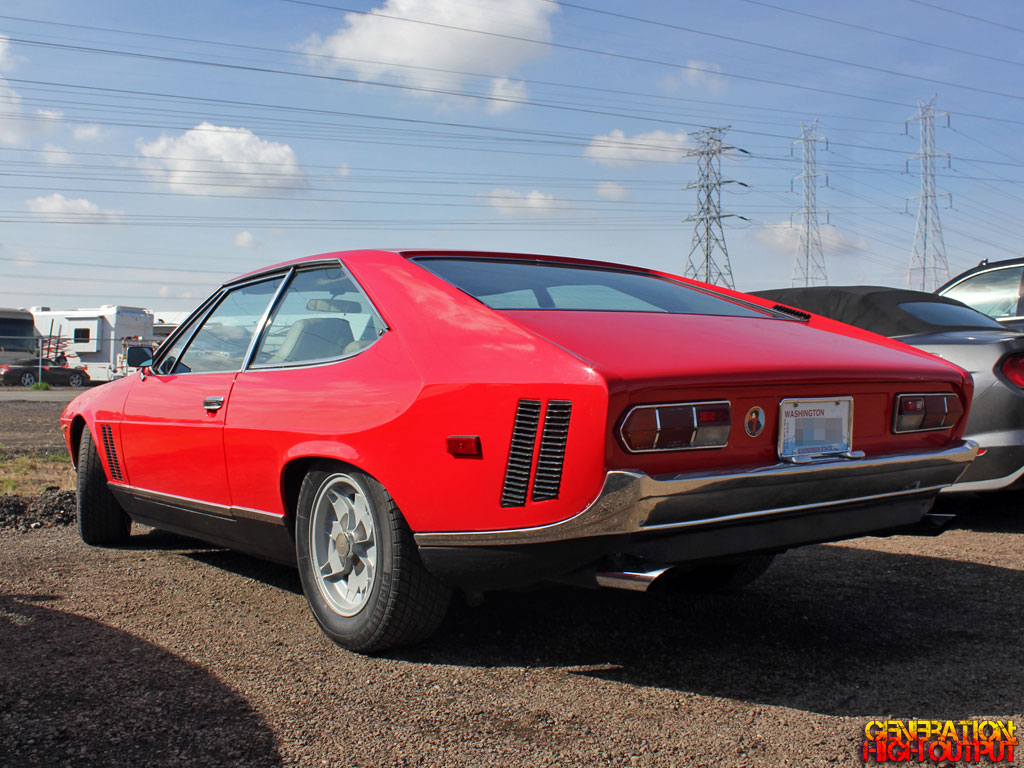
I stumbled across this car at the Barrett-Jackson 2019 collector car auction in Scottsdale. Funny enough, the car was not part of the auction, but rather parked outside in the parking lot! It’s not often that I see a car I cannot identify, and I thought at first it might have been another Lamborghini Islero, as they have quite similar body lines. With no visible badging, I went in for a closer look. The only emblem was a small Iso Rivolta badge on the hood.
These are extraordinarily rare cars, with only 285 produced during the five year production run. The chances of simply happening upon one in a random parking lot are unbelievable! After some research online, I learned that the cars came with either small block Chevy or Ford engines. I am not sure which engine this car has, though the split is pretty even with 125 of them being Chevy powered and 160 of them Ford powered.

The Hagerty price guide places the value on these cars at about $30,000 in Fair condition to $70,000 in Concours condition. For those who dream of owning an Italian sports car but with a Ford or Chevy budget, the Lele may be a great alternative to the more common Italian brands. I think it is a super neat car and would love to own one!

Update 1/24/2021: While attending the RM Sotheby’s Scottsdale 2021 auction, I met the owner of this car! He told me that it is a 1972 model, and that it is 1 of 3 equipped with a factory sunroof! I hope that I have the rest of the facts about this car correct!

Intermeccanica Indra 2+2 Coupe

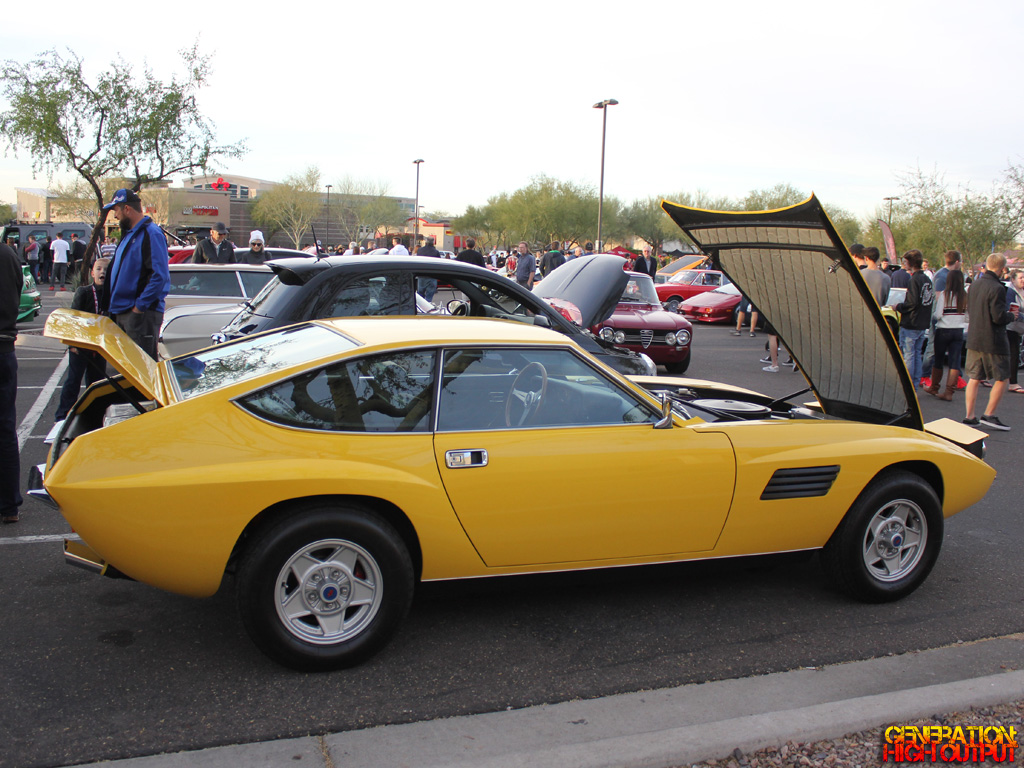
Now HERE’s something you don’t see every day! In fact, I would be quite surprised if you had heard of an Intermeccanica Indra before. I certainly had not, until I was standing in front of this one at the monthly Cars and Coffee car show in Scottsdale, Arizona. I was vaguely familiar with Intermeccanica because of the Italia, the car which took me years to figure out what it was.

Founded in Torino, Italy in 1959, the company began producing small numbers of sports cars such as the Apollo GT. I think the design of the Indra is very representative of what was happening in Italy in the 1970s. You can see a little bit of everything in this car, yet it doesn’t look like a carbon copy of a Ferrari, Lamborghini, or DeTomaso. The Intermeccanica has some distinct design elements, like the shape of the quarter windows, the flares over the wheel arches, and the vents on the front fenders.
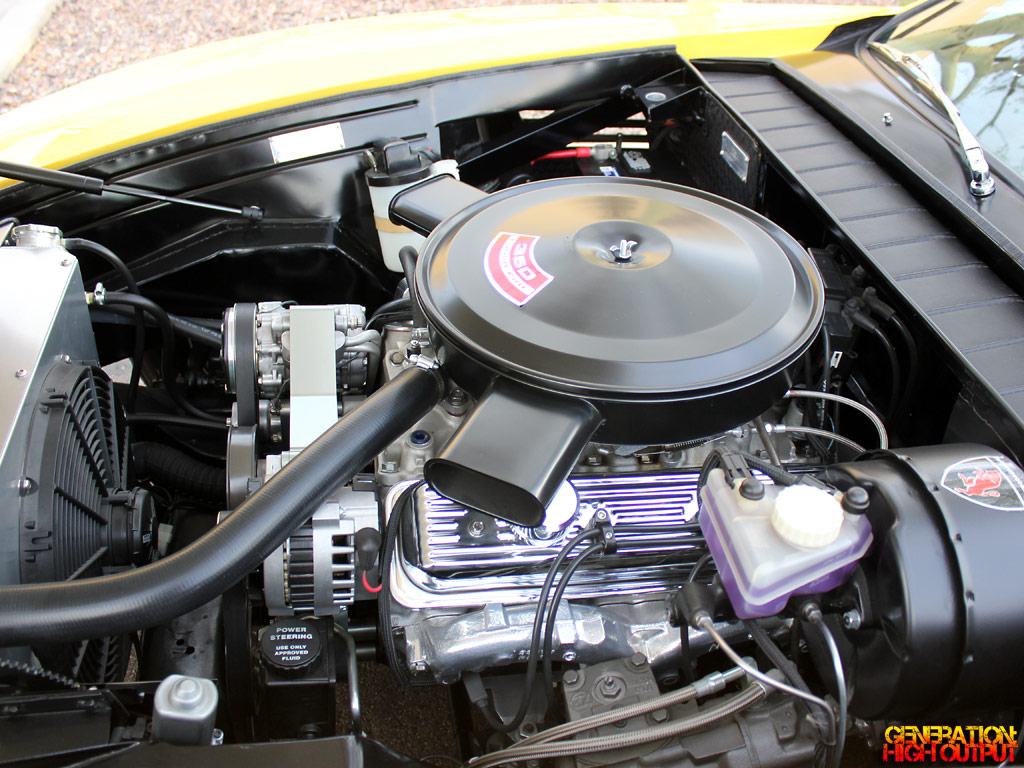
The Indra is an exceptionally rare car, with only 127 examples completed between early 1971 and mid-1974. According to the website intermeccanica.org, the breakdown was approximately 60 convertibles, 40 coupes and 27 two plus twos. That makes this yellow 2+2 the rarest of the rare! This one is well-equipped with an automatic transmission, power windows, air conditioning, a stereo, and a full complement of gauges.With a Chevrolet 350 under the hood, maintenance is both affordable and easy on the powertrain. I spent a few minutes chatting with the owner of this wonderful and unique car. He told me the car has had a complete restoration on the paint and body, with everything sorted out. Standing next to it, I can attest that for a 1970s Italian car, this one was in stunning condition.

The one custom touch the owner made was to have the Intermeccanica logo embroidered on the seats – he said it didn’t come that way from the factory, but he really liked it.

The car was on Dealer plates from South Dakota. A sign in the trunk said that the car was restored by Executive Touch Restorations in Sioux Falls, and that the paint and body work was done by Pierre’s Body Shop, also in Sioux Falls.

It rides on a set of Cromodora 6Jx14H2 14-inch wheels with period-correct Michelin XWX tires.

I really enjoyed learning about this interesting piece of automotive history, and I hope that you enjoyed reading about it!


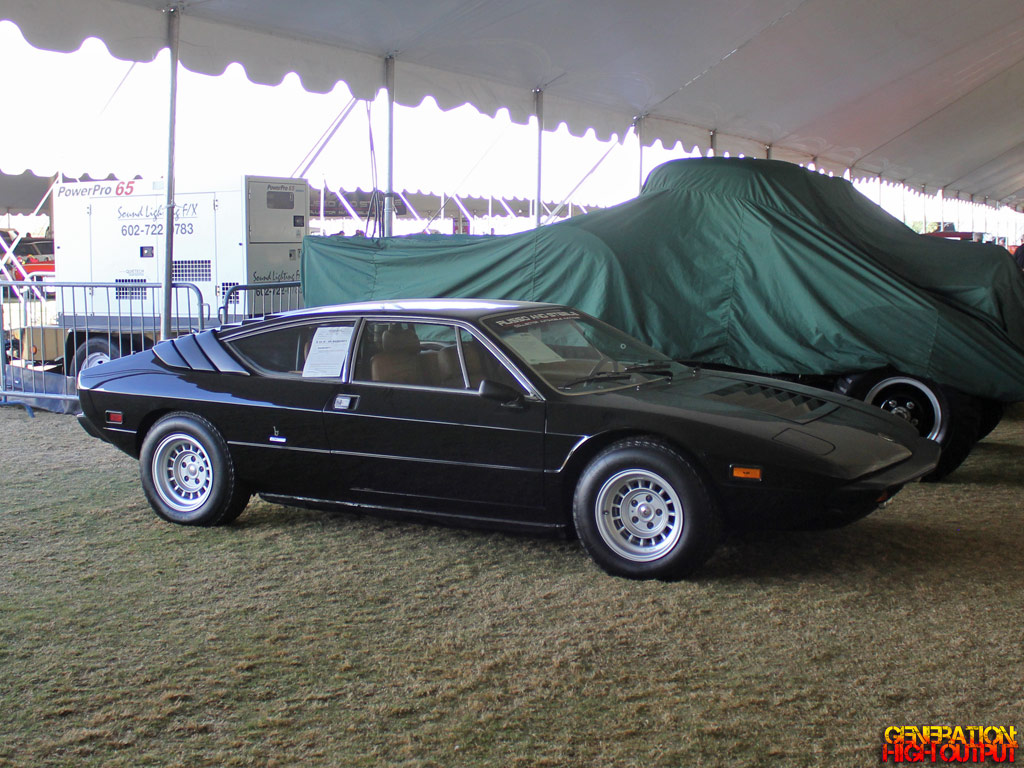
1975 Lamborghini Urraco – One Odd Bull

Readers who remember the 70s will recall the gas crisis of 1973 and the long-lasting effects it had on the global market for high performance cars. In response to the uncertain economic times and skyrocketing fuel costs, supercar manufacturers began to produce “budget supercars” like the V6-powered Ferrari Dino and Maserati Merak. Lamborghini was still producing the Miura, but they also rolled out a budget supercar of their own: the Urraco.

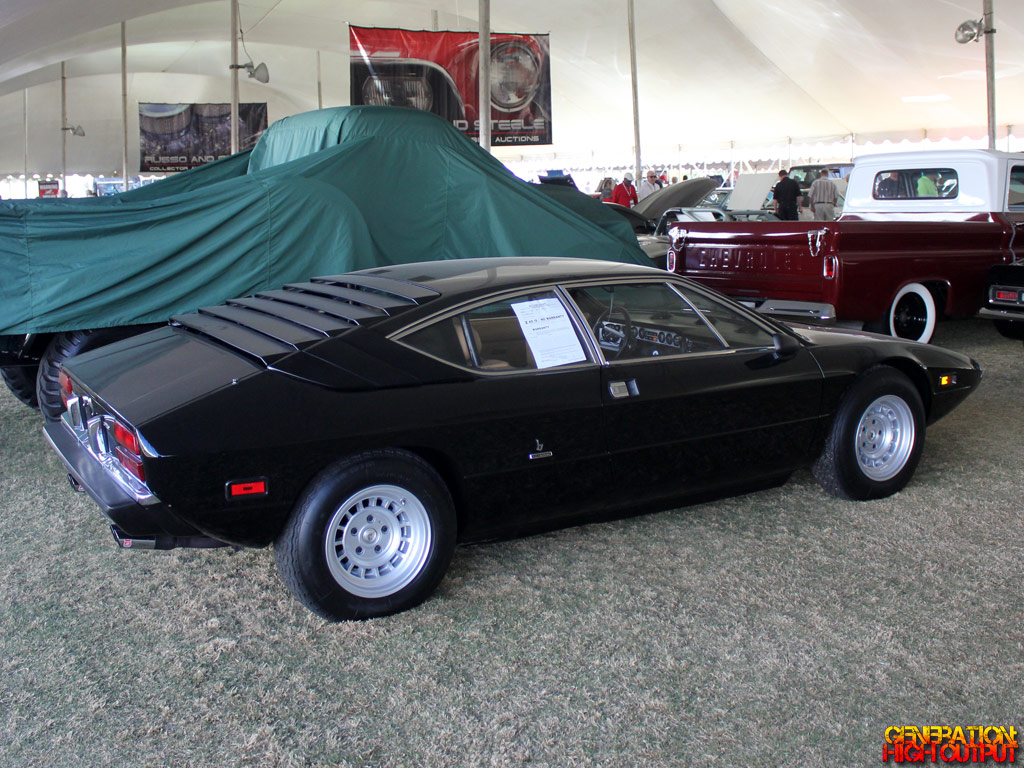
The Urraco is an extraordinarily rare car, with total production of just 791 vehicles between 1973 to 1979. Of those, just 21 were manufactured for export to the United States market. This car is one of them. I had a chance to get up close and personal with this 1975 Urraco P111 at the 2018 Russo and Steele Collector Car Auction in Scottsdale, Arizona.

The basis of Lamborghini’s cars has long been the V12 powerplant, but not with the Urraco. Because it was intended to be a more affordable supercar, it conceals a V8 engine under the rear hatch making 217 horsepower – significantly more than the Dino 206 and 246 GT and the early Merak (non-SS models).

This car was advertised as being in excellent mechanical condition, with an engine rebuild and major service completed in 2016 at a cost of $36,000. Other perks include the original owner’s manual and spare assembly, service history with records and receipts, and a 40-hour detailing job.
While a modern Lamborghini interior looks like the cockpit of a fighter jet, the cars of the 1970s were much more spartan. This Urraco sports a full suite of gauges, a stereo, and even factory air conditioning! I’m not sure if this was standard on US market cars or an option, but it would certainly be essential for an Arizona car.

I have to say that this 1975 Urraco was one of the more interesting cars at the Russo and Steele Scottsdale 2018 auction, and I am very glad I went. It’s definitely the odd bull of the herd as it doesn’t have the famous Lamborghini V12 or the amazing looks of the Miura, but it’s a part of the company’s history nonetheless. Collector car auctions offer a chance to see those rare and unique vehicles that you just don’t see every day, and Russo and Steele did not disappoint in that regard. I am very glad I went and would recommend that you do the same, if you are in the market for a unique collector vehicle.